
Learn how sportsbooks make money — the vig, how margin is priced into odds, how risk is balanced, and where live betting adds incremental revenue.

The online sports betting market is witnessing significant growth across the world. Driven by emerging trends, rising players’ demand, and mobile betting adoption, the sports betting market is valued at US$88.11 billion in 2026.
But one question keeps on hopping in both bettors’ and operators’ minds:
How do sportsbooks make money?
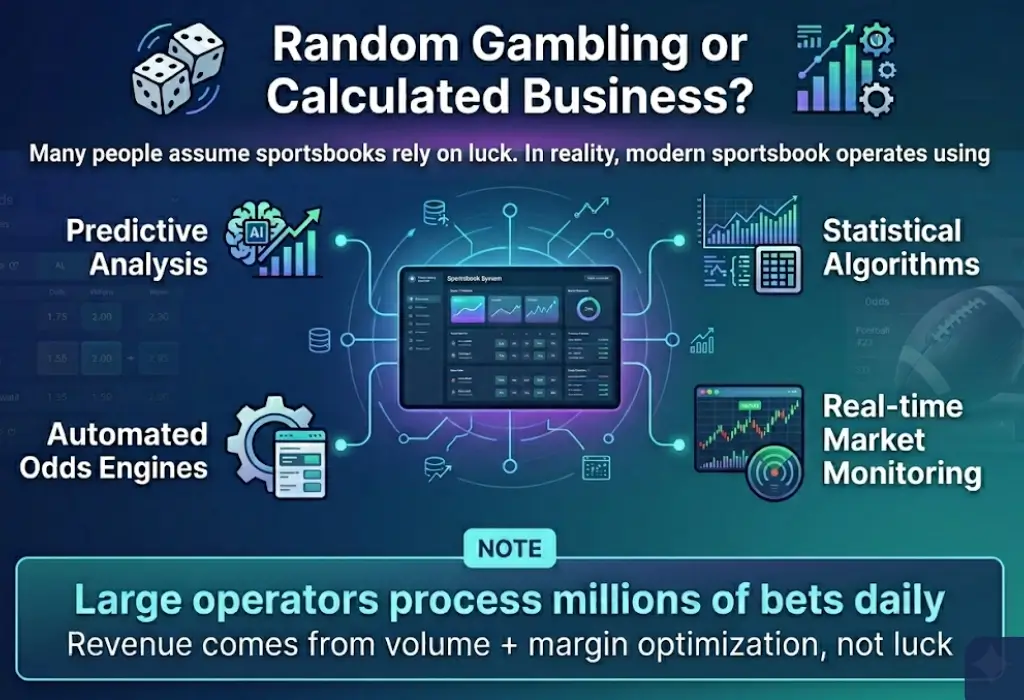
The true answer lies in the sportsbook revenue model. Today’s sportsbooks are not just random gambling platforms. In fact, they’re carefully structured platforms that are a mixture of betting odds, market demand, mathematical probability, and risk management strategies, all of which live inside the sportsbook software running underneath.
In this guide, we will explain what a sportsbook is, how do sportsbooks make money, the challenges operators face, myths, and more.
What Is a Sportsbook?
A sportsbook is basically a company or a platform that allows players to gamble on a variety of sports events and other competitions. It provides odds for outcomes like match winners, total points, individual player performances, and live or in-play events.
Sportsbook platforms can be either physical locations or online websites/apps.
How does sports betting work?
A sports betting site sets odds for every betting market. These betting odds depict the probability of an outcome occurring.
For example:
|
Events |
Odds |
|
Team A |
-110 |
|
Team B |
-110 |
A player places a bet on one side of the market. If the prediction is correct, the sportsbook pays the winning amount to the player as per the odds. And if the player loses, the sportsbook keeps the bet amount.
How sportsbooks earn money
How Do Sportsbooks Make Money on Every Bet?
The sportsbook makes money by adding small built-in advantages to its betting odds. This advantage is called vig, juice, or sports betting margins.
Sportsbook operators don’t predict the outcome; rather, they focus on earning small profits from many bets over time.
The revenue model of the sportsbook particularly depends upon the following:
- Balancing bets on both sides
- Managing financial risks
- Processing high betting volume daily
- Setting accurate betting odds
Note: This is how sports betting sites earn profit consistently.
Read Blog – sports betting site checklist
The Role of Odds in Sportsbook Profit
Odds play a significant role in sportsbook profit. They convey players two things:
- The chances of an outcome going to happen
- How much money they can win
Based on the above table, odds can appear in various formats, such as:
- American odds (-110)
- Decimal odds (1.91)
- Fractional odds (10/11)
Regardless of whether the odds appear to be different, they all represent probability.
To understand odds in detail, understanding implied probability is also important.
| What is implied probability? Implied probability refers to the conversion of betting odds into a percentage. How to calculate implied probability? Decimal Odds = 1/ Decimal Odds X 100 American Odds (Negative): Odds / Odds – 100 X 100 American Odds (Positive): Odds / Odds + 100 X 100 |
What is a Built-In Margin in Sports Betting?
Built-in margin depicts the actual distinction between the true probability of an event and the odds offered.
For instance,
|
Outcome |
Odds |
Implied Probability |
|
Team A |
-110 |
52.38% |
|
Team B |
-110 |
52.38% |
Total probability of an event = 104.76%; the extra 4.76% is the sportsbook’s built-in edge.
This extra margin shows the bookmaker’s income or profitability regardless of who wins the game.
The Vig or Juice Concept
The concept of vig or juice is the commission sportsbook operators charge for accepting bets. Operators don’t charge a direct fee; rather, they include this commission in the odds. This is the main source of revenue for sportsbook operators.
| Example of Vig in Sports Betting Let’s assume:
The sportsbook collects:
The winning bettor receives a $210 total payout ($100 profit + $110 original stake) |
How are odds calculated in a sportsbook?
In the sports betting market, odds are not random; rather, operators use data, statistics, and market behavior to calculate them. The following are the modes through which sportsbook operators calculate odds.
- Statistical models (player performance, weather conditions, historical results, player statistics)
- Market demand
- Betting patterns (large wagers, sharp bettors, unusual betting spikes)
- Risk exposure (limit potential losses, maintain balanced action, protect long-term profitability)
Read Blog – how to start a sportsbook
Additional Revenue Streams for Sportsbook
Apart from the above-mentioned sources, there are many more revenue streams operators can generate revenue from. This includes the following:
- Parlays (higher house edge) – Parlay merges multiple bets into a single bet. All selected bets must win, which is difficult for players. This increases the sportsbook’s profit margin.
- In-play/live betting (dynamic odds adjustments) – Live betting allows users to place bets during a match. Based on the game, odds change quickly. More bets help operators earn profit.
- Casino games (slots, roulette, etc.) – Casino games have fixed house edges, which gives operators reliable income.
- Bet settlement inefficiencies – Small factors like unused bonuses add to profit. Cash out may also favor the sportsbook.
Why Sportsbooks Win Long-Term
Even though bettors can win in the short term, sportsbooks win a long-term advantage as they rely on the following:
- High betting volume
- Statistical advantage (house edge)
- Large user bases
- Sophisticated risk controls
- Continuous betting activity
Initially, the sports betting margin may seem to be small per wager, but millions of transactions yield substantial revenue over time.
Why Most Bettors Lose Money
Many bettors complain about losing money while betting in sports. Why do they lose money? Because sportsbooks are mathematically designed to maintain an edge.
The common reasons include:
Emotional decisions
Many players bet on their favorite teams, chase losses, and overlook statistical value. Players’ emotions often override rational decision-making.
Misunderstanding odds
Casual bettors often get misled by implied probability, expected value in betting, and margin calculations, leading to poor betting decisions.
House edge
Skilled bettors must learn to overcome sportsbook commissions consistently. With thousands of bets, the vig gradually erodes profitability.
What Challenges Do Sportsbook Operators Face?
Despite the revenue sportsbooks generate, sportsbook operators face several operational and financial challenges:
Competitive pricing pressure
One of the main challenges for operators is pricing pressure from the competition. In saturated and regulated markets, big operators are in constant competition by offering better odds, lower margins, aggressive promotions, and high value to attract and retain players. High competition reduces profitability for operators.
Sharp bettors
Another major challenge comes from sharp bettors, also known as highly skilled players. These bettors use advanced statistical models, market analysis, and timing strategies to identify mispriced odds. When they identify inefficiencies, they place larger bets quickly. This forces sportsbooks to adjust lines and sometimes incur short-term losses.
Regulatory costs
The next obstacle is the regulatory cost. Operating a licensed sportsbook demands heavy investment in compliance infrastructure, including KYC verification, AML procedures, responsible gambling frameworks, and licensing fees. These requirements may differ by jurisdiction and increase operational costs, particularly for operators planning to tap into multiple regulated markets. Launching under a provider’s licence on a white-label sportsbook solution is how many operators defer that first cost.
Fraud & abuse
In the iGaming industry, fraud and abuse are constant threats that both operators and players face. Sportsbook operators should actively monitor and prevent activities such as bonus abuse, payment fraud, multi-accounting, and potential match-fixing. So, this requires advanced fraud detection tools, iGaming risk management systems, and a dedicated team to run them. All of this adds to operational complexity and cost.
Short-term volatility
Dealing with short-term volatility is the real struggle for operators. Unexpected outcomes like consistent wins by teams, major tournament upsets, or a large volume of bets on successful outcomes can impact profitability. Though these fluctuations are normal in the industry, operators rely on long-term margins, multiple betting markets, and high betting volume to stabilize revenue over time.
Read Blog – sportsbook bonus types
Common Myths About Sportsbook Earnings
There are numerous misconceptions prevailing about how sportsbooks make money, leading to misunderstandings about their business model. Common myths include:
- One of the common myths about sportsbooks is that “they always know the winner.” In fact, sportsbooks do not depend on predictive results. Instead, they apply mathematical methods, historical data, and market behavior to determine odds that carry built-in margins. Their game is not to be right every time but to maintain a consistent edge across thousands of bets.
- Another well-known belief is that “they lose when customers win.” However, this is only partially true. Sportsbooks do experience losses on particular events when popular teams win and a large number of bettors cash out. The diversified nature of sportsbook operations helps balance these short-term fluctuations.
- The next myth is that sportsbooks simply take the other side of every bet. In reality, operators run balanced risk systems. Their focus is on managing exposure, protecting margins, and ensuring steady betting activity across multiple events and markets.
Conclusion
Sportsbooks are a highly profitable business, but understanding how sportsbook operators make money requires looking beyond win or loss outcomes. Modern sportsbook operators run a highly data-driven business, led by probability models, vig or juice, built-in betting margins, risk systems, and high betting volumes.
Operators planning to enter the sportsbook industry must understand the sportsbook revenue models to build a sustainable betting platform. From odds management to live betting optimization, every aspect of a sportsbook platform impacts the long-term profitability of the business.

FAQ's
-
What is the main way sportsbooks make money?
Sportsbooks make money primarily via vig or juice built into betting odds. This commission creates a small metaethical edge on every wager.
-
Do sportsbooks always win?
No. Sportsbooks can lose on individual events, particularly when heavily backed teams win. But they usually remain profitable long-term due to betting margins and risk management.
-
How much profit do sportsbooks make?
Profit margins vary depending on the operator and the market. Many sportsbook operators make a profit between 4% and 10% based on bet types and products offered.
-
Can bettors beat sportsbooks consistently?
There are a few bettors who beat sportsbooks consistently in the long term. Professional bettors use advanced models, bankroll management, and value betting strategies to gain an edge.
-
What is the house edge in sportsbooks?
The house edge is the built-in edge that the sportsbook has over you in terms of betting margins and vig. It ensures that operators will be profitable for a while.
-
Are parlays more favorable to sportsbooks?
Yes, parlays usually carry higher sportsbook margins because multiple outcomes must all win together, making them tough for bettors to win.
-
How do live bets help sportsbooks earn more?
Live betting increases the frequency of betting and allows sportsbooks to follow the odds during the game dynamically. This means more revenue and engagement opportunities.
-
What is a sharp bettor?
A sharp bettor is a professional, highly skilled bettor who utilizes statistical analysis, market knowledge and disciplined strategies to find profitable betting opportunities.


Monika Gola is an iGaming content specialist at PieGaming. Since 2020, she has been researching and developing content around software selection, online casino & sports betting regulations, and operator growth strategies. Her research includes analyzing market opportunities in regions like Europe, Africa, and Southeast Asia, as well as evaluating regulatory frameworks and entry barriers. She is actively monitoring industry trends, compliance updates, and evolving player demands across global iGaming markets to help operators navigate this industry seamlessly.

Turnkey sportsbook solutions provide everything a betting platform needs—from software and odds management to payments and compliance. This complete guide describes how these solutions help operators enter the sports betting market faster.


See you in your inbox soon!

Stay ahead of the game. Subscribe for exclusive content, updates, and insiders!