
Casino influencer marketing involves the collaboration between licensed casino websites and influencers on platforms like YouTube, Kick, Twitch, TikTok, and Telegram who share casino games via tracked links and promo codes. Creators are paid by flat fee, CPA, revenue share or hybrid and paid based on results by FTD, NGR and retention. Campaigns must comply with local advertising, disclosure, and 18+ rules.
According to the Influencer Marketing Hub global influencer, the marketing market is expected to be worth $32.55 billion in 2025. Casino influencer marketing involves collaborating with influencers who promote your online casino products and services to their followers via approved posts and offers.
Your challenge is making those partnerships count in terms of actual acquisition, while remaining with the rules of advertising and platform policies. It will guide you through creator types, deal models, compliance, platform readiness and ROI, and help you assess campaigns on deposits, not just views and clicks.
What Is Casino Influencer Marketing?
Casino influencer marketing refers to when an influencer promotes your casino to their followers. They do so via games, video, reviews, and promotions. Each creator is given a promo code and/or tracked link, so they can view which players they recruited.
Payment is made by flat fee, CPA, revenue share or combination. There are several popular online casino influencers who demonstrate the player journey on camera. They watch them join, earn a free bonus, deposit funds, play, and withdraw. MILLIONS reports that there are five things that viewers focus on:
- Withdrawal speed: how fast the payout arrives.
- Game choice: which games the creator plays.
- Bankroll size: whether the money is real or sponsored.
- Transparency about losses: whether the creator shows losing sessions.
- Repeat use: whether the creator keeps returning to the same casino.
Live content lets viewers see things a written page can’t, like how long a withdrawal takes. One stream doesn’t prove every player gets the same result, though. Make sure your payouts are fast and reliable before a creator shows them on camera.
Creators share their content on Kick, YouTube, Twitch, and more. There are different rules for each platform. For instance, Twitch will not allow links and affiliate codes on the sites that offer slots, roulette, or dice games.
There are still advertising regulations to follow. Paid gambling ads are banned in numerous regulated jurisdictions, and some agency sources believe this is driving more interest in creator-led acquisition. But creators don’t get you around the rules.
In Great Britain, you’re responsible for the third parties you hire. In Ontario, you can’t advertise bonuses publicly, and you can’t use influencers likely to appeal to minors.
Influencer Marketing vs Affiliate Marketing in iGaming
The distinction is not only in the amount of payment, but also in the manner of approach. Influencer marketing is the approach of leveraging a creator’s content and audience for your casino promotion.
Affiliate marketing pays a partner a fee for sending players—either for each click that leads to an action or for the revenue generated by the players. The two overlap quite a bit. Many creators can earn CPA or revenue share, and many are also influencers.
CPA is a model where you pay if a player performs a pre-determined action, typically a requisitioned First Deposit. Some creators receive a fixed amount of content or sponsorship for agreed work regardless of whether the players convert.
Others are paid as affiliates, and some receive a combination of both. They both require effective reporting. If the platform permits, measure referrals through tracked links or promo codes, as some platforms do not allow for that.
For fixed-fee deals, also agree with the content you expect and how you’ll judge the campaign. Choose what set up is best for your objective: creator content and reach, performance-based acquisition, or both. Usually, “hybrid” in affiliate deals refers to CPA plus revenue sharing.
Types of Gambling Influencers Operators Work With
Types of Gambling Influencers
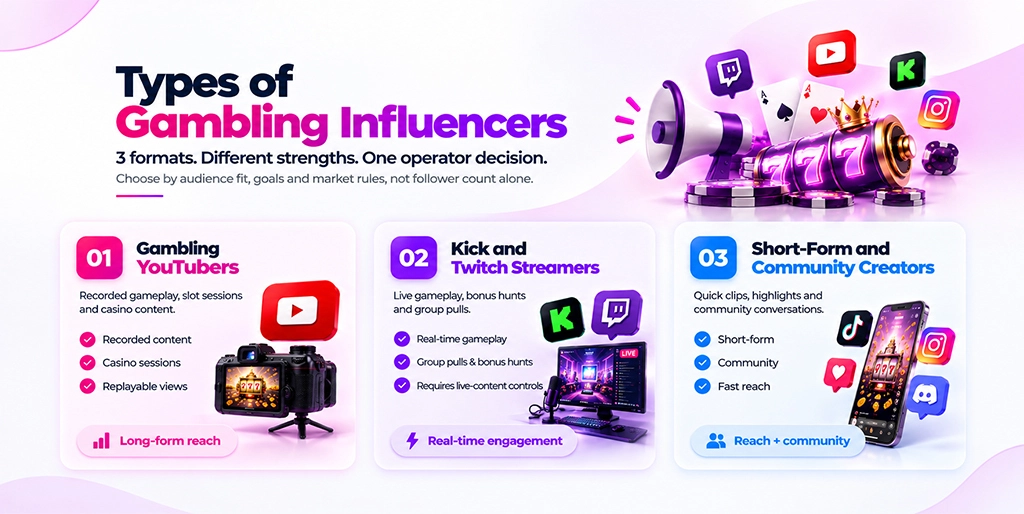
This guide groups gambling content creators by main format: long-form video, live streaming, and short-form and community channels. Many work across more than one. Choose a casino influencer by audience fit, your goals and what your market allows, not follower count alone. Even the top gambling influencers suit some campaigns better than others.
Gambling YouTubers
Gambling YouTubers publish recorded gameplay, slot sessions and casino content, and some also go live. A recorded video can keep attracting viewers after publication. Brian Christopher and Vegas Matt are established examples, but fame doesn’t mean fit. Check content history, audience and reporting. Regular posting is worth noting, but it doesn’t prove trust.
JCA reports a Brian Christopher slot tournament brought 300 followers to San Manuel Casino, where the casino tracked loyalty members’ spending against earlier trends. It’s a land-based example showing measurable event engagement, not online deposits.
Kick and Twitch Streamers
Kick and Twitch streamers play in real time, in formats like group pulls and bonus hunts. A stream doesn’t always show sign-up, deposit or withdrawal, and one session doesn’t prove your payouts for every player. Live content can’t be reviewed before it airs, so agree to conduct rules, disclosure wording, and an escalation process. Twitch bans links and affiliate codes to sites with slots, roulette or dice, and a license doesn’t change that. Check Kick’s rules too.
Short-Form and Telegram Creators
Short-form creators post on TikTok, Reels and Shorts, and rules differ by platform. TikTok gambling ads need certification and are limited to certain markets, and paid ad rules are separate from creator-sponsored posts. Telegram groups are community spaces. Judge them by audience, traffic quality and tracking, and don’t assume crypto preference. Telegram’s ad guidelines ban real-money gambling ads, so a creator’s post isn’t a workaround.
Read More: Telegram Casino
Influencer Deal Models for Casinos
Influencer Deal Models for Casinos
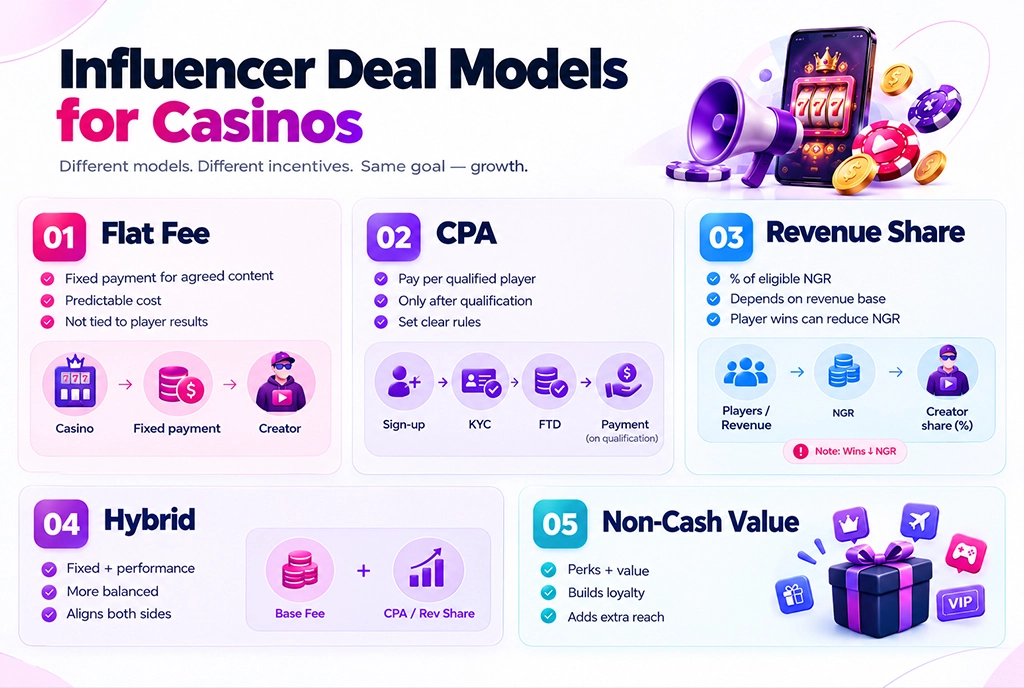
Casino influencer deals can use flat fees, CPA, revenue share, or a mix. Each model changes who carries the risk and what the creator is motivated to do. Choose based on your goal, your market, and how well you can track players.
Flat fee or sponsorship
Under a pure flat-fee deal, you pay a set amount for agreed content, whether players sign up. Your cost is predictable but not linked to deposits. It can suit awareness goals. If you’re entering a new market, also check that the creator and their audience are suitable and allowed there.
CPA (cost per acquisition)
CPA pays a fixed amount for each qualified player, usually a first-time deposit. Terms like a minimum deposit, completed KYC or a hold period decide what counts, so a sign-up alone may not earn a payment. The main iGaming risks are fraud, low-quality traffic, and paying more for a player than they’re worth. Set clear qualification rules and review referred players before you pay.
Revenue share
Revenue share pays a percentage of the net gaming revenue (NGR) from the players a creator refers to. Your contract decides the revenue base, the deductions, and how long payments last. Commission depends on eligible revenue, not just on players staying. Player wins can reduce that revenue and leave a negative balance in some months. State whether that balance resets or carries forward against future earnings.
Hybrid deals
A hybrid deal mixes payment types. In affiliate programs, it usually means CPA plus revenue share. In creator deals, it can also mean a base fee plus CPA or revenue share. Only a base fee guarantees income, because CPA plus revenue share can pay nothing if neither part qualifies. Spell out which parts are fixed and which depend on the results.
Stream funding and disclosure
State who funds the stream and whether the balance is real money, promotional credit or simulated funds. Say whether winnings can be withdrawn and on what conditions.
Non-cash value
Some deals add perks to payment, such as invitations to events or new-feature launches. Treat these as part of the commercial relationship and include them when you disclose the partnership.
How to Build a Casino Influencer Program
A strong casino influencer program follows five steps: set goals, define your player, vet creators, sign a clear contract, then launch and optimize. Work through them in order. Each step makes the next one easier.
1. Goals in Casino Metrics
Gambling influencer marketing works best when your goals use the numbers your casino already tracks. Count registrations per creator, then first-time deposits (FTD). Add net gaming revenue (NGR) per creator, and D30 retention, which shows how many players are still active after 30 days.
FTD volume alone doesn’t show player value. NGR and retention. Views and follower counts are weak signs of deposit quality, since a large audience can still bring few depositors. Impressions and reach can work as secondary goals but tie your budget to sign-ups and deposits.
2. Player Persona and Market
Decide who you want to reach before you shortlist creators. Start securing your iGaming license and target geography, since they set where you can accept players and advertise. Then look at payment methods, because a crypto audience and a fiat audience behave differently. Match the game mix too, whether that’s slots, live casino or crash games.
Finally, check the age of the creator’s audience. A creator whose audience skews under the legal gambling age is a compliance risk; however popular they are. A creator whose audience doesn’t match your license or products won’t convert either.
3. Creator Vetting
Vet online casino influencers before you talk about money.
- Compare likes and comments to audience size, then read the comments. Genuine replies beat generic ones.
- Look for sudden follower spikes and accounts that seem inactive or automated.
- Check past sponsorship disclosures, claims and responsible gambling behavior. Confirm that the creator is in good standing on their platform.
- Avoid creators who openly disparage other creators or casinos. It reflects on your brand.
- Test how they communicate, meet deadlines, and handle feedback. Professionalism varies widely, and many creators have no managers.
- Pick fit over fame. A mid-size creator who matches your brand can beat a famous one who doesn’t.
4. The Contract
Put everything in writing. The contract should cover:
- What gets posted, when, and what sets off payment.
- How does the creator label the partnership.
- Age warnings, responsible gambling, messaging and banned claims.
- What you can do with the creator’s content, and what they can do with your footage, each limited to an agreed purpose.
- When you can end the deal, such as if engagement or conduct falls short.
- What content you approve first, and where it can run.
5. Launch and Optimization
Start with formats that suit the creator, such as tutorials, “first big win” stories, or day-in-the-life streams. Plan a steady rhythm: bigger activations with your top creators, plus smaller pushes with micro-creators in between.
Then follow the deposit data. Review each creator’s cohort every quarter, using D30 and D90 retention. Move budget from creators who bring low-value players to those who bring high-value ones, instead of following engagement alone. Long-term partnerships tend to work better than one-off bookings, because audiences get to know your brand over time.
What Your Platform Needs Before You Sign an Influencer
Sign a creator before your platform is ready, and the gaps show live on their stream. Start with tracking, since every other decision depends on knowing who sent each player.
Tracking and Attribution
Give every creator a tracked link per channel with a sub-ID, such as creator plus channel, and a personal promo code. Fire postbacks on registration, first deposit and redeposits, and queue out-of-order or duplicate events. Write your rule for link versus code conflicts into the contract.
Bonus Setup
Next, decide what those players will get. Build one welcome offer per creator and fix wagering, max bet, max cashout, game contribution and expiry before launch through your bonus engine. Public codes attract bonus hunters, so limit bonuses per player, device and household, and review accounts that withdraw without playing. Check local bonus advertising rules too.
Payouts
Those players will test your withdrawals, often on camera, so test every method and crypto network first. Creators need reliable pay, too. Define payout currency, payment date and NGR deductions, and send a statement showing how revenue becomes commission.
KYC and Player Quality
Withdrawals also trigger KYC, so run it before the first withdrawal and keep it up to minutes. Use device fingerprinting to catch multi-accounting, and block VPNs and restricted regions at sign-up, since fans in banned countries can still follow a creator.
CRM
Once players clear KYC, keep them playing. Tag them by creator, send a welcome series and a second-deposit offer, and report D30 and D90 retention by creator.
Readiness Checklist
Before you sign, confirm:
- A test click, registration and deposit show under the right sub-ID.
- Commission reporting works per creator.
- Bonus terms are approved.
- A test account has passed KYC and withdrawn.
- 18+ and responsible gambling messaging is live.
- Geo rules block restricted countries.
How to Measure Casino Influencer Marketing ROI
Measure casino influencer marketing ROI by comparing the net gaming revenue each creator’s players generate with what you spent on that creator. Views and clicks can’t show that, so start with casino metrics.
KPIs to Track
Track the same eight numbers for every creator so you can compare them fairly.
CPA covers only what you pay the creator. CAC adds bonuses, tools, and production, so it shows what a depositor really costs.
Attribution Gaps
Your numbers will still miss some players. A stream can lift awareness, so people search for your name with no tracked link. Viewers share codes in chat, which credits the wrong creator, and others register days later through search. Add a “How did you hear about us?” question at sign-up and compare registration spikes with stream schedules. Treat the results as estimates.
Value Dashboards Miss
Some value never reaches a report. Your team may feel more confident when a creator brings real players, and an event can build energy around your brand. Note them but keep them apart from revenue numbers.
Creator Scorecard
Review a scorecard per creator for each quarter. Score conversion quality (FTD rate and deposit size), retention (D30 and D90), compliance record (disclosures and 18+ messaging) and cost (CPA and CAC). Weight conversion and retention, then move budget toward high scorers and renegotiate or end deals with the rest.
Common Mistakes Operators Make
Weak creator campaigns come from a few avoidable errors. These four mistakes cost operators the most.
Choosing on Follower Count
A following does not mean huge deposits. A creator with an audience can bring fewer depositors than a smaller one who matches your market and games. Judge creators by first‑time deposit rate, net gaming revenue and retention and check where their audience lives how old it. Whether the comments look genuine.
One-Off Deals with No Follow-Up
A video rarely gives enough data to judge a creator and viewers need to see your brand more than once. Start with a test review the numbers then renew with the creators who bring players worth keeping. Over time a long‑term partnership lets you improve offers and formats with activations from your top creators and smaller pushes in between.
Weak or Missing Tracking
Without a link promo code and sub‑ID for each creator you cannot tell who brought which player. You end up paying on guesswork or cutting out a creator who was actually performing.
Set deduplication rules so a player who arrives through channels is not counted twice. Decide ahead of time whether the link or the code wins when both appear. Test tracking from click to deposit before the first post goes live.
Undisclosed Sponsorships and Missing 18+ Messaging
If a creator does not label the partnership or an 18+ warning is missing you carry the risk. Regulators can hold operators responsible for the content they pay for and platforms can remove the content or the channel. Platform rules differ too so check what Twitch, TikTok and others allow before you book. Put disclosure wording 18+. Responsible gambling messaging and geo restrictions, in the contract then approve content before it goes live.
Wrapping Up…
Casino influencer marketing works when you treat it as a system, not a one-off post. Five decisions shape your results: your goals, the creators you choose, the deal model you sign, how you stay compliant, and whether your platform is ready.
Get these right and you can track every creator from first click to long-term value. PieGaming’s casino affiliate software and platform setups can help you build that foundation. Book a demo to see how.

Contact Us
FAQ's
-
Which social media platforms work best for casino influencer marketing?
YouTube suits long‑form reviews. Kick and Twitch suit play. Short‑form platforms and Telegram extend reach. The best fit depends on your audience, market and each platform’s gambling rules.
-
What rules must casino operators follow when working with influencer partners?
A casino must show sponsorship disclosure. A casino must also show 18+ signs and responsible gambling messages. A casino must follow its license and local advertising rules. A casino should check each platform’s policy. A casino stays responsible for the content it pays for.
-
Casino influencer marketing versus affiliate marketing: Which is better for casino operators?
Neither type is better by itself. Influencer marketing builds trust. Creates content for a casino. Affiliate marketing focuses on getting players for a casino. Many creators are paid like affiliates so a casino should choose its goal.
-
What cost does casino influencer marketing involve?
The cost depends on the deal model. A flat fee is fixed. A CPA model pays the casino per player. A revenue share model pays a portion of new revenue. The size of the creator also changes the price.
-
How can a casino find the online influencers for its brand?
A casino should search YouTube, Kick and Twitch for creators, in its market then vet them. A casino should check the audience age and location the quality of engagement the creator’s compliance history and how well the creator fits the brand before signing a deal.

Palak Madan has been writing about the iGaming industry since 2024. She focuses on helping operators and founders understand their options when launching an online casino, from choosing the right software provider to figuring out costs and compliance requirements across different markets. At PieGaming, she covers topics like white label casino solutions, platform selection, and market entry, turning complex industry information into practical guidance for people building iGaming businesses. She also keeps a close eye on licensing and regulatory changes; particularly how new rules shape the way operators enter and grow in different jurisdictions.
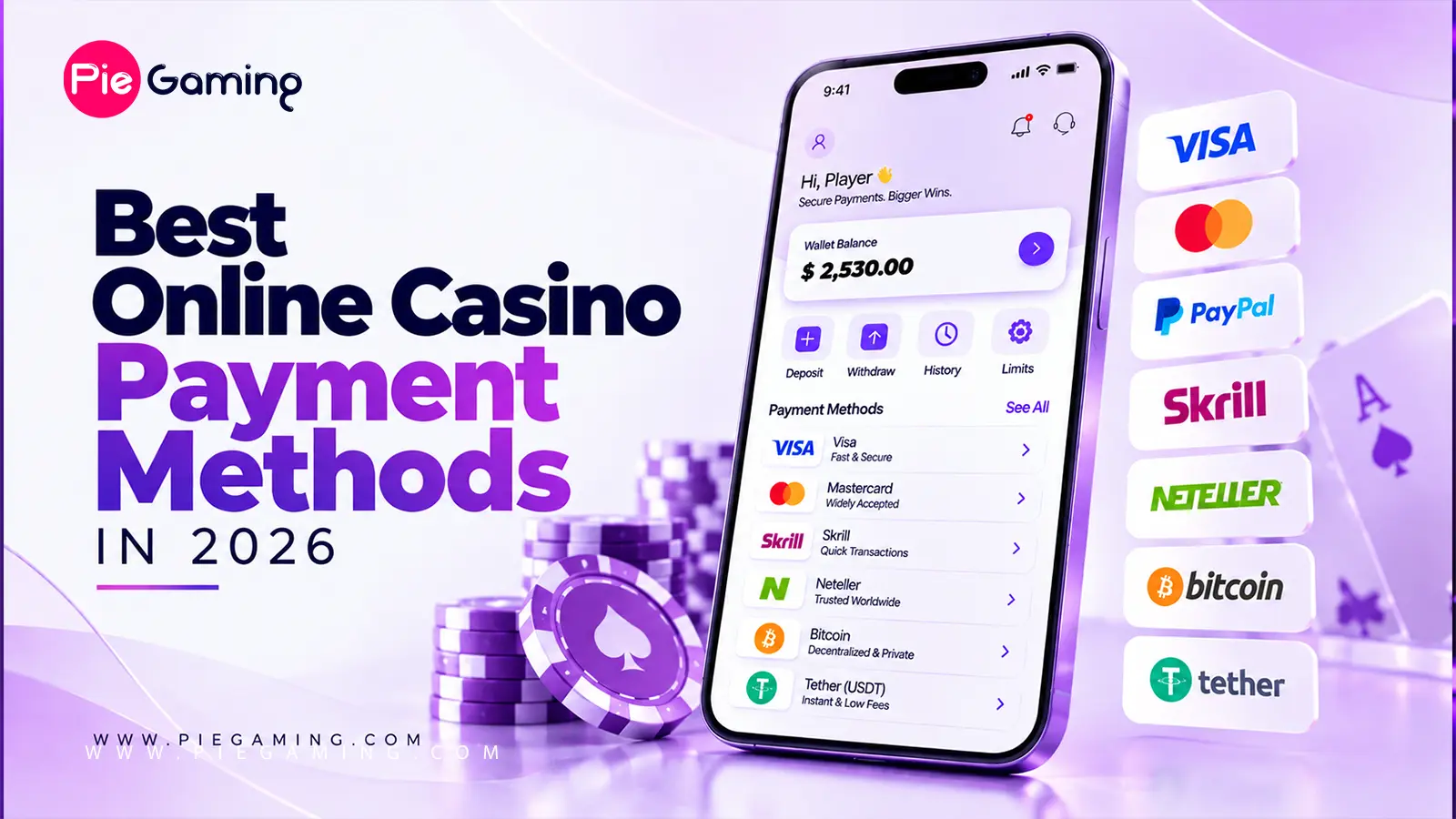
Best online casino payment methods in 2026 include credit and debit cards, e-wallets, open banking, cryptocurrencies, prepaid vouchers, and mobile money. Cards are the most widely supported but face issuer restrictions on gambling transactions. E-wallets like PayPal, Skrill, and Neteller offer faster withdrawals.
This blog explores ways and platforms to find and partner with top sports betting affiliates to grow the iGaming business.
This blog explains how iGaming affiliate marketing software helps operators boost revenue through smart tracking, automation, fraud prevention, and better campaign control.

Affiliate software is instrumental in managing partnerships and keeping track of performance in iGaming. This guide provides an overview of many iGaming affiliate software providers and features that operators can utilize for running an efficient affiliate marketing program.
This write-up talks about the best online casinos supporting GCash in the Philippines—also, the gaming variety, bonuses, and customer support they provide.
Top providers of payment applications for iGaming payment solutions are well-equipped with high transactional volume, robust compliance frameworks, and quick payouts for players using them. Selecting the right provider is your key to high authorization rates, fraud prevention, and seamless integration for your Internet betting platform.
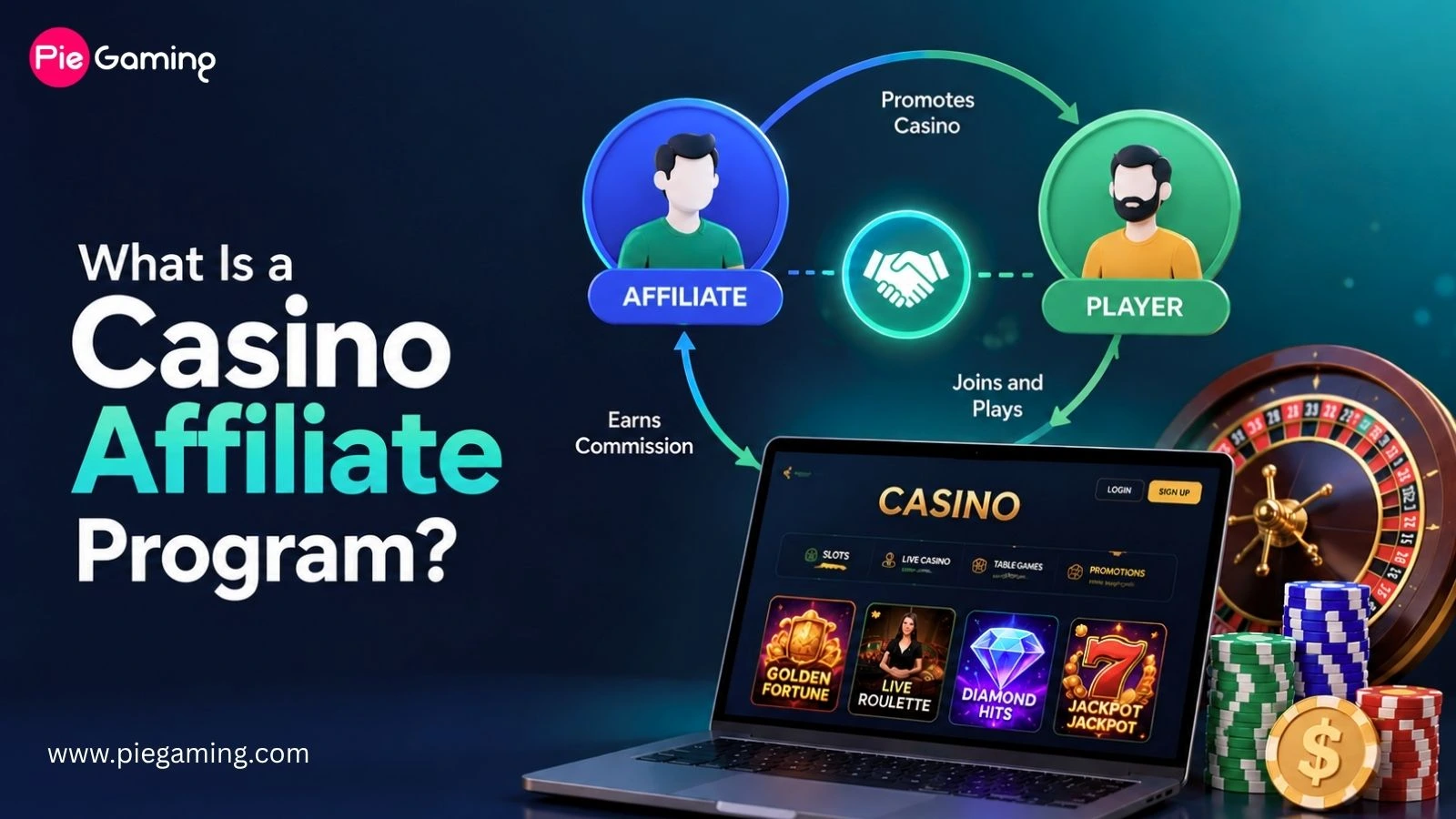
A casino affiliate program is a performance-based marketing model where affiliates promote casino brands and earn commissions for acquiring qualified players. This guide explains how casino affiliate programs work, explores commission models, highlights key performance metrics, and covers strategies to build and scale a profitable acquisition channel.

See you in your inbox soon!

Stay ahead of the game. Subscribe for exclusive content, updates, and insiders!