Self-exclusion tools are an important part of responsible gambling as they allow players to restrict their access to gaming platforms, allowing them to self-exclude or even just block out access. This article describes how these tools work and how they affect iGaming platforms in terms of compliance, player protection, and long-term platform credibility.
What happens when a player clicks “self-exclude”?
When a player hits that self-exclusion button, you’re not just losing one session—you could be looking at months of revenue impact per exclusion.
With regulators cracking down on self-exclusion tools everywhere, the iGaming market for casino operators has become complex.
They are stuck trying to balance doing right by players while keeping their business afloat.
Here’s the reality: you need to understand how self-exclusion from gambling impacts your numbers. It’s not optional anymore—it’s essential.
So, let’s talk about it.
What is Self-Exclusion in iGaming and Why Does it Matters to Operators?
Self-exclusion is a safety feature that lets players voluntarily block themselves from your platform for a set period. Players can choose anywhere from 24 hours to permanently ban themselves from betting activities.
As an operator, you are required to offer this casino self-exclusion feature in most regulated markets. Once activated, players can’t access their accounts, deposit funds, or participate in any gaming activities during the exclusion period.
What many operators miss is that online gambling self-exclusion isn’t just about compliance. It’s a window into player behavior and risk patterns.
When someone excludes themself, they are essentially telling you they’ve hit their limit.
Understanding these patterns helps you create better responsible gaming programs and create a more sustainable business model.
How Self-Exclusion Systems Work Technically in iGaming
Self-exclusion systems in iGaming use smart technology to protect players across all gambling platforms. Here’s how the technical architecture works behind-the-scenes.
1. Integration with Player Account Management Systems (PAM)
When a player chooses to exclude themselves, the (PAM) player account management software immediately shuts down everything connected to their account. Games stop working, payments get blocked, bonuses disappear, and marketing emails stop. It’s a complete lockdown that happens instantly across the entire platform.
2. Third-Party APIs and Centralized Databases
Think of services like GAMSTOP as a central phonebook that all gambling operators check before letting someone play. When a player excludes themselves from one site, that information gets sent to this central database through automated connections called APIs.
Other gambling platforms then check this database in real-time, so they know instantly if someone trying to sign up is already excluded elsewhere. This creates a network where exclusions follow players wherever they go.
3. Duration Settings and Reactivation Protocols
Players pick how long they want to be excluded—from one day to forever. But getting back to it isn’t easy. The system makes players wait through a cooling off period and proves their identity again. This stops people from making quick decisions they might regret when they are upset or stressed.
4. Player Verification and Data Syncing
The system remembers everything about players—their details, devices, and gaming habits. Even if someone tries to create a new account with different information, the technology spots similarities and blocks them. All this information is updated instantly across every gambling platform.
This layered approach creates strong player protection while keeping things running smoothly for players.
Read Blog – Explore What is PAM software in iGaming
Countries with Active Self-Exclusion Tools in iGaming
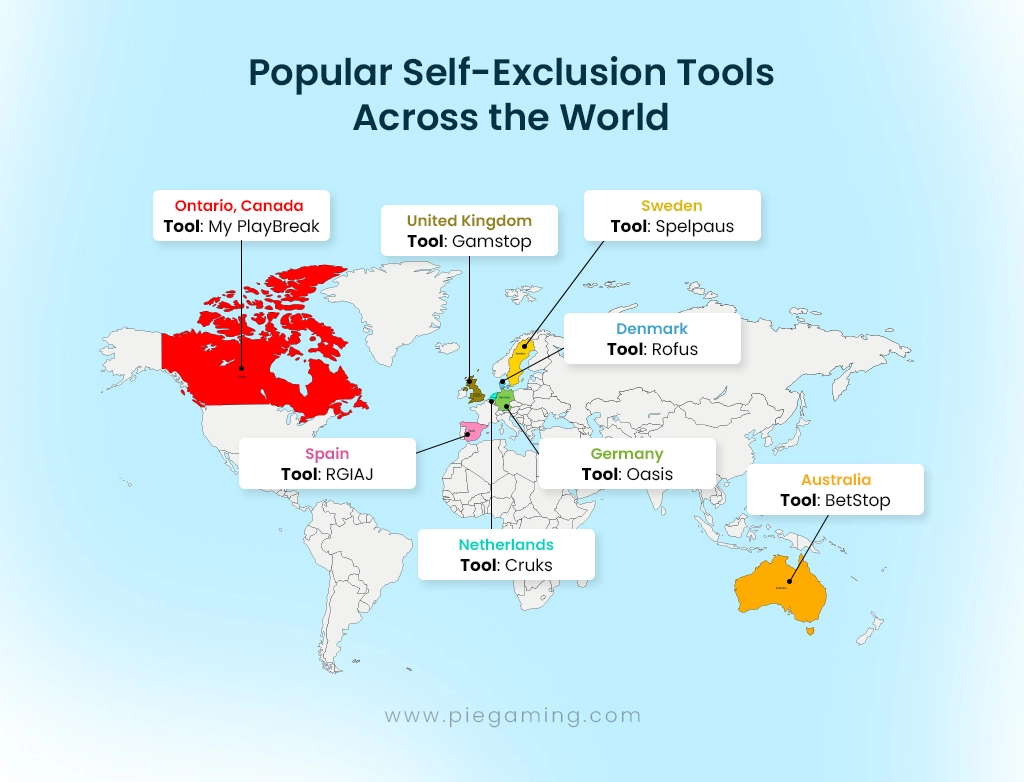
Region-specific self-exclusion tools
In this section, you’ll discover which countries have implemented self-exclusion tools, how they work, and what it means for operators targeting those markets.
1. United Kingdom
Tool: GAMSTOP
GAMSTOP blocks players from all UK-licensed betting sites and apps for six months, one year, or five years. It’s free, quick to register, and covers everything from popular casino games to sports betting.
For operators, GAMSTOP integration isn’t optional—it’s the law. You must check every player against the database and block anyone who’s registered. The system works automatically, so there’s no manual checking needed once you are connected.
2. Sweden
Tool: Spelpaus
Spelpaus covers both online and offline gambling across Sweden. Players use their bankID to exclude themselves for periods from one month to forever, making it super secure and instant.
Swedish operators must check every single player against Spelpaus before they can play. The system updates in real-time, so exclusions happen immediately across all platforms.
3. Germany
Tool: OASIS
OASIS is Germany’s complete gambling exclusion system covering online casinos, sports betting, and land-based venues. Players add themselves to stop all gambling activities with licensed operators.
German operators must verify every new and existing customer against OASIS and immediately block access for anyone listed. It’s a blanket ban that covers everything gambling-related.
4. Netherlands
Tool: Cruks (Central Register for Exclusion of Games of Chance)
Cruks uses DigiD for secure, instant exclusions across all Dutch gambling. Players can block themselves from everything – online casinos, sports betting, and physical locations.
Operators must check every player against Cruks before allowing access. The system is part of the licensing requirements, so compliance is essential for staying legal.
5. Denmark
Tool: ROFUS
ROFUS covers all Danish gambling using national ID verification. Players choose temporary or permanent exclusions that work immediately across all regulated operators. Danish operators must check ROFUS before any player can register or log in.
6. Australia
Tool: BetStop (National Self-Exclusion Register)
BetStop is Australia’s new national system covering all licensed online gambling. Players can exclude themselves for three months to a lifetime, and the process is confidential and user-friendly.
Operators must participate by law and enforce all exclusions quickly to keep their licenses. It’s a unified approach that works across all states and territories.
7. Ontario, Canada
Tool: My PlayBreak (formerly Self-Exclusion Program)
My PlayBreak covers all regulated online gambling in Ontario. Players pick exclusion periods that work for them, and once registered, they’re blocked from all provincial gambling sites.
Ontario operators must integrate with the system and ensure excluded players can’t access their platforms.
8. Spain
Tool: RGIAJ (General Registry of Gambling Access Bans)
RGIAJ is Spain’s single exclusion point for all licensed gambling, online and offline. Players register once and get blocked everywhere.
Spanish operators must check RGIAJ before allowing any player access. It’s a key part of Spain’s responsible gambling laws and covers the entire regulated market.
Read Blog – Regulations Guide in Various Countries
What does this mean for operators?
Getting these tools on your platform is simple. Most back-office system providers give you easy-to-use connections that plug straight into your site. Your tech team sets up the connection once, and it automatically checks players against exclusion lists.
Many software companies also sell ready-made packages that handle multiple countries at the same time.
Best Practices for Implementing Self-Exclusion Tools
Getting self-exclusion right isn’t just about compliance – it’s about building trust with players and protecting your business. Here’s how to do it properly:
1. Partner with Trusted Providers
Work with established self-exclusion service providers who have proven track records. These companies handle the technical heavy lifting and ensure your integrations stay up to date with changing regulations. They also provide ongoing support when issues arise.
2. Connect to all Relevant Registers
Don’t just integrate with one system. Connect to national registers like GAMSTOP, Spelpaus, and local databases where you operate. This creates comprehensive coverage and shows regulators that you’re serious about player protection.
3. Make Processes Crystal Clear
Your opt-in and opt-out processes should be straightforward. Players need to understand exactly what they’re signing up for and how their data gets used. Keep everything GDPR compliant and transparent – no hidden terms or confusing language.
4. Train Your Team
Staff need to know how self-exclusion works and what to do when alerts pop up. Set up backend systems that flag excluded players immediately. Train your customer service teams to handle these situations properly.
5. Be Transparent Everywhere
Make self-exclusion options easy to find in player dashboards and clearly explain everything in your terms and conditions. Players should never have to hunt for these tools.
Does Self-Exclusion Affect Operator Revenue?
Yes, self-exclusion can hit your revenue in the short-term, especially when your biggest players decide to take a break. This is most noticeable in regulated markets where systems like GAMSTOP make exclusions unavoidable across all operators.
When high-spending players self-exclude, you’ll feel it immediately. These are often the players who bring in serious money, so when they are gone, your numbers drop. In markets with strong exclusion systems, this impact can be significant.
Regulators are cracking down hard on responsible gambling. If you get caught ignoring exclusions and you are looking at massive fines, suspended licenses, or complete shutdowns.
These penalties cost way more than any revenue you’d lose from excluded players.
Supporting self-exclusion builds something more valuable than quick cash trust. Players want to know that you care about their safety, not just their spending. This reputation attracts better players who gamble responsibly and stay loyal longer.
Letting problem gamblers keep playing creates huge risks. Legal fights, bad publicity, and costly refunds can destroy your business. One major problem is that the gambling scandal can cost more than years of lost revenue from excluded players
Smart operators see self-exclusion as protection, not punishment. Short-term losses prevent long-term disasters while building a business that lasts.
Wrapping Up…
Self-exclusion might look like just another feature, but it’s actually huge for your business. It keeps you legally compliant, protects players, and shows you’re responsible.
For any gambling operator, offering self-exclusion isn’t just about ticking boxes – it’s about creating trust and building a platform that players want to use long-term. 
FAQs
-
How long does self-exclusion last?
Self-exclusion periods vary by location and personal choice, ranging from several months to permanent lifetime bans.
-
Is self-exclusion available for sports betting too?
Yes, self-exclusion covers all gambling activities, including sports betting, casino games, and poker on regulated platforms.
-
What is the difference between temporary and permanent self-exclusion?
Temporary exclusion has set end dates; permanent exclusion blocks access forever, though removal of requests may be possible.
-
Do all online betting sites offer self-exclusion options?
Licensed sites must offer self-exclusion by law. Unlicensed or offshore sites may not provide these protections.

Palak Madan has been writing about the iGaming industry since 2024. She focuses on helping operators and founders understand their options when launching an online casino, from choosing the right software provider to figuring out costs and compliance requirements across different markets. At PieGaming, she covers topics like white label casino solutions, platform selection, and market entry, turning complex industry information into practical guidance for people building iGaming businesses. She also keeps a close eye on licensing and regulatory changes; particularly how new rules shape the way operators enter and grow in different jurisdictions.

An iGaming CRM helps operators turn players’ data into targeted communication, automated journeys, and more relevant experiences. Explore this blog to learn how it works, what features matter, and how to build a smarter CRM strategy.
Certified RNG uses independent labs like GLI and eCOGRA to test game software before launching. Provably fair uses server seeds, client seeds, and a nonce, so players can verify individual round outcomes cryptographically after each bet.
The best lottery games to include on an online lottery platform are Lotto Games, Instant Win Games, Scratch Cards, Daily Numbers Games, Keno, Bingo, Raffle Games, Lottery Syndicates, and Progressive Jackpots. These games attract diverse player segments. They boost engagement and drive long-term revenue growth.
Big Data in iGaming is the aggregation and analysis of large amounts of player, transaction, and gameplay information to inform more intelligent decision-making. It enables operators to offer personalized experiences, optimize odds, identify fraud, and drive retention. Here’s how Big Data is crucial to staying competitive in the data-driven iGaming. Information is the currency at the highest stakes in online gambling.
Top iGaming PAM providers in 2026 includes PieGaming,Pragmatic Solutions, EveryMatrix, SoftSwiss, Playtech, Digitain, BetConstruct, GammaStack, Tecpinion, Skilrock offering advanced player management, payments, CRM, fraud prevention, and scalable gaming infrastructure.
RTP, or Return to Player, is the percentage of total wagers a casino game is designed to give back to a player. For operators, RTP casinos directly influence the theoretical house edge, while for players, it gives a usual way to compare long-term mathematical returns of different casino games.

Explore how a casino back office system enhances profits through effective management, data analysis, and operational efficiency, driving success in the gaming industry.



See you in your inbox soon!

Stay ahead of the game. Subscribe for exclusive content, updates, and insiders!