
Certified RNG uses independent labs like GLI and eCOGRA to test game software before launching. Provably fair uses server seeds, client seeds, and a nonce, so players can verify individual round outcomes cryptographically after each bet.
You spin the reels. The result appears in less than a second. But here’s the question most players never think to ask: how do you actually know that outcome was fair?
Ogni software per casinò online claims its games are fair. That part is easy to say. What’s harder to explain is the evidence behind that claim, and that’s where the two approaches in online gambling diverge completely.
The traditional route relies on certified RNG. An independent testing lab like eCOGRA or GLI reviews the game software, runs statistical analysis on the RNG, and certifies it meets regulatory standards before a single player ever bets on it.
You don’t verify anything yourself. You rely on the regulator, the test house, and the certification process to have done that work on your behalf.
The second approach is provably fair. Here, the casino commits to a cryptographic seed before your round begins. Once it’s over and the seed data is made available, you can run the same calculation yourself and check that the result matches what was committed to in advance.
Entrambi i progetti editoriali di provably fair vs traditional RNG approaches can provide real evidence of fairness. But they do it differently. This guide breaks down how each system works, what each one actually verifies, and the blind spots both leave uncovered.
What is a Traditional RNG?
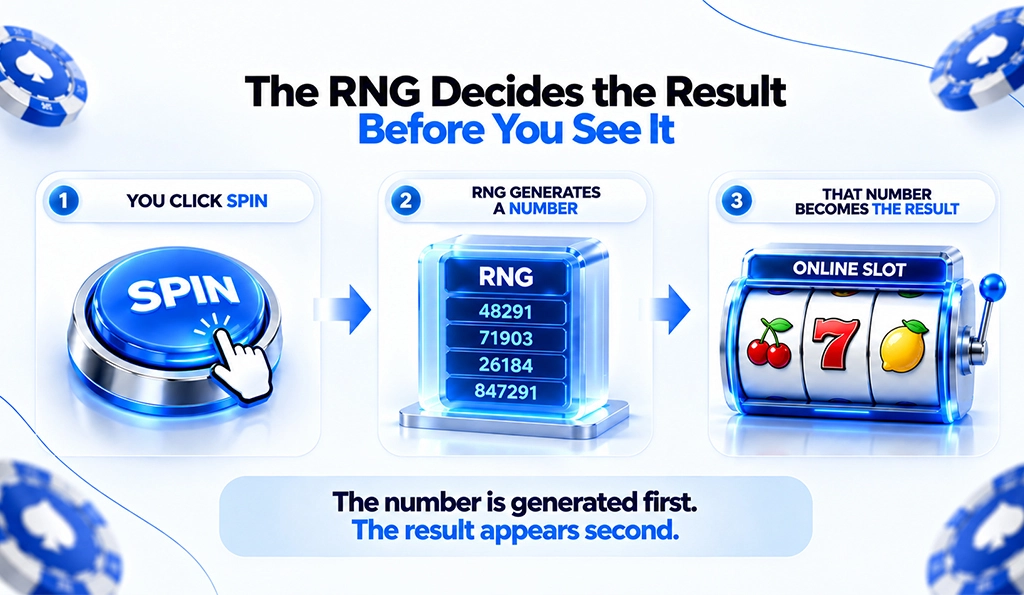
The RNG Decides the Result Before You See It
A Random Number Generator, or RNG, is a deterministic algorithm that uses entropy to produce statistically unpredictable number sequences. The entire process runs on the game provider’s server.
By the time a result reaches your screen, the outcome is already calculated. You receive a finished output: reels stopping on symbols, cards being dealt, a number on the roulette wheel. How it got there is never visible to you.
This is the system powering virtually every slot online, blackjack table, and digital roulette game in the industry.
Because players cannot see the RNG in action, independent testing labs verify it on their behalf. Labs like GLI, eCOGRA, BMM Testlabs, and iTech Labs simulate millions of game rounds, check that outcomes are statistically distributed as expected and confirm that the declared RTP is accurate. The MGA, UKGC, and Licenze di Curaçao contesto all require a valid RNG certificate as a condition of holding a gaming license.
A few things are worth understanding about what that certificate actually covers:
- It is issued to a specific game version, not to individual spins. Your spin is not certified. The game build was.
- Certification happens before launch. There is no continuous live monitoring after the game goes live.
- As a player, you can verify that the certificate exists. What you cannot do is use it to confirm your specific round produced a fair result.
The certificate is institutional proof that the system was tested. It is not round-level proof that your game was fair.
What is Provably Fair?
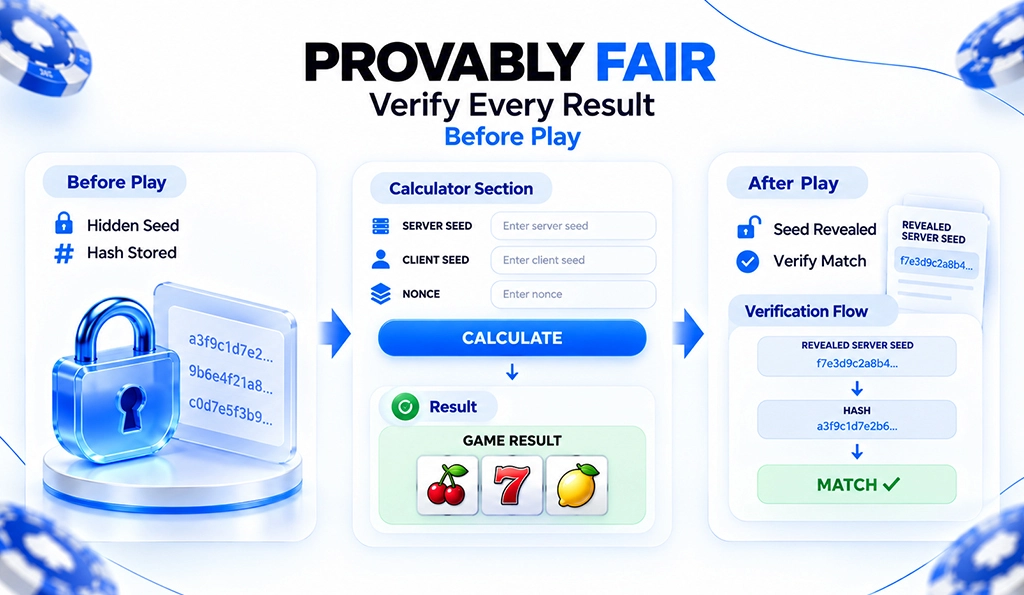
Provably Fair Verify Every Result
Abbastanza giusto is a way for you to check a game round yourself, without taking the casino’s word for it. After the round, you can confirm the result came from seeds that the casino locked in before you played.
Three ingredients go into every result: a server seed from the casino, a client seed from you, and a nonce, which is a counter that goes up with each bet. There’s one catch worth knowing. Provably fair shows that a result was calculated honestly from those inputs, but it can’t tell you whether the game’s odds or payout table are fair. That’s why published probabilities and RTP still matter.
Here’s how the 4-Step Verification Process works:
- The casino locks its seed. Before you bet, it publishes a SHA-256 hash of its secret server seed. The hash can’t be reversed, but it exposes any later attempt to swap the seed.
- You add your client seed. It’s yours to set, so the casino can’t tailor its seed to yours.
- The result is calculated. The server seed, client seed, and a nonce (a counter that rises with each bet) go through a fixed formula.
- You verify. After you rotate seeds, the casino reveals the old server seed. Hash it to confirm it matches the published hash, then rerun the formula.
It works best on games with simple numerical outcomes, like dice, crash, plinko, mines, limbo, and roulette, where each round comes down to a single number. Slots are harder, since multiple reels and bonus features are difficult to encode without exposing a studio game logic.
That is starting to change: in April 2026, Stake added provably fair verification to 1,200+ games built on its own Stake Engine, publishing every possible result and its probability up front. You’ll also find it often in crypto casinos and Mini app Telegram.
Provably Fair vs Traditional RNG: Side-by- Side Comparison
Both approaches give players evidence that a game is fair, but at different levels. Certified RNG nell'iGaming offers independent, system-level assurance that a game was tested. Provably fair lets you check individual results yourself.
With certified RNG, a lab and a regulator process show the system was tested for random, unpredictable outcomes, but you can’t recreate a single spin yourself. It’s worth checking that the certificate is current, covers your game, and comes from a lab the regulator recognizes.
With provably fair, you hash the revealed server seed, confirm it matches the fingerprint published before you played, then rerun the calculation with your client seed and nonce.
That check has limits. It won’t tell you about bordo della casa, RTP, licensing, or withdrawal speed.
The strongest setup combines both: independently tested games, clear RTP disclosures, and provably fair verification where it’s supported.
Provably Fair and RNG Certification: What Each System Leaves Unverified
Both approaches give you real evidence of fairness, but neither covers everything. Knowing where each one stops helps you tell a genuine fairness check from a bigger claim that a casino is completely trustworthy.
What Provably Fair Doesn’t Cover
In a typical setup, the casino commits to a server seed before you bet and reveals it later, so you can reproduce an eligible result yourself. What that check proves depends on what the casino makes verifiable.
Provably fair checks one thing: that the random number behind your result was generated from seeds the casino committed to before you bet. It doesn’t check what the game does with that number afterward.
- The check stops at random numbers. Say a dice game produces a roll of 42. Verification confirms the 42 is genuine, but it doesn’t confirm how the game pays a 42. If the payout for that roll is lower than the casino advertised, the check would still pass.
- Payout rules need to be published to be checked. A result can only be verified from end to end if the casino also publishes the pay table and the rules that convert the number into a win or lose, and its verifier uses them. If those rules aren’t part of the check, they’re unverified.
- A casino’s own verifier means trusting the casino. The tool is built and run by the casino, so it only shows that the result matches the casino’s own formula. Look for a published specification that anyone can follow, and ideally an independent verifier or audit.
- Complex games need more disclosure. A slot with bonus rounds and multiple features involve far more than a seed and a number. Real verification needs the game rules, paytable, and bonus mechanics to be published for the specific game version you’re playing.
- A hash mismatch is a red flag. Before you bet, the casino publishes a hash of its server seed. After the seed is revealed, hashing it should give you the same hash. If it doesn’t, the revealed seed isn’t the one the casino committed to. First, make sure you’re using the right seed pair, nonce, and hash function.
What RNG Certification Doesn’t Cover
A certificate shows that a specific game or RNG version was assessed within a defined scope at a particular point in time. Testing can include source-code review, seeding checks, and statistical randomness tests.
- It’s not a live check. A certificate doesn’t monitor every spin or hand as it happens.
- You can’t recreate a round. It won’t let you verify one completed spin or hand.
- It won’t confirm the live build. You can’t confirm from the certificate alone that the game you’re playing is the exact version tested or that its RTP setting hasn’t changed.
- Regulation adds a safety net. Regulated operators often face change-control, audit, and re-testing requirements, and UK licensees must submit game and RNG test results. Even so, a certificate is one layer of assurance, not continuous monitoring.
What Neither System Tells You
Verification shows a game that behaves as designed, not that the design is generous. RTP, bonus terms, ottenere una licenza di gioco, and payment policies are separate questions from whether a result can be verified.
Avvolgere Up
In the provably fair vs traditional RNG debate, neither label makes a casino safe on its own. What matters is what sits behind it.
Ad una casinò con licenza, look for a named testing lab on the certificate — GLI, eCOGRA, iTech Labs, or BMM — and a valid license from the MGA, UKGC, or Curaçao. A badge that doesn’t name either is worth nothing.
Ad una piattaforma di casinò crittografici with provably fair algorithm, check whether the game logic has been independently audited, not just the RNG layer. A casino running its own verifier is only confirming its own work.
The actual risk in online gambling is neither system failing. It’s unlicensed casinos with no certification and no accountability at all. That’s where players lose money with no recourse.
One rule covers both: a named lab or a named audit report always outweighs a generic badge.

Contattaci
FAQ
-
How does provably fair gaming actually work behind the scenes?
Before each round, the casino locks a server seed using a SHA-256 hash. Combined with your client seed and a nonce, it generates the result. You verify it after.
-
Crypto casino RNG vs provably fair: Which is better for player trust?
Provably fair gives you direct mathematical proof per round. RNG relies on third-party certification. Neither is inherently safer, it depends on whether the casino behind it is legitimate.
-
Do Provably Fair games offer better winning chances?
No. Provably fair verifies how a result was generated, not how generous the game is. House edge and RTP exist in provably fair games exactly as they do in RNG-certified ones.
-
What types of casino games commonly use Provably Fair technology?
Dice, crash, plinko, mines, limbo, and roulette are the most common. Slots have historically been harder to implement, but that is gradually changing across crypto casino platforms.
-
Are Provably Fair games becoming more popular in online casinos?
Yes. Adoption is growing steadily, particularly in crypto casinos and Telegram mini apps. Provably fair verification is also expanding beyond simple in-house games into more complex slot content.


Palak Madan scrive del settore iGaming dal 2024. Si concentra nell'aiutare operatori e fondatori a comprendere le loro opzioni quando lanciano un casinò online, dalla scelta del fornitore di software giusto alla valutazione dei costi e dei requisiti di conformità nei diversi mercati. PieGamingSi occupa di argomenti come le soluzioni white label per casinò, la selezione delle piattaforme e l'ingresso nel mercato, trasformando informazioni complesse del settore in una guida pratica per chi desidera avviare un'attività nel settore dell'iGaming. Monitora inoltre attentamente le modifiche normative e di licenza, in particolare come le nuove regole influenzano l'ingresso e la crescita degli operatori nelle diverse giurisdizioni.

I migliori giochi di lotteria da includere in una piattaforma di lotterie online sono Lotto, giochi a vincita istantanea, gratta e vinci, giochi con numeri giornalieri, Keno, Bingo, lotterie a premi, gruppi di gioco e jackpot progressivi. Questi giochi attraggono diverse tipologie di giocatori, aumentano il coinvolgimento e favoriscono la crescita dei ricavi a lungo termine.

Nel settore dell'iGaming, i Big Data consistono nell'aggregazione e nell'analisi di grandi quantità di informazioni su giocatori, transazioni e gameplay, al fine di supportare un processo decisionale più intelligente. Permettono agli operatori di offrire esperienze personalizzate, ottimizzare le probabilità di vincita, identificare le frodi e fidelizzare i clienti. Ecco perché i Big Data sono fondamentali per rimanere competitivi nel settore dell'iGaming, sempre più orientato ai dati. L'informazione è la moneta di scambio più preziosa nel gioco d'azzardo online.

I principali fornitori di PAM per iGaming nel 2026 includono PieGamingPragmatic Solutions, EveryMatrix, SoftSwiss, Playtech, Digitain, BetConstruct, GammaStack, Tecpinion, Skilrock offrono soluzioni avanzate per la gestione dei giocatori, i pagamenti, il CRM, la prevenzione delle frodi e infrastrutture di gioco scalabili.

Gli strumenti di autoesclusione sono una componente importante del gioco responsabile, in quanto consentono ai giocatori di limitare il proprio accesso alle piattaforme di gioco, permettendo loro di autoescludersi o addirittura di bloccarne completamente l'accesso. Questo articolo descrive il funzionamento di tali strumenti e il loro impatto sulle piattaforme di iGaming in termini di conformità, tutela dei giocatori e credibilità a lungo termine.
L'RTP, o Return to Player (ritorno al giocatore), è la percentuale delle puntate totali che un gioco da casinò è progettato per restituire al giocatore. Per gli operatori, l'RTP dei casinò influenza direttamente il vantaggio teorico della casa, mentre per i giocatori rappresenta un metodo comune per confrontare i rendimenti matematici a lungo termine di diversi giochi da casinò.

Scopri come un sistema di back office di un casinò aumenta i profitti attraverso una gestione efficace, l'analisi dei dati e l'efficienza operativa, favorendo il successo nel settore del gioco d'azzardo.
Un sistema di bonus per casinò online è un software backend specializzato, progettato per automatizzare la creazione, la gestione, la distribuzione e il monitoraggio dei premi promozionali per le piattaforme di iGaming. Anziché erogare manualmente giri gratuiti o bonus sul deposito, il sistema di bonus del casinò utilizza regole automatizzate che offrono incentivi mirati ai giocatori in tempo reale.

Ci vediamo presto nella tua casella di posta!

Stai al passo con i tempi. Iscriviti per l'esclusiva
contenuti, aggiornamenti e addetti ai lavori!