
Çevrimiçi kumarhaneler ve kripto kumarhaneler benzer kumarhane oyunları sunabilir, ancak ödemeler, para birimleri, işlem süreçleri, düzenlemeler ve operasyonel gereksinimler açısından farklılık gösterirler. Çevrimiçi Kumarhane ve Kripto Kumarhane karşılaştırması, operatörler ve oyuncular için temel farklılıkları vurgular.
The choice between a traditional online casino and a crypto casino involves more than just the payment methods. Both for the operator and the player, there are additional differences – be it in the transaction process, KYC/AML requirements, legal aspects, or the target audience’s specific requirements. While both these types of platforms can provide almost the same sets of games, they still differ significantly in their features and benefits. So, operators need to understand what each model requires before choosing their payment and software setup, while players need to know how the differences can affect their overall casino experience.
In this guide, we compare online and crypto casinos across payments, transaction speed, privacy, security, regulation, bonuses, currency, and accessibility.
Online Casino vs Crypto Casino Comparison
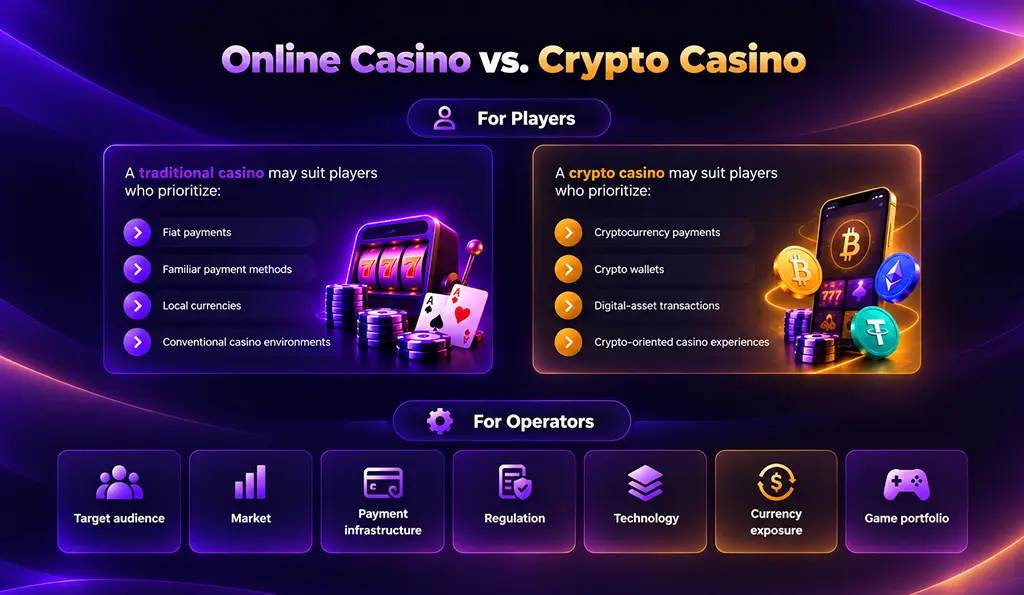
Çevrimiçi Kumarhane mi, Kripto Kumarhane mi?
Knowing the differences between these two models is what enables operators and players to make informed decisions. Here is a breakdown of the areas that matter the most.
Payment Methods and Banking Systems
Çevrimiçi kumarhane yazılımı runs on fiat currencies. Depending on the market, this may include debit cards, bank transfers, e-wallets, and other regulated payment services. Crypto casinos eliminate all those layers by implementing blockchain payments such as Bitcoin, Ethereum, Litecoin, USDT, and Solana.
Players can make and withdraw funds via banks, credit cards, wire transfer, or e-wallets and can fund the account in USD, EUR, GBP, etc.
For operators, this makes payment architecture an important consideration. The payment stack must support deposits, withdrawals, transaction monitoring, reconciliation, and fraud controls.
Yapısal farklılıklar önemlidir:
- Fiat kumarhaneleri bankacılık onay sistemlerine bağlıdır.
- Kripto casino çözümleri use direct wallet-to-wallet transfers.
- Geleneksel ödeme yöntemleri, geri ödeme ve iptal işlemlerine izin verir.
- Blockchain işlemleri onaylandıktan sonra geri alınamaz.
- Payment gateway delays are a common reality in fiat systems.
Operatörler için son nokta göründüğünden daha önemlidir. Ödemelerdeki gecikmeler oyuncunun güvenini etkiler ve oyuncunun güveni de oyuncu tutma oranını etkiler.
İşlem Hızı
Kripto kumarhanelerin açık bir avantajı işte burada ortaya çıkıyor. Geleneksel kumarhane para çekme işlemleri genellikle şu kadar sürüyor:
- 24 saatten birkaç iş gününe kadar.
- Bunun üzerine bir de banka doğrulama işlemi için ek süre gerekiyor.
Crypto casino withdrawals are usually processed with:
- Birkaç dakikadan birkaç saate kadar.
- Blok zinciri yoğunluğuna ve onay gereksinimlerine bağlı olarak.
Oyuncular ödemelerinin ne kadar hızlı yapıldığını fark ediyorlar. Operatörler de bunu fark etmeli.
Gizlilik ve Anonimlik
Online casinos require full KYC verification before withdrawals. That means ID proof, banking documents, and a process that adds friction for players who just want to cash out. Whereas crypto casinos have historically allowed wallet-based gambling with minimal verification.
Dikkate alınması gereken temel farklılıklar:
- Bazı kripto kumarhanelerinde hâlâ anonim kumar oynama seçenekleri mevcut.
- Fiat kumarhaneleri, doğrulanmış oyuncu sistemleri üzerinden çalışır.
- Uyumluluk standartları, yargı bölgelerine göre önemli ölçüde farklılık göstermektedir.
Güvenlik Altyapısı
Both models take security seriously, but the approach is different. Online casinos use encrypted banking systems and centralized payment security. Crypto casinos rely on blockchain transparency and smart contract-based transactions.
So, account protection, transaction monitoring, fraud detection, access controls, and secure integration with payment providers—all ensure overall security architecture. This is important for both players and operators.
Düzenleme ve Lisanslama
Geleneksel kumarhaneler genellikle iyi kurulmuş düzenleyici çerçeveler altında faaliyet gösterir. Yetkili kurumlar, örneğin... Birleşik Krallık Kumar Komisyonu Malta Oyun Otoritesi, oyuncu koruması, adil oyun ve mali uyumluluk konularında net standartlar belirledi.
Cryptocurrency brings in a number of additional considerations. For instance, the İngiltere'de Kumar Commission, in particular, requires operators to take into account factors such as the volatility of the crypto-asset against fiat currency and how customer deposits will be handled.
As the requirements vary depending on the jurisdiction, operators should research the target market to choose the payment or software model.
Bonus Yapıları
Both online casino and crypto casinos can offer bonuses, free spins, loyalty rewards, and other promotional mechanisms.
But crypto casinos have expanded the playbook:
- Jeton bazlı nakit iade programları.
- Kripto para yatırma bonusları.
- NFT tabanlı VIP üyelikleri.
- Staking ödülleri ve zincir içi sadakat sistemleri.
For operators looking to differentiate, this is one area where crypto casinos offer genuinely creative rooms. This is something players also love in casino platforms.
Desteklenen Para Birimleri
Geleneksel kumarhanelerde yerel bankacılık ağları aracılığıyla itibari para birimleri kabul edilmektedir. Ek olarak, kripto kumarhaneler çeşitli ödeme seçenekleri ve stablecoin'ler sunarak farklı uluslararası sınırlar arasında daha hızlı ve daha uygun maliyetli işlemler yapılmasını kolaylaştırmaktadır. Bitcoin, Ethereum, USDT ve Solana popüler kripto para birimlerinden bazılarıdır.
Accessibility and Geographic Restrictions
Online casinos are often restricted by regional banking laws and iGaming regulations. Crypto casinos have an advantage here. Blockchain payments bypass many of the banking limitations that restrict fiat platforms, making global access more achievable.
Bununla birlikte, erişim koşulsuz değildir. Operatörlerin yine de şunları dikkate alması gerekir:
- Hedef pazarlardaki yerel kripto kumar yasaları.
- Hızla gelişen bölgesel kripto para düzenlemeleri.
- Ülkeye göre değişen, yetki alanına özgü lisanslama gereksinimleri.
Bonus: Key Factors to Consider in Online and Crypto Casino
A broader comparison must consider both the player experiences and operator’s infrastructure as highlighted in the table below:
Responsible Gambling in Online and Crypto Casinos
Everyone knows that gambling is risky and to protect players’ interest and money, the Sorumlu Kumar Konseyi requests operators to promote safe gambling platform by integrating the following tools:
- Para yatırma limitleri
- Kendini dışlama
- Oturum sınırları
- Gerçeklik kontrolleri
- Account controls
For example, in Great Britain, the Gambling Commission’s updated requirements state that, from 30 Eylül 2026, operators must offer gross “deposit limits” and prevent further deposits once the applicable limit is reached, subject to the specified rules.
Benzer şekilde, Malta Gaming Authority requires online casino operators to offer Kendini dışlama and either deposit or wagering limits, as well as reality checks. They also encourage additional tools like loss and betting limits.
For crypto operators, responsible gambling controls also take into account the volatility of cryptocurrency against fiat. The Gambling Commission explicitly states that this factor is taken into account when crypto assets are accepted directly.
Provably Fair and Crypto Volatility: What Operators and Players Need to Know
Two areas stand out when we compare crypto casinos with traditional online casinos: provably fair gaming and crypto volatility.
What Does Provably Fair Mean in Crypto Casinos?
Muhtemelen adil is a cryptographic approach that allows players to verify whether a game outcome was generated according to the stated mechanism.
Usually, this involves elements such as:
Sunucu çekirdeği: a value generated by the casino system;
Müşteri tohumu: a value provided or influenced by the player;
şimdiki zaman: a varying value between game rounds
Çırpı: cryptographic operation(s) to generate or verify the result.
The player can use the disclosure of information as inputs to verify the outcome once the game is finished. This is contrasted with the conventional RNG model, where randomness is derived from an RNG, and the gaming system is subject to testing, technical controls and, depending on the jurisdiction and product, independent certification or auditing.
For operators, provably fair technology can provide transparency around specific game outcomes. It should not, however, be regarded as proof of an entire casino being licensed, secure, and compliant.
How Crypto Volatility Affects Players and Operators?
Crypto volatility refers to fluctuating market values of a cryptocurrency against fiat currencies or other assets.
For players, this means the fiat value of a crypto deposit or withdrawal has the potential to change while the transaction is being processed or while funds are held in a crypto balance.
For operators, the issue extends to treasury management. An operator accepting crypto needs to determine how balances are stored, converted and settled, and how fluctuations are reflected in accounting and customer-facing balances.
Stablecoins can be one mechanism to mitigate some exposure to price volatility, though the use of these introduces its own considerations in terms of payment, liquidity, and regulatory aspects.
Network fees are another consideration: the final cost and processing experience will depend on the blockchain, network, and payment infrastructure utilized.
The UK’s Gambling Commission specifically expects operators that accept crypto-assets to consider how fluctuations against fiat currency will be handled, including the impact on sorumlu kumar tools and AML triggers.
Security Risks in Online and Crypto Casinos
Her platform risk taşır. Fark, bu riskin nerede olduğu ve kimin yönetmekten sorumlu olduğudur. Operatörler için her iki tarafı da anlamak isteğe bağlı değil, oyuncuların güvenebileceği bir platform oluşturmanın bir parçasıdır.
Where Online Casinos Are Vulnerable
Geleneksel çevrimiçi kumarhaneler merkezi sistemler üzerine kuruludur. Bu, müşteri verilerinin, bankacılık bilgilerinin ve KYC belgelerinin hepsinin tek bir yerde bulunduğu anlamına gelir. Ve merkezi sistemler hedef konumundadır.
Oyuncuların para çekme işleminden önce kişisel ve finansal bilgilerini vermeleri gerektiğinden, tek bir güvenlik ihlali önemli miktarda hassas veriyi açığa çıkarabilir.
İşletmecilerin dikkate alması gereken riskler şunlardır:
- Çalıntı kredi kartları veya yetkisiz işlemler içeren ödeme dolandırıcılığı
- Kumarhane ödeme işlemcilerini veya müşteri veritabanlarını hedef alan bankacılık ihlalleri
- Pasaport veya fatura gibi kimlik doğrulama belgelerinin sızdırılması yoluyla kimlik hırsızlığı.
- Oyuncuların tamamlanmış işlemleri hileli bir şekilde geri alması durumu olan geri ödeme suistimali.
Üçüncü taraf ödeme sağlayıcıları, özellikle birden fazla uluslararası pazarda faaliyet gösteren ve çeşitli ödeme işlemcileriyle çalışan operatörler için ek bir risk katmanı oluşturmaktadır.
Kripto Kumarhanelerinin Savunmasız Olduğu Noktalar
Kripto kumarhaneler bankacılık bağımlılığını ortadan kaldırıyor, ancak beraberinde farklı riskler de getiriyor. Blockchain işlemleri geri alınamaz olduğundan, güvenlik konusundaki riskler çok özel bir şekilde daha yüksek. Fonlar çalınırsa, geri alınması nadiren kolaydır ve çoğu zaman imkansızdır.
Burada en önemli riskler şunlardır:
- Gizli anahtarların ele geçirilmesi veya cihazların hacklenmesi sonucu cüzdan hırsızlığı.
- Akıllı sözleşme saldırıları, merkeziyetsiz kumarhane sistemlerindeki güvenlik açıklarını hedef alıyor.
- Sahte kumarhane web siteleri veya kötü amaçlı cüzdan bağlantı istekleri aracılığıyla yapılan kimlik avı saldırıları.
- Kripto para fiyatlarındaki dalgalanmaların sermaye değerini ve gerçek kazançları etkilediği, değişken varlık riski.
Kripto platformlarını işleten operatörler için bu, fonların nasıl tutulduğu ve hangi güvenlik önlemlerinin alındığı konusunda oyunculara karşı şeffaf olmak anlamına da gelir. Bu şeffaflık, ürünün bir parçasıdır.
Online Casino vs. Crypto Casino: Which One Is Better?
Burada evrensel bir cevap yok. Her iki modelin de gerçek güçlü yönleri ve gerçek sınırlamaları var. Doğru seçim, oyuncularınızın ne beklediğine ve onlar için ne tür bir platform oluşturduğunuza bağlıdır.
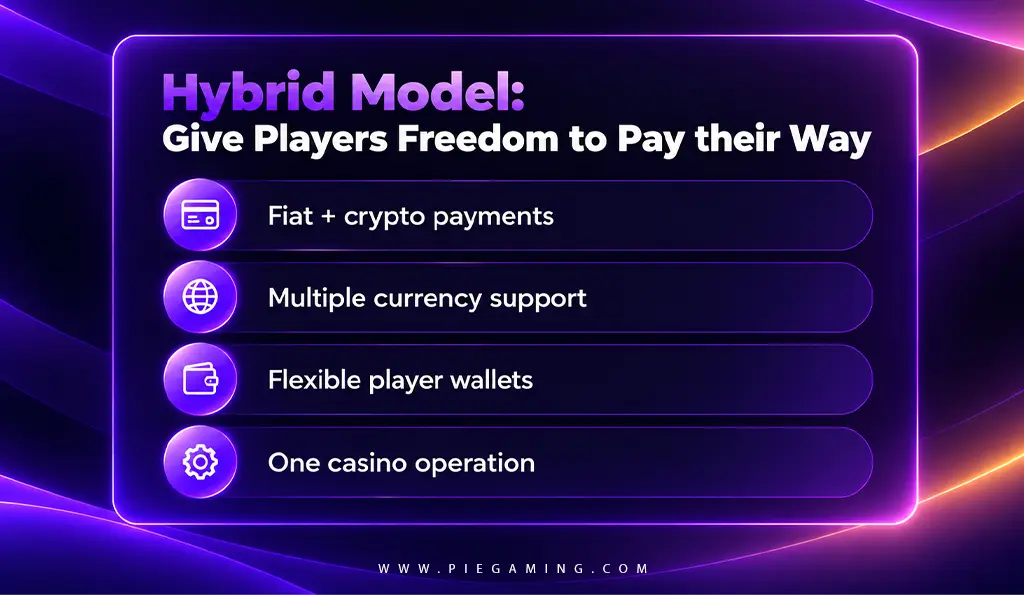
Hybrid casino model
Sonuç
The debate on online casino vs. Crypto casino extends beyond the type of currency for placing bets. It includes variations in the payment stack process, means of payment, KYC approach, and regulatory differences and, for operators, impacts the treasury and operations.
For players, the differences are likely to relate to ödeme yöntemleri, withdrawal experience, privacy, currency support, and security, and accessibility.
For operators, the question is more involved and depends on factors such as the relevant licensing, target markets, payment infrastructure, KYC/AML controls, responsible gambling solutions, currency exposure, and the technology required to support both fiat and crypto transactions.
For businesses looking to appeal to both customer segments, a hybrid fiat-and-crypto casino could be considered if permitted by the target jurisdiction.

İletişim
SSS
-
Can I run both online and crypto payment options on the same casino platform?
Yes. A simple casino platform can be designed to support both fiat and crypto payment options. The operator is required to manage various transaction flows, currencies, reconciliation requirements, and risk controls.
-
Do Online casinos or crypto casinos have higher operating margins?
There is no universal margin advantage. Operating margins depend on factors like game provide fees, payment costs, customer acquisition costs, bonus, taxes, compliance, fraud losses, etc.
-
How much does it cost to set up an online casino and crypto casino?
There is no single setup cost for either model. The budget covers the factors like licensing, software, payments integration, game content, KYC/ AML tools, etc. A crypto casino may also require crypto payment processing, wallet infrastructure, conversion, or settlement capabilities. The costs are determined by the target market and the technology required.
-
What should operators look for in an online & crypto casino software provider?
Operators must look for the following: Casino and sportsbook software capabilities, where relevant Fiat and crypto payment support KYC/AML integrations Player account and wallet management Game-provider integrations Back-office controls Responsible gambling tools Reporting and transaction management Scalability across target markets Support for the operator's licensing and compliance requirements The provider should also disclose what capabilities are provided, and what licensing, compliance, or other third-party services are the responsibility of the operator.
-
What are the biggest regulatory risks of running a crypto casino in 2026?
The risks will vary depending on the jurisdiction, but operators should consider licensing, AML/KYC, payment control, responsible gambling, treatment of customer funds and crypto-specific transaction risks and restrictions by geography. Regulators may also request further information concerning crypto payment terms. For example, the UK Gambling Commission requires licensees to report any changes in payment methods and processors and to assess the AML impact of new payment methods. Operators should therefore check the requirements of each target market before launching rather than treating crypto acceptance as a separate avenue around gambling regulation.
-
How does KYC/AML compliance differ between crypto and traditional casino operations?
Both are subject to KYC and AML controls, depending on the jurisdiction and model of operation. Crypto assets can raise additional transaction-monitoring considerations because funds flow through crypto exchanges, processors or other virtual asset service providers. FATF standards require that those providing virtual asset services apply measures including customer due diligence, record keeping and suspicious transaction reporting.

Monika Gola, iGaming içerik uzmanıdır. PieGaming2020 yılından beri yazılım seçimi, çevrimiçi kumarhane ve spor bahisleri düzenlemeleri ve operatör büyüme stratejileri konularında araştırma yapıyor ve içerik geliştiriyor. Araştırmaları, Avrupa, Afrika ve Güneydoğu Asya gibi bölgelerdeki pazar fırsatlarının analizini ve düzenleyici çerçevelerin ve giriş engellerinin değerlendirilmesini içeriyor. Operatörlerin bu sektörde sorunsuz bir şekilde ilerlemelerine yardımcı olmak için küresel iGaming pazarlarındaki sektör trendlerini, uyumluluk güncellemelerini ve gelişen oyuncu taleplerini aktif olarak takip ediyor.

Telegram casinoları, kullanıcıların casino oyunlarına doğrudan Telegram botları veya mini uygulama tabanlı kanallar aracılığıyla erişebildiği yeni bir oyun kanalıdır. Bu kılavuz, Telegram casinolarının nasıl çalıştığını, nasıl oluşturulduğunu, temel özelliklerini, neden işlev gördüklerini ve birçok şirketin bu büyüyen platformu neden keşfetmek istediğini açıklamaktadır.
Kripto para kumarhanesi kurmak birçok adımı içerir. Hedef pazarınızı seçmekten lisans almaya, kumarhane modeline, oyun entegrasyonuna ve uyumluluk yönetimine kadar birçok şeyi göz önünde bulundurmanız gerekecek.
Güvenli, ölçeklenebilir ve karlı bir çevrimiçi kumarhane işletmesi kurmak için doğru Bitcoin kumarhane yazılım sağlayıcısını seçmek çok önemlidir. İşte en iyi sağlayıcılara ve doğru olanı nasıl seçeceğinize dair kısa bir bakış.
Bitcoin casinoları, slot, blackjack, rulet ve canlı casino oyunları sunan ve bitcoin ödemelerini kabul eden çevrimiçi casinolardır. Bu kılavuz, Bitcoin casinolarının nasıl çalıştığını, avantajlarını ve dezavantajlarını, ödeme yöntemlerini, güvenlik önlemlerini, lisans gereksinimlerini ve 2026'da bir kripto casino açmak için gereken adımları açıklamaktadır.

Kripto para iGaming çözümleri, blockchain destekli ödemeler, daha hızlı işlemler ve daha fazla şeffaflıkla çevrimiçi kumarı dönüştürüyor. Kripto paralar gelişmeye devam ettikçe, yeni trendler oyuncuların dijital oyun platformlarıyla etkileşim biçimini şekillendiriyor.
2026'da en iyi 10 kripto kumarhane yazılım sağlayıcısı şunlardır: PieGamingSoftGamings, Digient, Slotegrator, NuxGame, GR8 Tech, TRUEiGTECH, Tecpinion, BetConstruct ve KodeDice. Her biri kripto ödemeleri, oyun çeşitliliği, uyumluluk ve dağıtım hızı dahil olmak üzere altı faktör üzerinden sıralanmıştır.
Bitcoin'in hızı, gizliliği ve güvenliği, Bitcoin'in çevrimiçi kumar oyunlarında popüler bir ödeme yöntemi haline gelmesinin nedenlerinden bazılarıdır. Bu kılavuzun amacı, çevrimiçi bahis için Bitcoin kullanmanın başlıca avantajlarını ve dezavantajlarını ortaya koyarak, hem operatörlerin hem de oyuncuların kripto paranın oyun işlemlerinde doğru seçim olup olmadığına karar vermelerine yardımcı olmaktır.

Yakında gelen kutunuzda görüşürüz!

Oyunun ilerisinde kalın. Ayrıcalıklı abone olun
içerik, güncellemeler ve içerdekiler!