
Kasino za mtandaoni na kasino za crypto zinaweza kutoa michezo sawa ya kasino, lakini hutofautiana katika suala la malipo, sarafu, usindikaji wa miamala, pamoja na mahitaji ya kanuni na uendeshaji. Ulinganisho wa Kasino Mtandaoni dhidi ya Kasino ya Crypto unaonyesha tofauti kuu kwa waendeshaji na wachezaji.

The choice between a traditional online casino and a crypto casino involves more than just the payment methods. Both for the operator and the player, there are additional differences – be it in the transaction process, KYC/AML requirements, legal aspects, or the target audience’s specific requirements. While both these types of platforms can provide almost the same sets of games, they still differ significantly in their features and benefits. So, operators need to understand what each model requires before choosing their payment and software setup, while players need to know how the differences can affect their overall casino experience.
In this guide, we compare online and crypto casinos across payments, transaction speed, privacy, security, regulation, bonuses, currency, and accessibility.
Online Casino vs Crypto Casino Comparison
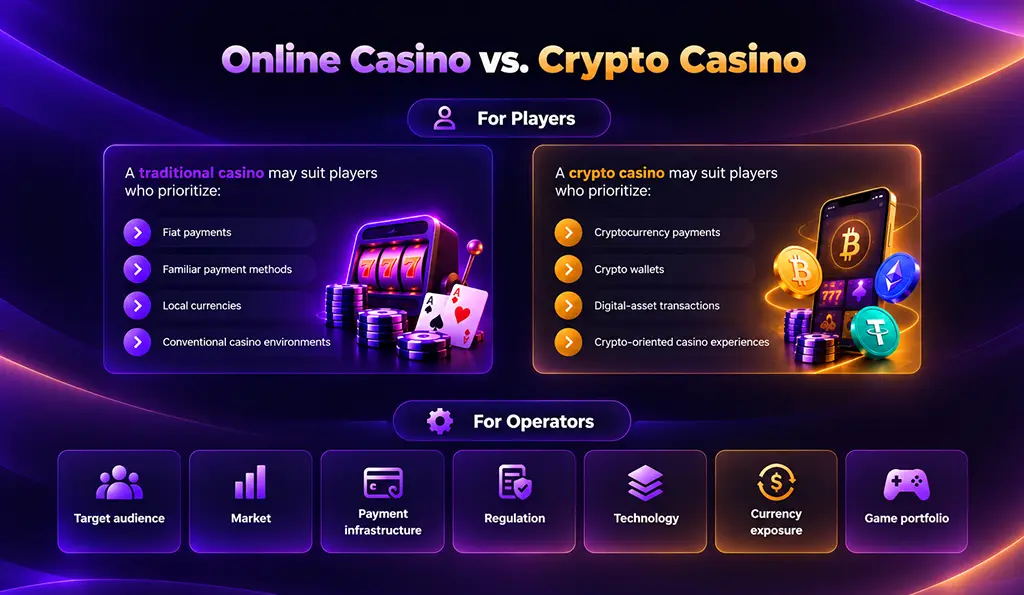
Kasino Mtandaoni dhidi ya Kasino ya Crypto
Knowing the differences between these two models is what enables operators and players to make informed decisions. Here is a breakdown of the areas that matter the most.
Payment Methods and Banking Systems
Programu ya kasino mkondoni runs on fiat currencies. Depending on the market, this may include debit cards, bank transfers, e-wallets, and other regulated payment services. Crypto casinos eliminate all those layers by implementing blockchain payments such as Bitcoin, Ethereum, Litecoin, USDT, and Solana.
Players can make and withdraw funds via banks, credit cards, wire transfer, or e-wallets and can fund the account in USD, EUR, GBP, etc.
For operators, this makes payment architecture an important consideration. The payment stack must support deposits, withdrawals, transaction monitoring, reconciliation, and fraud controls.
Tofauti za kimuundo ni muhimu:
- Kasino za Fiat hutegemea mifumo ya idhini ya benki.
- Suluhisho za kasino za crypto use direct wallet-to-wallet transfers.
- Malipo ya kawaida huruhusu kurejeshewa pesa na kurudisha pesa.
- Miamala ya Blockchain haiwezi kurekebishwa mara tu itakapothibitishwa.
- Payment gateway delays are a common reality in fiat systems.
Kwa waendeshaji, hoja ya mwisho ni muhimu zaidi kuliko inavyosikika. Kuchelewa kwa malipo huathiri uaminifu wa mchezaji, na uaminifu wa mchezaji huathiri uhifadhi.
Kasi ya Ununuzi
Hapa ndipo kasino za crypto zina faida dhahiri. Utoaji wa pesa wa kawaida wa kasino kwa kawaida huchukua:
- Saa 24 hadi siku kadhaa za kazi.
- Muda wa ziada wa uthibitishaji wa benki juu ya hayo.
Crypto casino withdrawals are usually processed with:
- Dakika hadi saa chache.
- Kulingana na msongamano wa blockchain na mahitaji ya uthibitisho.
Wachezaji hugundua jinsi wanavyolipwa haraka. Waendeshaji wanapaswa pia.
Usiri na kutokujulikana
Online casinos require full KYC verification before withdrawals. That means ID proof, banking documents, and a process that adds friction for players who just want to cash out. Whereas crypto casinos have historically allowed wallet-based gambling with minimal verification.
Tofauti kuu za kukumbuka:
- Baadhi ya kasino za crypto bado zina chaguzi za kamari zisizojulikana.
- Kasino za Fiat hufanya kazi kwenye mifumo ya wachezaji iliyothibitishwa.
- Viwango vya uzingatiaji wa sheria hutofautiana sana katika maeneo mbalimbali.
Miundombinu ya Usalama
Both models take security seriously, but the approach is different. Online casinos use encrypted banking systems and centralized payment security. Crypto casinos rely on blockchain transparency and smart contract-based transactions.
So, account protection, transaction monitoring, fraud detection, access controls, and secure integration with payment providers—all ensure overall security architecture. This is important for both players and operators.
Udhibiti na Leseni
Kasino za kitamaduni kwa kawaida hufanya kazi chini ya mifumo ya udhibiti iliyoanzishwa vizuri. Mamlaka kama vile Uingereza Tume Kamari na Mamlaka ya Michezo ya Kubahatisha ya Malta waliweka viwango vilivyo wazi kuhusu ulinzi wa wachezaji, uchezaji wa haki, na kufuata sheria za kifedha.
Cryptocurrency brings in a number of additional considerations. For instance, the Kamari ya Uingereza Commission, in particular, requires operators to take into account factors such as the volatility of the crypto-asset against fiat currency and how customer deposits will be handled.
As the requirements vary depending on the jurisdiction, operators should research the target market to choose the payment or software model.
Miundo ya Bonasi
Both online casino and crypto casinos can offer bonuses, free spins, loyalty rewards, and other promotional mechanisms.
But crypto casinos have expanded the playbook:
- Programu za marejesho ya pesa taslimu za tokeni.
- Bonasi za amana ya crypto.
- Uanachama wa VIP unaotegemea NFT.
- Zawadi za kuweka akiba na mifumo ya uaminifu iliyopo kwenye mnyororo.
For operators looking to differentiate, this is one area where crypto casinos offer genuinely creative rooms. This is something players also love in casino platforms.
Fedha zilizoungwa mkono
Sarafu za Fiat zinakubaliwa katika kasino za kitamaduni kupitia mitandao ya benki za ndani. Zaidi ya hayo, kasino za crypto hutoa chaguzi mbalimbali za malipo na sarafu thabiti, kuwezesha miamala ya haraka na yenye gharama nafuu zaidi katika mipaka tofauti ya kimataifa. Bitcoin, Ethereum, USDT, na Solana ni baadhi ya sarafu maarufu za crypto.
Accessibility and Geographic Restrictions
Online casinos are often restricted by regional banking laws and iGaming regulations. Crypto casinos have an advantage here. Blockchain payments bypass many of the banking limitations that restrict fiat platforms, making global access more achievable.
Hata hivyo, ufikiaji si bila masharti. Waendeshaji bado wanahitaji kuzingatia:
- Sheria za kamari za crypto za mitaa katika masoko lengwa.
- Kanuni za kikanda za crypto zinazobadilika haraka.
- Mahitaji ya leseni mahususi ya mamlaka ambayo hutofautiana kulingana na nchi.
Bonus: Key Factors to Consider in Online and Crypto Casino
A broader comparison must consider both the player experiences and operator’s infrastructure as highlighted in the table below:
Responsible Gambling in Online and Crypto Casinos
Everyone knows that gambling is risky and to protect players’ interest and money, the Baraza la Kamari linalowajibika requests operators to promote safe gambling platform by integrating the following tools:
- Mipaka ya Amana
- Kujitenga
- Vikomo vya kikao
- Ukaguzi wa ukweli
- Account controls
For example, in Great Britain, the Gambling Commission’s updated requirements state that, from 30 Septemba 2026, operators must offer gross “deposit limits” and prevent further deposits once the applicable limit is reached, subject to the specified rules.
Vivyo hivyo, Mamlaka ya Gaming ya Malta requires online casino operators to offer Kujitenga and either deposit or wagering limits, as well as reality checks. They also encourage additional tools like loss and betting limits.
For crypto operators, responsible gambling controls also take into account the volatility of cryptocurrency against fiat. The Gambling Commission explicitly states that this factor is taken into account when crypto assets are accepted directly.
Provably Fair and Crypto Volatility: What Operators and Players Need to Know
Two areas stand out when we compare crypto casinos with traditional online casinos: provably fair gaming and crypto volatility.
What Does Provably Fair Mean in Crypto Casinos?
Hakika ni haki is a cryptographic approach that allows players to verify whether a game outcome was generated according to the stated mechanism.
Usually, this involves elements such as:
Mbegu ya seva: a value generated by the casino system;
Mbegu ya mteja: a value provided or influenced by the player;
Nonce: a varying value between game rounds
Hashing: cryptographic operation(s) to generate or verify the result.
The player can use the disclosure of information as inputs to verify the outcome once the game is finished. This is contrasted with the conventional RNG model, where randomness is derived from an RNG, and the gaming system is subject to testing, technical controls and, depending on the jurisdiction and product, independent certification or auditing.
For operators, provably fair technology can provide transparency around specific game outcomes. It should not, however, be regarded as proof of an entire casino being licensed, secure, and compliant.
How Crypto Volatility Affects Players and Operators?
Crypto volatility refers to fluctuating market values of a cryptocurrency against fiat currencies or other assets.
For players, this means the fiat value of a crypto deposit or withdrawal has the potential to change while the transaction is being processed or while funds are held in a crypto balance.
For operators, the issue extends to treasury management. An operator accepting crypto needs to determine how balances are stored, converted and settled, and how fluctuations are reflected in accounting and customer-facing balances.
Stablecoins can be one mechanism to mitigate some exposure to price volatility, though the use of these introduces its own considerations in terms of payment, liquidity, and regulatory aspects.
Network fees are another consideration: the final cost and processing experience will depend on the blockchain, network, and payment infrastructure utilized.
The UK’s Gambling Commission specifically expects operators that accept crypto-assets to consider how fluctuations against fiat currency will be handled, including the impact on kuwajibika kamari tools and AML triggers.
Security Risks in Online and Crypto Casinos
Kila jukwaa hubeba hatari. Tofauti ni mahali ambapo hatari hiyo inaishi na ni nani anayewajibika kuisimamia. Kwa waendeshaji, kuelewa pande zote mbili si jambo la hiari. Ni sehemu ya kujenga jukwaa ambalo wachezaji wanaweza kuliamini.
Where Online Casinos Are Vulnerable
Kasino za kawaida mtandaoni hujengwa kwenye mifumo ya kati. Hiyo ina maana kwamba data ya wateja, maelezo ya benki, na hati za KYC zote ziko mahali pamoja. Na mifumo ya kati ni shabaha.
Kwa sababu wachezaji wanatakiwa kuwasilisha taarifa binafsi na za kifedha kabla ya kujiondoa, ukiukaji mmoja tu unaweza kufichua kiasi kikubwa cha data nyeti.
Hatari zinazopaswa kuzingatiwa na waendeshaji ni pamoja na:
- Ulaghai wa malipo unaohusisha kadi za mkopo zilizoibiwa au miamala isiyoidhinishwa
- Uvunjaji wa sheria za benki unaolenga wasindikaji wa malipo ya kasino au hifadhidata za wateja
- Wizi wa vitambulisho kupitia hati za KYC zilizovuja kama vile pasipoti au bili za huduma
- Matumizi mabaya ya kurudisha pesa ambapo wachezaji hubadilisha miamala iliyokamilishwa kwa njia ya ulaghai
Watoa huduma za malipo wa wahusika wengine huongeza kiwango kingine cha udhihirisho, haswa kwa waendeshaji wanaofanya kazi katika masoko mengi ya kimataifa huku wasindikaji kadhaa wakihusika.
Ambapo Kasino za Kidijitali Ziko Hatarini
Kasino za crypto huondoa utegemezi wa benki, lakini huleta hatari tofauti. Na kwa sababu miamala ya blockchain haiwezi kurekebishwa, hatari zinazozunguka usalama ni kubwa zaidi kwa njia maalum sana. Ikiwa fedha zinaibiwa, kuzirejesha mara chache huwa rahisi na mara nyingi haiwezekani.
Hatari muhimu zaidi hapa ni pamoja na:
- Wizi wa pochi unaosababishwa na funguo za kibinafsi zilizoathiriwa au vifaa vilivyodukuliwa
- Mikataba mahiri inalenga udhaifu katika mifumo ya kasino iliyogatuliwa
- Mashambulizi ya ulaghai kupitia tovuti bandia za kasino au maombi mabaya ya muunganisho wa pochi
- Mfiduo wa mali tete ambapo mabadiliko ya bei ya crypto huathiri thamani ya benki na ushindi halisi
Kwa waendeshaji wanaoendesha mifumo ya crypto, hii pia inamaanisha kuwa wazi kwa wachezaji kuhusu jinsi fedha zinavyohifadhiwa na ni ulinzi gani uliopo. Uwazi huo ni sehemu ya bidhaa.
Online Casino vs. Crypto Casino: Which One Is Better?
Hakuna jibu la jumla hapa. Mifumo yote miwili ina nguvu halisi, na yote miwili ina mapungufu halisi. Chaguo sahihi linategemea kile ambacho wachezaji wako wanatarajia na aina ya jukwaa unalojenga kwa ajili yao.
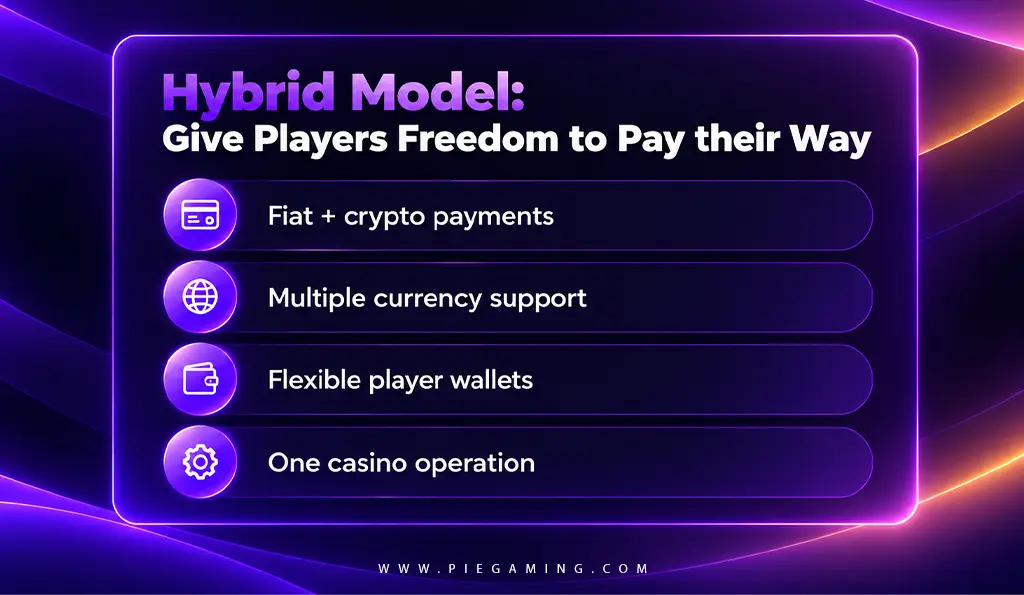
Hybrid casino model
Hitimisho
The debate on online casino vs. Crypto casino extends beyond the type of currency for placing bets. It includes variations in the payment stack process, means of payment, KYC approach, and regulatory differences and, for operators, impacts the treasury and operations.
For players, the differences are likely to relate to njia za malipo, withdrawal experience, privacy, currency support, and security, and accessibility.
For operators, the question is more involved and depends on factors such as the relevant licensing, target markets, payment infrastructure, KYC/AML controls, responsible gambling solutions, currency exposure, and the technology required to support both fiat and crypto transactions.
For businesses looking to appeal to both customer segments, a hybrid fiat-and-crypto casino could be considered if permitted by the target jurisdiction.

Wasiliana Nasi
Maswali ya
-
Can I run both online and crypto payment options on the same casino platform?
Yes. A simple casino platform can be designed to support both fiat and crypto payment options. The operator is required to manage various transaction flows, currencies, reconciliation requirements, and risk controls.
-
Do Online casinos or crypto casinos have higher operating margins?
There is no universal margin advantage. Operating margins depend on factors like game provide fees, payment costs, customer acquisition costs, bonus, taxes, compliance, fraud losses, etc.
-
How much does it cost to set up an online casino and crypto casino?
There is no single setup cost for either model. The budget covers the factors like licensing, software, payments integration, game content, KYC/ AML tools, etc. A crypto casino may also require crypto payment processing, wallet infrastructure, conversion, or settlement capabilities. The costs are determined by the target market and the technology required.
-
What should operators look for in an online & crypto casino software provider?
Operators must look for the following: Casino and sportsbook software capabilities, where relevant Fiat and crypto payment support KYC/AML integrations Player account and wallet management Game-provider integrations Back-office controls Responsible gambling tools Reporting and transaction management Scalability across target markets Support for the operator's licensing and compliance requirements The provider should also disclose what capabilities are provided, and what licensing, compliance, or other third-party services are the responsibility of the operator.
-
What are the biggest regulatory risks of running a crypto casino in 2026?
The risks will vary depending on the jurisdiction, but operators should consider licensing, AML/KYC, payment control, responsible gambling, treatment of customer funds and crypto-specific transaction risks and restrictions by geography. Regulators may also request further information concerning crypto payment terms. For example, the UK Gambling Commission requires licensees to report any changes in payment methods and processors and to assess the AML impact of new payment methods. Operators should therefore check the requirements of each target market before launching rather than treating crypto acceptance as a separate avenue around gambling regulation.
-
How does KYC/AML compliance differ between crypto and traditional casino operations?
Both are subject to KYC and AML controls, depending on the jurisdiction and model of operation. Crypto assets can raise additional transaction-monitoring considerations because funds flow through crypto exchanges, processors or other virtual asset service providers. FATF standards require that those providing virtual asset services apply measures including customer due diligence, record keeping and suspicious transaction reporting.


Monika Gola ni mtaalamu wa maudhui ya iGaming katika PieGamingTangu 2020, amekuwa akitafiti na kutengeneza maudhui yanayohusu uteuzi wa programu, kanuni za kamari za kasino na michezo mtandaoni, na mikakati ya ukuaji wa waendeshaji. Utafiti wake unajumuisha kuchambua fursa za soko katika maeneo kama vile Ulaya, Afrika, na Asia ya Kusini-mashariki, pamoja na kutathmini mifumo ya udhibiti na vikwazo vya kuingia. Anafuatilia kikamilifu mitindo ya tasnia, masasisho ya kufuata sheria, na mahitaji yanayobadilika ya wachezaji katika masoko ya kimataifa ya iGaming ili kuwasaidia waendeshaji kupitia tasnia hii kwa urahisi.

Kasino za Telegram ni njia mpya ya michezo ambapo watumiaji hupata michezo ya kasino moja kwa moja kupitia roboti za Telegram au njia ndogo zinazoendeshwa na programu. Mwongozo huu unaelezea jinsi kasino za Telegram zinavyofanya kazi, ikiwa ni pamoja na jinsi zinavyojengwa, vipengele vyake muhimu, kwa nini zinafanya kazi, na kwa nini makampuni mengi yanataka kuchunguza mfumo huu unaokua.

Kuanzisha kasino ya crypto kunahusisha hatua nyingi. Kuanzia kuchagua soko lako lengwa hadi kupata leseni, mfumo wa kasino, ujumuishaji wa mchezo, na usimamizi wa kufuata sheria, utahitaji kuzingatia mambo mengi kati ya hayo.
Kuchagua mtoa huduma sahihi wa programu za kasino za Bitcoin ni muhimu kwa kujenga biashara salama, inayoweza kupanuliwa, na yenye faida mtandaoni ya kasino. Hapa kuna muhtasari wa watoa huduma bora na jinsi ya kuchagua inayofaa.

Kasino za Bitcoin ni kasino za mtandaoni zinazoangazia michezo ya sloti, blackjack, roulette, na michezo ya kasino ya moja kwa moja na zinakubali malipo ya bitcoin. Mwongozo huu unaelezea jinsi kasino za Bitcoin zinavyofanya kazi, faida na hasara zake, mbinu za malipo, hatua za usalama, mahitaji ya leseni, na hatua zinazohitajika ili kuzindua kasino ya crypto mnamo 2026.

Suluhisho za Crypto iGaming zinabadilisha kamari mtandaoni kwa kutumia malipo yanayoendeshwa na blockchain, miamala ya haraka, na uwazi zaidi. Kadri sarafu za kidijitali zinavyoendelea kubadilika, mitindo mipya inaunda jinsi wachezaji wanavyoshirikiana na mifumo ya michezo ya kidijitali.

Watoa huduma 10 bora wa programu za kasino za crypto mwaka wa 2026 ni PieGaming, SoftGamings, Digient, Slotegrator, NuxGame, GR8 Tech, TRUEiGTECH, Tecpinion, BetConstruct, na KodeDice. Kila moja imepangwa kulingana na vipengele sita ikijumuisha malipo ya crypto, kina cha mchezo, kufuata sheria, na kasi ya uwasilishaji.

Kasi, faragha, na usalama wa Bitcoin ni baadhi ya sababu zinazofanya Bitcoin iwe njia maarufu ya malipo katika kamari za mtandaoni. Madhumuni ya mwongozo huu ni kufichua faida na hasara kuu za kutumia Bitcoin kwa kuweka dau mtandaoni, na kuwasaidia waendeshaji na wachezaji kuamua kama crypto ni chaguo sahihi kwa miamala yao ya michezo ya kubahatisha.

Tutaonana kwenye kikasha chako hivi karibuni!

Endelea mbele ya mchezo. Jisajili kwa ajili ya kipekee
maudhui, masasisho, na watu wa ndani!