
Starting a crypto casino involves multiple steps. From choosing your target market to obtaining a license, casino model, game integration, and compliance management, you’ll need to consider a lot of things in between.

The global iGaming industry is evolving rapidly. Holding on to traditional payment methods is like betting on a horse-drawn carriage in a Formula 1 race. Today, the global online market continues to expand, and crypto casinos are taking all the attention. Crypto casinos represent the future of the gambling industry.
Many operators see crypto casinos as a huge opportunity to start a business. But starting a crypto business requires more than just a mere website and a handful of games. Rather, it requires a deep understanding of legal, technical, and financial architecture
This is an ultimate guide for operators on “how to start a crypto casino” in the competitive iGaming industry.
Why Are Operators Launching Crypto Casinos?
Crypto casinos are growing at a fast pace. The crypto casino tool market is currently valued at USD 13 billion in 2026 and is projected to reach USD 114.05 billion by 2035 , at a CAGR of 27.29%. In this segment, North America leads the market with a 40-45% share, due to high crypto adoption, followed by Europe with 30-35%.
As per a GlobeNewswire news release, crypto casino market expansion with bitcoin casinos is expected to capture 45% of global casino market share by 2027. As per the same report, bitcoin casino platforms with 200+ live casino tables and game collections of more than 5000 titles with 97% RTP have collected 89% positive feedback across diverse player demographics.
The above market data shows the crypto casino demand in the competitive iGaming industry, where operators are seeing the potential of this segment.
Not only do players find crypto casinos safe to play, but they also ensure safe payment processing. This is only one of the factors contributing to the growth of casino platforms. There are many more behind it. For instance, crypto as an alternative payment option ensures no payment latency, has global demand with GEO-specific restrictions, and offers the opportunity to make a casino brand differentiated from others.
Crypto Casino vs Blockchain Casino vs Dice Site vs Hybrid Casino
Crypto, blockchain, dice, and hybrid casino terms might be used interchangeably, but they are completely different business models.
Crypto Casino
A crypto casino is an online iGaming platform where transactions happen in crypto. From deposit to withdraw, all transactions done on games are crypto focused. A crypto casino works like any regular online casino, with cryptocurrency added into the mix. Players sign up for an account, deposit their crypto, and the funds are stored in their casino wallet.
Blockchain Casino
A blockchain casino is entirely different from a crypto casino because everything is recorded on blockchain infrastructure. Deposits, bets, payouts – all of them get recorded on the chain. Moreover, all blockchain casinos may have cryptocurrencies, but not all crypto casinos are blockchain-based. The blockchain model focuses more on transparency.
Dice Sites
A dice site is a platform that offers dice-based probability games, where players bet on the outcome of a dice roll. Many dice sites offer games like Crash, Plinko, Limbo, Hi-Lo, and Mines. Dice platforms are particularly famous among crypto-native players who want quick gameplay and simple betting mechanics.
Hybrid
A hybrid platform is one that combines the functionality of both casino and sportsbooks. This platform is helpful for operators who want to target players from both segments and expand their business.
The table below highlights the difference between these casino models.
| Model | Definition | Typical products | Payment model | Best for |
| Crypto Casino | Online casinos accepting crypto as a payment method | Slots, table games, live casino, instant games | Crypto, fiat or both | operators entering crypto-enabled casino |
| Blockchain Casino | Casinos that are built on blockchain technology for selected parts of the platform | Casino games, provably fair games, and blockchain-based games | Majorly crypto | Operators prioritizing transparency or blockchain functionality |
| Dice Site | Crypto-focused gambling platform around simple chance-based/ dice-based betting games | Dice, crash, Plinko, Limbo, and similar games | Majorly crypto | Crypto-native audience looking for quick-play products |
| Hybrid Casino | A mix of traditional and crypto-native platform | Slots, live casinos, table games, crash and a full casino portfolio. | Fiat+ crypto | Operators targeting both fiat and crypto players |
The right model always depends on the operator’s target market, technology, budget, strategy, selected payment method, and acquisition channels.
However, a new operator targeting a wide casino audience may go with hybrid models, while brands focusing on crypto audiences particularly may choose a crypto model.
How does Crypto Volatility Affect Casino Operators?
Cryptocurrencies are dynamic, which means their values keep changing. The fluctuation in value can be both positive and negative. That’s why they’re known for their volatility, which makes a significant impact on crypto casino operators.
It’s crucial to analyze the impact of crypto volatility on online casinos or bookmakers. It’s important to consider crypto fluctuations on both operators and players.
How Does Volatility Affect Players?
The following are the main points to consider when evaluating the impact of crypto volatility on players:
- The increase or decrease in crypto value doesn’t impact players directly unless and until they convert it into fiat currency.
- Major fluctuations in prices may influence the behavior of players.
- Players may convert crypto before depositing or withdrawing money.
How Does Volatility Affect Operators?
Unlike players, operators can see a major impact on their casino if there is any fluctuation in cryptocurrency, whether it is positive or negative. Basically, if changes occur in crypto, players start to panic and may want to withdraw their cryptocurrencies and then change them to fiat or stablecoins. This will affect networks, which will make transactions more expensive and slower.
Ways for Operators to Manage Volatility
- Operators must support stablecoins alongside major cryptocurrencies
- Set limits for minimum/maximum deposit and withdrawal value
- Define clear exchange rate rules
- Reduce unnecessary holding periods
- Monitor crypto balance regularly
- Explain exchange rates to players clearly
Step-by-Step Process to Start a Crypto Casino
Below is the step-by-step process on how to start an online crypto casino to make it a profitable business.
Step 1 — Define Your Target Market & Business Model
The first step in starting a crypto casino involves market research. Not having key information about your market may result in failure. Try to collect as much data as you can.
Collect data on the following:
- Target countries and player segments
- Crypto native vs. mainstream casino audience
- Preferred cryptocurrencies and stablecoins
- Acquisition channels
- Competitor positioning
- Crypto-focused games vs. Fiat games
Operators should also identify which markets they can legally serve before product finalization. Once you’re done with analyzing the market, you will see gaps and opportunities, which will allow you to create a unique brand identity.
Bonus: The major crypto-focused countries you can target include the US, the UK, the Philippines, Thailand, and the UAE
Step 2 — Select a Suitable License
To legally run a platform, you must obtain a license for the targeted country. For instance, the UK Gambling Commission offers a license for offering remote gambling services to players in Great Britain.
Further, jurisdictions like Malta, Gibraltar, and Curacao offer licenses that operators can use to run an online casino business. Having said that, these jurisdictions’ licenses don’t grant you permission to run a casino business in other countries where a separate license is required like Turkey, South Africa, and the Philippines.
Remember that holding a license is important to make your brand a trustworthy choice for players.
Step 3 — Choose Your Crypto Casino Launch Model
Choosing the right software provider is the cornerstone for your entire business. A casino platform is the backbone of your business on which everything will run. There are different types of casino models, including white label casino software, turnkey casino software, custom development, and hybrid (casino + sportsbook).
All business models serve the same purpose. Before you choose to go with any model, make sure it fulfills all the essential requirements such as:
- The platform must be able to offer games that accept cryptocurrencies. Not all games support crypto, so it’s important to do your own research or connect with a game provider.
- Make sure the platform supports cryptocurrencies that players demand or want to play with. It will be key to your business growth.
- There should be an in-game currency conversion as well. It is one of the important parts of the best crypto casino platforms. With this, players can play games that don’t even support cryptocurrencies. So, players can convert the crypto balance into currency supported by the game.
- Check whether the platform has a wallet for managing cryptocurrencies. CoinsPaid is the best payment processor available for cryptocurrency. So, ensure that it is integrated into the platform.
Step 4 – Design a Crypto-friendly Website
The website of a traditional casino platform is different from crypto casino platforms due to the target audience associated with them. The main difference here lies in the age of players. For instance, the traditional casino players range from 30 to 40 years old, while for crypto audiences the age range is between 20 and 30 years old.
So, the website design should be appealing considering young and tech-savvy players. The changes to make in website design include game lobby design, variety/ category of games displayed, and other things.
Step 5 — Set Up Crypto Payments & Wallets
Payment is one of the crucial elements of a crypto casino. Players should experience a seamless crypto transaction while depositing and withdrawing money.
The typical flow should look like:
Deposit Address → Player Wallet Transfer → Transaction Verification → Casino Balance
For withdrawal, the flow should be like:
Withdrawal Request → Risk/Compliance Checks → Approval → Crypto Transaction Processing → Blockchain Confirmation → Player Wallet
Which Cryptocurrencies Should You Support?
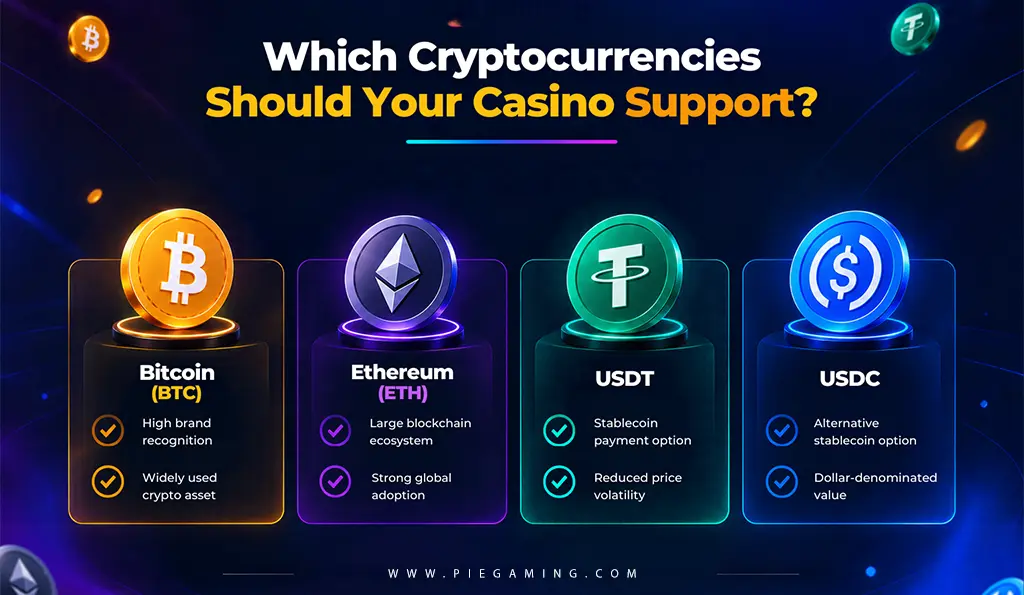
Cryptocurrencies for operators
Well, there is no defined list. Operators must select the cryptocurrency based on players’ demand, payment provider reliability, and regulatory considerations.
The most demanded cryptocurrencies include:
- Bitcoin (BTC)
- Ethereum (ETH)
- USDT
- Litecoin (LTC)
Step 6 — Integrate Casino Games
Online casino games are what attract players to your platform. But as a crypto operator, you must make a compelling game portfolio. Some game providers may not support cryptocurrency payments. Thus, you must connect with the providers who support crypto-focused games.
The table below highlights the popular crypto casino games and the providers that support crypto as a payment method.
| Top Crypto Casino Games |
| Blackjack |
| Plinko |
| Slot |
| American Blackjack |
| Blackjack VIP |
| Wild Spin |
| Top Crypto Game Providers |
| Evolution |
| Pragmatic Play |
| BetSoft |
| Booming |
| Platipus |
| BGaming |
| Belatra |
Step 7 — Configure KYC, AML & Risk Controls
To ensure that your crypto platform is secure, you must integrate tools like KYC, AML, and risk controls. Also include preventive measures like customer due diligence, record keeping, and suspicious transaction reporting.
A crypto casino should therefore consider:
- Identity verification
- Age verification
- AML screening
- Transaction monitoring
- Suspicious activity detection
- Multi-account detection
- Bonus abuse detection
- Responsible gambling monitoring
Moreover, risk control should operate alongside the PAM rather than being treated as a separate afterthought.
Step 8 — Test Before Launch
Once games, payments, and other tools are integrated into your platform, make sure players have a seamless experience. So, to build a great player experience, you must ensure that the payment journey and overall experience aren’t complicated for players.
What you need to focus on:
- Simple registration Easy deposit
- Seamless wallet management
- Simple withdrawal requests
- Mobile-first UX
- Localized content
- Responsible gambling tools
- Responsive customer support
Step 9 — Launch & Acquire Players
Finally, your platform is ready to go live. It’s important to launch your platform in the beta phase so that you can test whether everything is working fine. After that, you can focus on the player acquisition strategy around the target market.
Build your acquisition strategy around the following:
- Affiliate sites, forums, and communities
- SEO
- Social media platforms like Telegram
- CRM campaigns
- Promotional offers
- Paid advertising where permitted
Further, don’t just rely on acquisition. The platform should have tools for:
- Player segmentation
- Personalized promotions
- Loyalty programs
- VIP management
- Churn monitoring
Bonus: How to Check the Success of your Crypto Casino Platform?
To measure the success of your casino platform, the following are the metrics you must measure. This includes:
- First-time depositors
- Deposits
- Withdrawals
- GGR
- NGR
- Player retention
- Affiliate performance
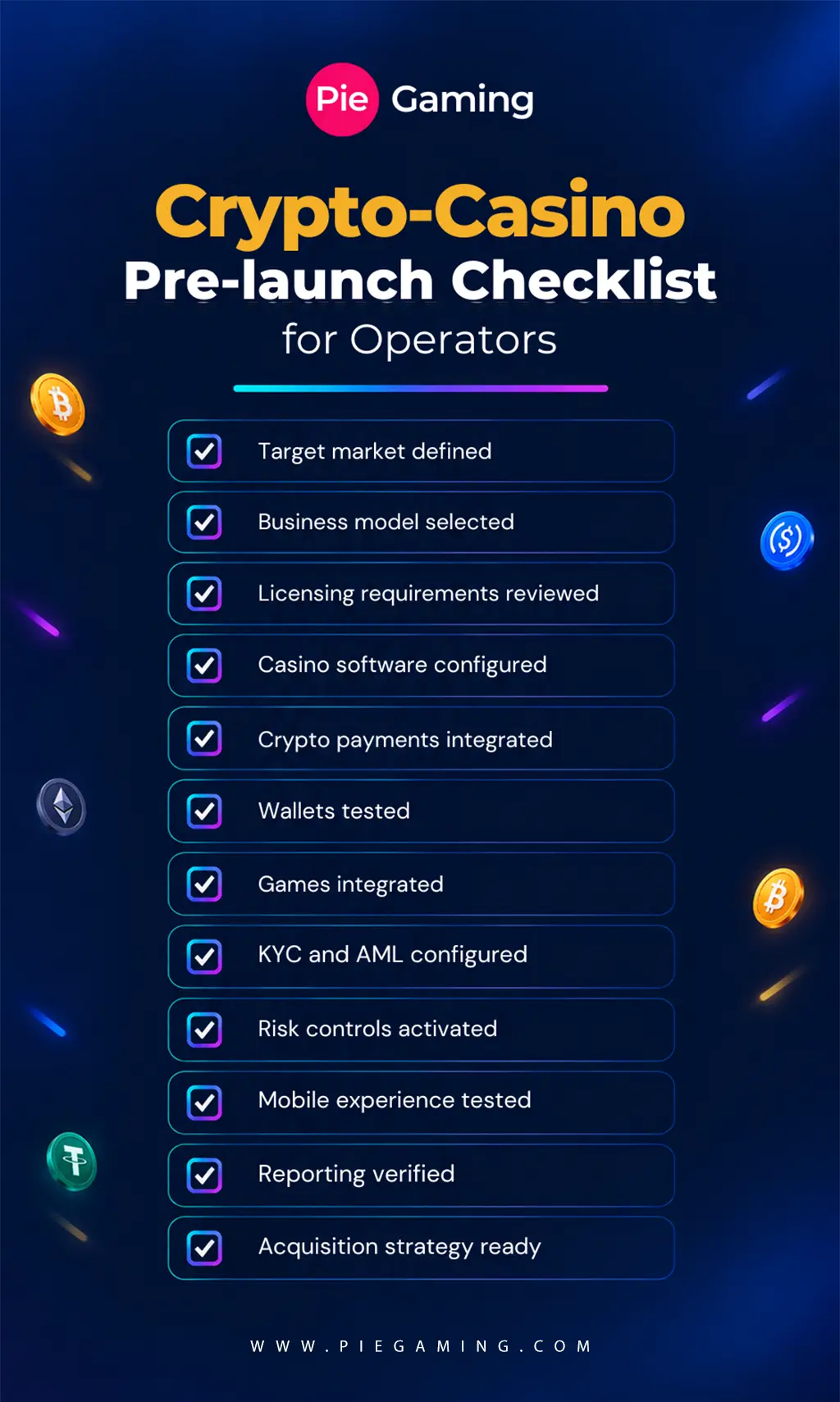
Crypto casino business checklist
How Much Does It Cost to Start a Crypto Casino?
There is no fixed price to launch a crypto casino. The price varies from operator to operator. It also depends on the type of license, business model, target market, third-party integration tools, game portfolio, and acquisition channels.
Take an estimated or rough idea of crypto casino cost from the table below:
| Cost category | White label | Turnkey | Custom |
| Platform setup fee | $15,000 – $40,000 | $40,000 – $100,000 | $300,000+ |
| License (1st year) | Included (sub-license) | Operators have to obtain. May cost around -$35,000 | $150,000+ (Malta) |
| Game integration | Included | Included (integration of specific games may cost between $5,000 – $15,000) | $50,000+ |
| Maintenance | $5,000 – $10,000/- | $10,000-$25000/- | $25000+ |
*Values are subject to change.
Launch Your Own Crypto Casino with PieGaming
Launching a crypto casino doesn’t necessarily require you to build a technology stack from scratch. PieGaming offers a ready-to-launch crypto casino platform designed for operators specifically. They offer support for cryptocurrencies, including Bitcoin, Ethereum, and USDT, along with casino games, crypto payments, and back-office management tools.
The platform comes pre-integrated with the following:
- 5000+ casino games
- Crypto payment support
- 100+ top game providers
- PAM and back office
- Affiliate management
- Bonus engine
- Multi-language support
Though operators have the options to choose from different deployment models, i.e., White label and turnkey. PieGaming states that its white label can be launched within 2 weeks while turnkey casino software is designed for greater customization which takes around 4 weeks to launch.
Conclusion
Starting a crypto casino is a great idea for operators as it ensures profitability for the operators. But this business demands expertise and solid preparation before tapping into the market. Remember the following points if you want to succeed in the crypto casino business:
- Crypto casinos require more expertise apart from just cryptocurrencies.
- Crypto casino operators should know how to market their brand to a target audience.
- Operators offering both fiat and cryptocurrencies yield more profit than those who just offer crypto.
Undoubtedly, crypto creates additional opportunities for casino operators. But it also introduces considerations around volatility, transaction monitoring, wallet management, and regulatory compliance. So, make sure to address these requirements before getting your first player.

Contact Us
FAQs
-
How do I start a crypto casino?
You can start by defining your target market and business model. Then select an appropriate license, launch model, and software provider. You will also need crypto payments, wallet infrastructure, games, KYC/AML, risk controls, player management tools, and a tested strategy.
-
What do I need to start a crypto casino as an operator?
To start, you need a proper legal structure and license, casino software, payment, games, player management, risk management, customer support, etc. However, the exact requirements depend on the target market and operating model.
-
What software and infrastructure are required to start a crypto casino?
A typical platform includes PAM, back office, CMS, CRM, bonus management, game integration, affiliate management, crypto wallet, risk controls and reporting. Operators may use a white label, turnkey, custom, or hybrid technology model.
-
What license do I need to start a crypto casino?
Well, there is no single license that applies to every crypto casino. However, the appropriate license depends on the operator's target market, audience, gambling product, and local regulatory requirements. For instance, businesses operating in the UK require a UK Gambling Commission license.
-
How long does it take to launch a crypto casino?
The timeline depends on the launch model, licensing process, platform customization, integrations, and compliance requirements. A ready-made white label solution can be configured faster than a custom platform.

Monika Gola is an iGaming content specialist at PieGaming. Since 2020, she has been researching and developing content around software selection, online casino & sports betting regulations, and operator growth strategies. Her research includes analyzing market opportunities in regions like Europe, Africa, and Southeast Asia, as well as evaluating regulatory frameworks and entry barriers. She is actively monitoring industry trends, compliance updates, and evolving player demands across global iGaming markets to help operators navigate this industry seamlessly.

Telegram casinos are a new gaming channel where users access casino games directly via Telegram bots or mini app-driven channels. This guide explains how Telegram casinos work, including how they are built, their key features, why they function, and why many companies want to explore this growing platform.

Choosing the right Bitcoin casino software provider is crucial for building a secure, scalable, and profitable online casino business. Here’s a quick look at the top providers and how to pick the right one.

Bitcoin casinos are online casinos that feature slots, blackjack, roulette, and live casino games and accept bitcoin payments. This guide explains how Bitcoin casinos operate, their advantages and disadvantages, payment methods, security measures, licensing requirements, and the steps required to launch a crypto casino in 2026.

Crypto iGaming solutions are transforming online gambling with blockchain powered payments, faster transactions, and greater transparency. As cryptocurrencies continue to evolve, new trends are shaping how players engage with digital gaming platforms.

Crypto casinos accept cryptocurrency for deposits, withdrawals, and gambling, whereas traditional casinos accept cash, credit cards, or bank payments. Crypto casinos have gained popularity due to their numerous benefits, including their global accessibility, higher level of privacy, and quicker transactions. However, traditional casinos have continued to attract classical players with stricter policies, credibility, and personal interaction with a physical game.

The top 10 crypto casino software providers in 2026 are PieGaming, SoftGamings, Digient, Slotegrator, NuxGame, GR8 Tech, TRUEiGTECH, Tecpinion, BetConstruct, and KodeDice. Each is ranked across six factors including crypto payments, game depth, compliance, and deployment speed.

Bitcoin’s speed, privacy, and security are some of the reasons why Bitcoin is becoming a popular payment method in online gambling. The purpose of this guide is to reveal the major pros and cons of using Bitcoin for online betting, helping both operators and players decide whether crypto is the right choice for their gaming transactions.

See you in your inbox soon!

Stay ahead of the game. Subscribe for exclusive content, updates, and insiders!

