
Choosing between a land-based vs. online casino business model is the primary decision that any operator must make. Both options possess unique characteristics in terms of costs, profit, market reach, and other factors.

Starting a casino business involves a fundamental choice: building a digital operation or investing in a physical venue. The decision shapes your budget timeline, licensing, and player acquisition. It simply means that online casinos require less capital and launch faster but face heavy competition in the market.
Whereas land-based casinos require major upfront cost but provide physical experience, hospitality and local market presence.
This article will provide additional information on the key differences between the two options. The analysis will focus on the business model’s impact on costs, profit, technology, regulation, and other factors relevant to the operator.
Land-based vs. Online Casinos: Industry Growth
To understand land-based vs. online casinos, it’s important to understand market growth as well.
Global Online Casino Industry
The online casino industry has seen a major surge due to increasing legalization and people’s growing interest in mobile or web gaming. According to Grand View Research, the global online casino market was valued at USD 19.1 billion in 2024 and is projected to grow from USD 23.9 billion in 2026 to USD 38.0 billion by 2030, a CAGR of 12.2% from 2025 to 2030. Europe led the market with a 48.0% revenue share in 2024.
The market growth is driven by high penetration of smartphones and high-speed internet. Further, the UK online casino industry is the most regulated market in Europe. Also, the convenience of remote gambling combined with the availability of a wide variety of games like slots, poker, and roulette continues to attract a large number of players across the world.
Apart from this, online gambling companies are leveraging AI in the gaming industry to automate operations like customer service. From chatbots to predictive analytics , AI is enabling operators to deliver faster responses and build stronger relationships with players.
The North America online casino market is undergoing significant changes due to the increased popularity of internet gambling, particularly in the United States. In addition, regulatory supervision of responsible gaming and enhanced consumer protection impact the market, making North America a key region for international casino market development.
As online gambling gets legalized in many countries, major players like Betsson are strategically entering the newer market and solidifying their position in the already established market through celebrity endorsement and partnership.
Global Land-Based Casino Industry
Land-based casinos are evolving and becoming more important than ever. Despite the rapid expansion of online casinos, land-based casinos still dominate the global market.
Region-wise, the largest land-based casino market worldwide includes North America and Asia Pacific. Nevada casinos continue to dominate U.S. gambling revenue. In Asia, Macau and Singapore are key hubs. Europe also has major land-based casino centers like London and Monaco.
This reveals that the land-based casino industry is still large and established, with billions in annual revenue and significant employment.
Online vs. Land-Based Casinos: Quick Comparison
The table below highlights a quick comparison between land-based vs. Online casinos.
| Factors | Land-based casinos | Online casinos |
| Market Reach | Majorly serves customers within casino’s geographic area including residents and tourists. | Can serve players across different permitted jurisdictions. Expansion into new markets is easy and scalable. But each market needs its own license or lawful access.
|
| Launch time | The launch time to open a land-based casino is typically around 6 months. | The launch time to open an online casino is around 2-4 weeks with a white label casino solution. |
| Operating Hours | Can operate 24/7, but it requires staff and facilities to be available.
|
Typically, available 24/7, allowing players to access the platform anytime where online gambling is legal. |
| Revenue Streams | Can generate revenue from gaming alongside hotels, restaurants, entertainment events, and other hospitality services.
|
Generates revenue with gaming, and some operators add products like poker, bingo, sportsbook, and other digital verticals. |
| Player Experience | Offers a physical and social experience, including casino ambience, face-to-face service, entertainment, & hospitality.
|
Prioritize convenience and accessibility via desktop and mobile platforms. But it doesn’t replicate the full physical casino experience. |
| payment methods
|
Commonly supports cash, cards, with physical payout available at the property. | Requires integration with approved digital payment methods and processes for deposits, withdrawals, verification, and transaction monitoring.
|
| Player Retention
|
Uses loyalty clubs, VIP hosts, complimentary offers, and personalized in-person services. | Uses CRM, player segmentation, personalized promotions, loyalty programs, bonuses, and automated lifecycle campaigns. |
| Security & risks
|
Focuses on physical security, surveillance, cash management, fraud prevention and responsible gambling controls. | Requires cybersecurity, account security, fraud detection, KYC/AML controls, payment security and responsible gambling technology. |
Online Casino Business —Benefits and Challenges
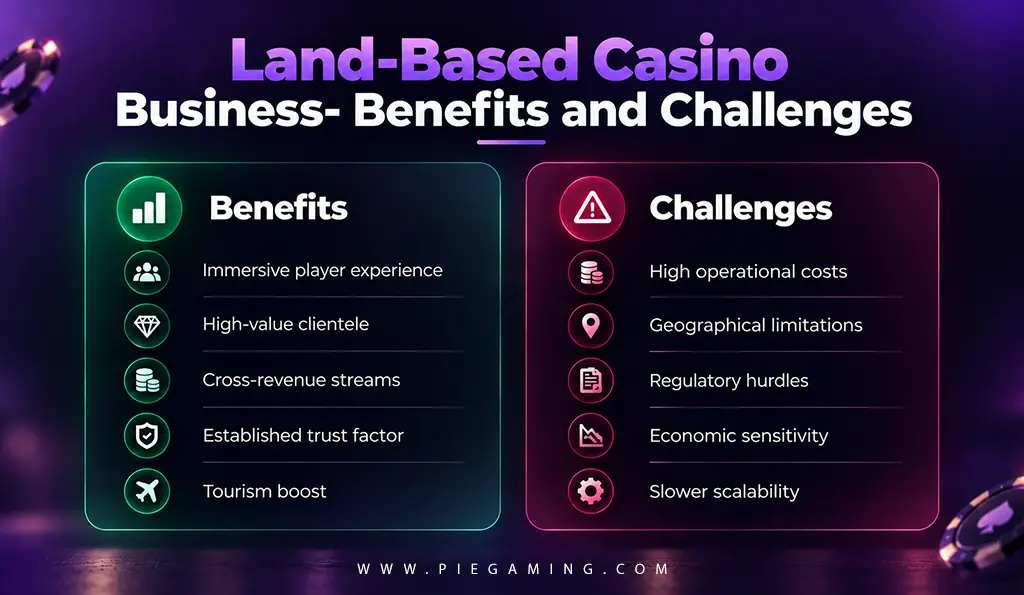
Land-based casino benefits and challenges
From high-tech games to complex regulations, the online casino business is a mix of promise and problems. Here’s a look at both sides.
Benefits:
1. Global reach
Online casinos can accept players from multiple countries, where they are legal and licensed without needing physical locations everywhere. You can tap into international markets and different time zones, giving you access to millions of potential players worldwide. This global presence means more players and higher revenue potential.
2. Lower operational costs
Running an online casino costs much less than a traditional one. You don’t need to pay for expensive real estate, large security teams, or hundreds of employees. Marketing and affiliates can cost you a lot, which is far cheaper than maintaining physical buildings.
3. Scalability
Your platform can handle more players without major additional costs. Adding new games or features is straightforward and does not require physical renovations or expansion.
4. 24/7 accessibility
Players can access your casino anytime, day or night, from their computers or phones. There are no closing hours or travel requirements. This constant availability means you are generating revenue around the clock, and players appreciate the convenience of playing whenever they want.
5. Data-driven marketing
You can track exactly how players behave on your platform—which games they prefer, when they play the most, and what keeps them engaged. This data helps you make smart business decisions, improve your offerings, and target marketing efforts more effectively than traditional casinos ever could.
Challenges:
1. Regulatory complexity
Different countries have different gambling rules, and they keep changing. Getting the right permits costs a lot of money. You need lawyers to help you understand what’s allowed where. What works in one place might be totally illegal somewhere else.
2. Cybersecurity risks
Hackers love targeting online casinos because money is involved there. You need strong iGaming risk management to protect player funds and personal information. One successful attack can ruin your business overnight. Keeping everything safe costs money and requires constant attention from tech experts.
3. High competition
There are tons of online casinos out there, and new ones pop up all the time. Everyone’s fighting for the same players with bigger online casino bonuses and promotions and flashier websites. You have to spend a lot on advertising just to get noticed. Many casinos struggle to make money.
4. Dependence on technology
When your website goes down, you stop making money instantly. Everything depends on computers working properly – games, payments, and security. You need backup systems and tech people ready to fix problems 24/7. Even small technical issues can upset players and hurt your reputation.
5. Player trust
People worry about whether online casinos are fair and if they’ll actually get paid when they win. Building trust takes years, but one bad experience can destroy it quickly. You need to prove that you’re honest through good customer service and fast payouts.
Online Casino vs. Land-Based Casino: Cost Comparison
The below highlights the major cost differences an operator can expect in online vs land-based casinos.
| Cost Category | Land-based Casinos | Online Casinos |
| Initial setup | Very high as it includes land purchase, construction, gaming equipment, and interior furnishing. | Relatively low as it includes software development, IT infrastructure, platform setup, and licensing costs. |
| Property/ infrastructure | Land/building costs, plus ongoing cost for rent, utilities and facility maintenance. | Costs are for server infrastructure, and hosting. |
| Gaming content | Physical slot machines and table must be purchased/ leased. | Digital game licenses from software providers. costs are per-game fees or revenue share with suppliers. |
| Licensing & regulatory costs technology & software | Casino gaming license plus any entertainment permits. | Online gaming license plus compliance cost. |
| Marketing & acquisition | Local marketing like billboards, events, travel partnerships, and tourism promotions. | Affiliate marketing for acquisition and re-engagement. |
| Expansion | Building new venues or gaming floors is very expensive. | Expanding online means getting new licenses or simply scaling networks. |
Based on the table above, it has been analyzed that land-based casinos require far more capital. So, in practice, launching an online casino may require only a few hundred thousand dollars for software and compliance. Whereas building a land-based casino can cost you around tens or even hundreds of millions.
Land-Based vs Online Casino: Which Model Is More Profitable?
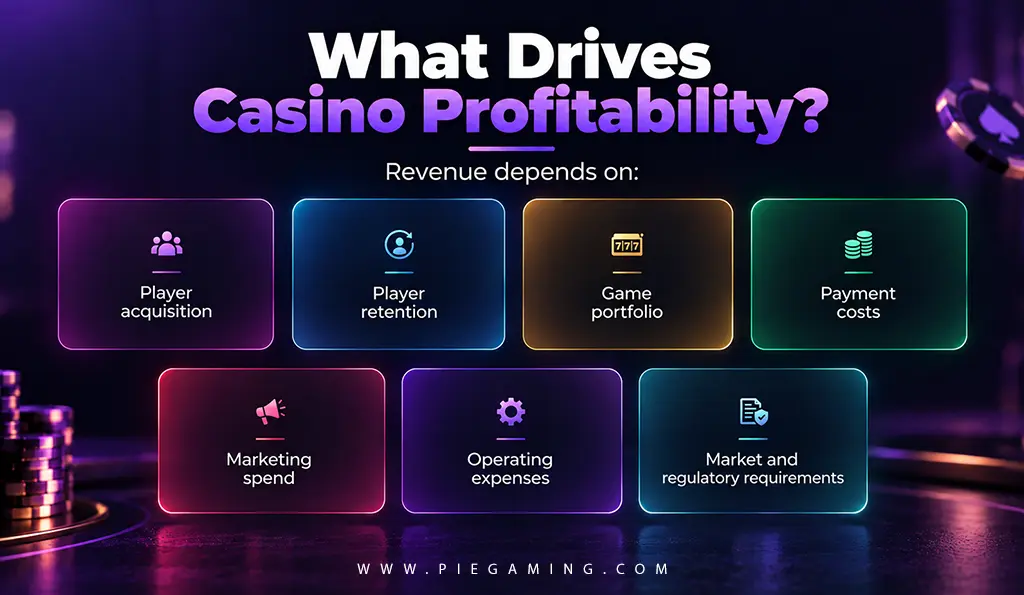
Revenue factors of casino platform
Well, there is no clear-cut answer as it depends on many factors. However, the online model has advantages in terms of potential margins, provided that it is developed properly. Since the online casino has significantly lower overheads, a decent number of players is sufficient for it to be profitable.
In the case of traditional casinos, they require a huge visitor to reach the desired profit level. Further, to offset the costs of maintaining a gaming hall, luxury casinos add other services: accommodation, catering, entertainment, and so on. It is important to understand that these are all additional costs, which can be a problem if, for example, tourists cannot afford to stay in the hotel.
At the same time, the online casino is more vulnerable in terms of costs: marketing costs can be very high. Additionally, the online business model is more dependent on legal issues: third-party platforms can block access to the company’s resources at any time.
So, it should be said that both business models are attractive, but each has its advantages.
Can Land-Based and Online Casinos Work Together?
Operators who want to go beyond traditional vs. online casinos can choose a hybrid or omnichannel casino model. The online and land-based casinos can complement each other. For example, loyal visitors to the online portal can receive more rewards when they first visit the traditional casino. Moreover, some of the largest gambling companies have realized the importance of the hybrid system.
Thus, Wynn Resorts owns both the WynnBET online platform and the Wynn Las Vegas and Encore traditional casinos. Similar strategies can be seen in the work of Flutter Entertainment (PokerStars, Betfair), and Entain (Ladbrokes/Coral).
Such a business model allows you to maximize profits by expanding the customer base. First, you can advertise the traditional casino on the online platform and vice versa. Second, you can provide discounts and special bonuses to those who manage to visit both channels at once. Thus, a hybrid system allows you to expand the possibilities of both online and traditional casinos.
Conclusion
Deciding between online vs. Land-based casinos completely depends on the operator’s business requirements and target audience. Simply put, with land-based ones appealing more to the local population and are able to take a bigger bite of the local economy. On the one hand, an online-only approach enables greater penetration of the market. Besides, it allows for higher growth rates.
However, at the same time, note that the online gambling market experiences a lot of competition. The choice, as per the user, depends on the available capital and speed of entry. Attracting a younger audience is better for an online concept, while a land-based solution better caters to the needs of tourists and the clientele of high-net-worth individuals.
For most new operators today, online has the lower barrier to entry. Nevertheless, the right license, a reliable platform, and payment setup, as well as a realistic marketing budget, are still required for success. The right technology partner, such as PieGaming, can help you launch faster and avoid the setup costs and errors of inexperience.

Contact Us
FAQs
-
Land-based casino vs online casino — which is easier to start?
Generally, an online casino is easier and faster to start. Online operators require support, as well as live dealer studios if they offer live games. In addition, they need a platform, game content, payment integrations, KYC/AML, and responsible gambling tools. Land-based casinos require site acquisition, construction, and regulatory approval for a physical venue.
-
Which have lower entry costs — land based or online casino?
Online casinos come with lower entry costs. A basic online casino platform can be launched for 15,000 dollars or more, depending on scale. On the contrary, land-based casinos require tens or hundreds of millions in real estate, construction, machines, and interiors. That's why many new operators start with online casinos before opening a brick-and-mortar store.
-
How much do licenses cost for land-based vs online?
Licensing costs vary depending on jurisdiction. Land-based casinos often involve multi-dollar fees plus hefty annual charges. Online gaming licenses are typically cheaper.
-
How do I get licensed to operate legally?
You must apply to the gaming regulator in each targeted jurisdiction. The process usually involves showing corporate documents, financial documents, RNG certification, responsible gaming measures, etc. Consulting with a specialized gaming team is highly recommended.
-
What are common startup challenges for new online casino operators?
Key challenges include acquiring players, building trust, content selection, managing liquidity, ensuring responsible gaming, etc. Overcoming these challenges requires careful planning, a solid technology partner, and adequate capital.


Monika Gola is an iGaming content specialist at PieGaming. Since 2020, she has been researching and developing content around software selection, online casino & sports betting regulations, and operator growth strategies. Her research includes analyzing market opportunities in regions like Europe, Africa, and Southeast Asia, as well as evaluating regulatory frameworks and entry barriers. She is actively monitoring industry trends, compliance updates, and evolving player demands across global iGaming markets to help operators navigate this industry seamlessly.

What are prediction markets, and why is everyone in iGaming suddenly talking about them? The answer may be just one number: $44.8 billion….

Policies, tools, and practices that address gambling harm by keeping betting safe, controlled, and strictly for entertainment are called responsible gambling. Stakeholders such as regulators, operators, and players collectively set the financial boundaries, provide self-exclusion options, and verify the right age for gambling.

This blog walks you through the top eSports games, most played and watched by the audience. Stay tuned to find out about the best eSports betting games available worldwide.
This blog covers everything from success keys to case studies of successful Asian iGaming operators to help start your dream business.
This blog is a comprehensive guide on key success strategies for European iGaming Operators. Read on to build your iGaming empire in the European market.
Explore top iGaming events 2025 in this blog. Learn why you need to be part of gambling conferences and what you can learn from them.
Find out why SiGMA Asia 2025 is a must-visit event for iGaming operators, startups, and investors. See what’s happening, who’s coming, and how it can help grow your iGaming business in Manila.







See you in your inbox soon!

Stay ahead of the game. Subscribe for exclusive content, updates, and insiders!