
Argentina’s growing iGaming market offers strong opportunities. Operators must navigate provincial licensing, local regulations, payments, and taxation to successfully launch and start an online casino platform in Argentina

Starting an online casino in Argentina is like running 24 businesses at once. Each province sets its gambling rules, which means operators have to deal with multiple licensing systems and compliance requirements across the country.
That said, Argentina’s iGaming market is on track to reach $1.57 billion by 2025, growing at over 9% annually, which makes it one of the fastest-growing markets in Latin America.
Yes, the fragmented regulatory landscape adds some complexity. But for operators willing to put in the work, it also opens the door to a market that’s still wide open compared to more saturated regions.
This guide covers everything about how to start an online casino in Argentina, from securing an iGaming license and setup to costs and marketing strategies. We have done the legwork, so you don’t have to.
Argentina’s Online Gambling Market Overview
Argentina is fast becoming one of Latin America’s most exciting iGaming markets for operators planning to start an online casino in Argentina. It attracts both local operators and international casino brands alike.
The numbers tell a compelling story. The online gambling sector is projected to exceed $1.5 billion in revenues by end-2025, with around 4.6 million active online gamers already playing across licensed online casinos in Argentina. As more players move away from land-based casinos toward digital platforms, that figure is only going to climb.
The increasing internet penetration implies that the infrastructure to enable a successful online casino market is already in place. The audiences are not only connected, but they are also comfortable with digital transactions and more than ever willing to play online.
Sports betting leads the way, driven by Argentina’s deep-rooted football culture. However, online casino games such as slots, roulette, and live dealer games are taking a serious run. By 2026, it is predicted that casino verticals will contribute over half of the total increase in revenues in the industry.
The average player is a mobile-first younger adult who resides in an urban center such as Buenos Aires or Córdoba. Smartphones account for more than 70% of all action, and this means that mobile optimization is not a nice-to-have but rather a prerequisite to any operator that is going to venture into this market.
What’s fueling all of this? The set of regulatory developments in major provinces, the increasing popularity of mobile usage, the expansion of digital payment methods, and the growing popularity of crypto-friendly environments. Combine the high population of Argentina and its cultural interest in betting, and one can easily understand why this market is the most promising iGaming opportunity in Latin America at the moment.
Is Online Gambling Legal in Argentina?
For operators researching how to get casino licenses in Argentina, understanding the country’s decentralized regulatory structure is essential.
Online gambling in Argentina exists in a legally complex but workable space. No federal law controls the online activities, and therefore, the power to regulate gambling is put squarely on each of the 24 jurisdictions of the country, which are 23 provinces and 1 city, Buenos Aires.
This implies that the legal landscape differs greatly depending on the location of the operation. Provinces such as Buenos Aires City (via LOTBA), Cordoba, Mendoza, RN and most recently San Juan have proceeded with licensing frameworks of online platforms. Other countries have been less prolific, with some even banning or just postponing regulations.
For operators, this creates a clear split. The ones who receive legitimate provincial licenses receive legal protection, can use the local banking systems, and can advertise within their compliance requirements. They are required to fulfill the standards concerning RNG certification, player protection, and tax concerns and advertising restrictions, though they have a strong legal framework.
Unregulated offshore operators, though, have a more difficult time. They may have their domains and IP addresses blocked by ENACOM, the communication regulator in Argentina, unless it is locally approved. Without a known license, player trust becomes even more difficult to establish even in cases where access via gray channels is technically possible.
The implications of working without a license are quite severe. Fines in millions of pesos, the freezing of assets, and the loss of a license are included in the list of penalties. Criminal Code Section 301 bis provides the operator of a fraudulent transaction or money laundering with three to six years of imprisonment.
International operators looking to enter the Argentine market in 2026 have a clear path forward. The first step is securing the necessary provincial licenses. From there, consider partnering with local Argentine companies where regulations require it, as Cordoba for example mandates at least 15 percent local ownership.
Alternatively, operating under a compliant white label arrangement is another viable route into the market. The crackdown is intensifying, with Buenos Aires alone already halting over 72 rogue websites, rendering compliance with them less of a choice than it has ever been.
Read Blog – Explore where online casinos are legal?
Federal vs. Provincial Gambling Laws
Argentina’s gambling authority flows from the top down, but it stops well short of the federal level when it comes to online operations. The national government, through the Agencia de Recaudación y Control de Loterías (ARJL), limits its role in overseeing land-based bingo halls and lotteries.
What this means in practice is that each province writes its own rulebook. Understanding provincial gambling regulation in Argentina is essential before starting an online casino in Argentina.
Tax structures, ownership requirements, certification standards, and licensing timelines all differ depending on where you operate.
Across the country, roughly nine provinces actively regulate online gambling, around ten restrict operations to land-based venues only, and the rest remain in gray zones with little formal framework in place.
ENACOM, the federal communications regulator, can block unlicensed domains and IP addresses but has no power to issue licenses. That authority stays with the provinces, which is why multi-province licensing is the only real path to national reach.
Online Gambling Regulation by Province in Argentina
The table below provides a province-by-province overview of the current regulatory status, the governing body in each region, and the key conditions operators need to be aware of before entering a specific market.
| Province / City | Regulator | Online Gambling Status | Key Requirements / Notes |
| Buenos Aires City | LOTBA | Fully regulated (sports + casino) | 15% GGR tax + VAT; IP blocks |
| Buenos Aires Province | IPLyC | Sports only; casino pending | Strict ad rules; local partnership |
| Córdoba | Lotería de Córdoba | Fully regulated | 15% local equity; RNG mandatory |
| Mendoza | Instituto Provincial de Juegos | Fully regulated | Progressive tax (up to 20%) |
| Río Negro | Lotería de Río Negro | Fully regulated | Focus on slots/sports |
| San Juan | Instituto de Juegos | Newly regulated (Dec 2024) | Comprehensive framework |
| Tucumán | Lotería de Tucumán | Sports only | Expanding to a casino in 2026 |
| Entre Ríos | Instituto de Juegos | Land-based only | Online gray zone |
| Santa Fe | Lotería de Santa Fe | Restricted | Blocks offshore |
| Salta | Instituto Provincial de Juegos | Sports betting regulated | Emerging casino rules |
| Chaco | Lotería del Chaco | Unregulated | High enforcement risk |
| Misiones | Instituto de Juegos | Sports only (limited) | Local ops are preferred |
| Neuquén | Lotería de Neuquén | Land-based dominant | Online pilot in testing |
| La Pampa | Lotería de La Pampa | Restricted | Offshore blocked |
| Tierra del Fuego | Instituto Provincial | Unregulated | Prohibited |
Disclaimer: This information has been taken from publicly cited sources and may change over time.
Approximately 80 percent of the total countrywide gross gaming revenue comes in six regulated provinces, and thus these are the natural place to start for any operator wishing to enter the market in an efficient way. The acquisition of licenses in these jurisdictions will provide you with the best possible base to be in before moving to the emerging or developing markets further down the road.
| Important Thing to Remember
Buenos Aires City, Córdoba, Mendoza, and Río Negro are the four provinces where online casinos are fully legal and properly regulated as of 2026. Together they account for the vast majority of iGaming activity across the country. For any operator serious about entering the Argentine market, these four are the natural starting point. |
Step-by-Step Roadmap to Open an Online Casino in Argentina
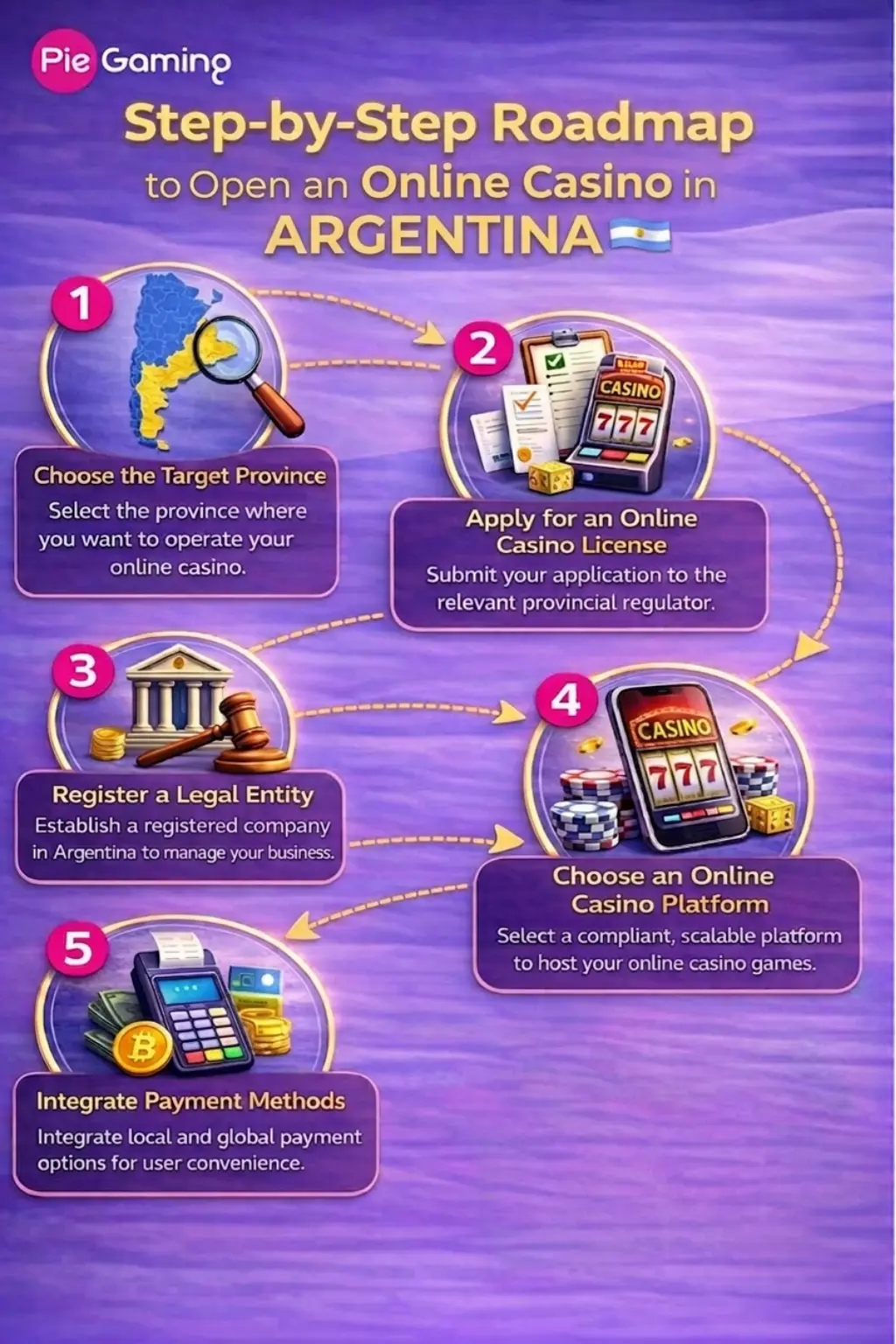
Easy steps to launch a casino in Argentina
Starting an online casino in Argentina involves more steps than most expect. Here’s a clear roadmap to help you move through the process without missing anything critical.
1. Choose the Target Province
This decision plays a major role in how you start an online casino in Argentina and expand later. Since each of Argentina’s 24 jurisdictions sets its own rules, taxes, and licensing requirements, where you launch shapes everything that follows.
The most popular options are Buenos Aires City and Buenos Aires Province. They collectively constitute approximately 40 percent of the total population of Argentina, which is 46 million, and this offers operators the biggest base of players and highest gross gaming revenue potential in Argentina. They both have developed regulatory frameworks, which, even though challenging, provide a clear and well-founded way to the market.
Cordoba and Mendoza are also worth serious consideration, especially to operators who need a robust growth opportunity with a slight bit more competition. Gambling already surpasses tourism as a source of tax revenue in these provinces, and both are drawing a significant portion of the 4.6 million active online gamers who are expected in 2025.
By making this decision properly at the beginning, you are already in the best position possible in a market that is already estimated to grow to over $1.5 billion in online revenues by end-2025.
2. Apply for an Argentine Online Casino License
Once you’ve chosen your target province, the next step is applying for a license through the relevant provincial regulator. In Argentina, there is no national gambling license and therefore, which authority you will apply to depends solely on where you will be operating. That is LOTBA of Buenos Aires City, IPLyC of Buenos Aires Province, Loteraria de Córdoba of Cordoba, etc.
The application itself is comprehensive. The regulators will demand a comprehensive business plan, full disclosure of the ownership of the company; financial documentation; technical documentation of your gaming platform, such as RNG certification; and proof of secure payment systems and protection against negative impacts on the players.
Foreign operators must also know that in certain provinces a partnership with a locally licensed firm is a requirement. An example is Córdoba, which requires approximately 15% domestic equity, and which is something to consider with your corporate structure at the outset.
After obtaining your license, you are allowed to serve players in that jurisdiction. To achieve this nationally, you will have to do the same in several other provinces, but your initial license approval is the basis on which all the others are built upon.
3. Register a Legal Entity
Setting up a company structure is one of the first requirements when starting an online casino in Argentina. Most provincial regulators won’t process an application without one, as it ensures your operation falls under Argentine corporate law, local taxation rules, and regulatory oversight from day one.
Foreign operators typically register either a Sociedad Anónima (S.A.) or a Sociedad de Responsabilidad Limitada (S.R.L.), both of which are widely used by gambling companies operating in the country. Registration is handled through the Inspección General de Justicia (IGJ) in Buenos Aires, or the equivalent corporate registry in whichever province you’re setting up in.
You’ll also need to appoint local directors or legal representatives who can collaborate with regulators and government authorities on your behalf. This isn’t just a formality. Having the right people in place locally can make a real difference when it comes to navigating the application process and building relationships with provincial bodies.
Getting your legal entity set up properly also makes the practical side of running the business significantly smoother. It opens the door to local banking relationships, makes it easier to integrate regional payment systems, and puts you in a much stronger position when it comes to meeting the compliance requirements tied to your provincial license.
4. Choose an Online Casino Platform
Everything runs through your platform, and it is important to make this decision correctly. The platform that you pick must go beyond the provincial gambling regulations in Argentina.
The majority of operators joining the market will use turnkey or white-label casino software provided by established vendors, which already contains compliance and security requirements. This will save time, and the possibility of getting into technical snags during the licensing process is minimized.
At the center, your platform should have a player account management system, integration of game aggregation and payment gateway as well as fraud prevention tools. In addition to the technical fundamentals, it must also have to accommodate Spanish-language interfaces, mobile compatibility, and localized payments. Considering that in Argentina more than 70 percent of players use the services of casinos through smartphones, mobile performance is not an area that you want to be cutting corners on.
The choice of the game is also significant. Online slots, roulette, blackjack, and live dealer titles are the favorite games of Argentine players, so your platform must be able to connect with reputable game providers who handle these games adequately.
Lastly, consider your future in 3 or 5 years. The decision to use a scalable platform, which can be reinforced with new games, new payment options, and more marketing tools, will place you in a much better position as the market is only continuing to develop.
5. Integrate Payment Methods
Payment flexibility is one of the main competitive advantages for licensed online casinos in Argentina. Players in the country rely heavily on local payment solutions, so offering familiar and trusted options can significantly improve deposits, withdrawals, and overall user experience.
Many Argentine players prefer cash-based and local payment networks such as Rapipago and Pago Fácil, which allow users to deposit money through physical retail locations or digital vouchers. Digital wallets are also widely used, with Mercado Pago being one of the most popular payment platforms in the country.
Online casinos should also support bank transfers, debit cards, and international e-wallets to give players multiple deposit options. Fast and reliable withdrawal processing is particularly important, as players tend to favor platforms that offer smooth and transparent payout systems.
Due to Argentina’s economic volatility and currency fluctuations, cryptocurrency payments are becoming increasingly common. Some online casinos allow deposits through cryptocurrencies such as Bitcoin or stablecoins to provide players with additional financial flexibility.
6. Compliance & Responsible Gambling
Getting licensed is one thing. Staying licensed is another. Argentina’s provincial regulators take compliance seriously, and operators need robust systems in place before they go live, not after.
Each licensing authority, whether that’s LOTBA in Buenos Aires City or IPLyC in Buenos Aires Province, requires operators to demonstrate genuine commitment to player protection, financial transparency, and fair gaming. These aren’t box-ticking exercises. They’re conditions of your license.
KYC verification sits at the heart of your compliance setup. Before any player can place a bet or withdraw winnings, you need to verify their identity, age, and location. That means collecting and checking national ID documents, proof of address, and payment information. This process protects against underage gambling and identity fraud, both of which regulators watch closely.
AML monitoring is equally non-negotiable. You’ll need systems in place to track transactions, flag suspicious activity, and report unusual financial behavior to the relevant authorities. The expectation is that your platform actively works to prevent illegal financial activity, not simply react to it when it’s flagged externally.
Read Blog – Checkout how to choose the right software
Cost to Start an Online Casino in Argentina
Opening an online casino in Argentina is a significant financial commitment. Between licensing fees, compliance requirements, platform costs, and ongoing operations, total startup expenses for a single province typically fall somewhere between $2 million and $5 million.
Going multi-province adds to that considerably, which is why most operators start with one or two jurisdictions and expand from there.
Since there is no national license, every province requires its own application and approval process. Fees vary widely depending on the jurisdiction.
Buenos Aires City is among the most demanding, requiring a $30,000 application fee, a $100,000 annual license fee, and a $2 million compliance guarantee. Buenos Aires Province charges around $500,000 for a 15-year license. Mendoza sits at approximately $400,000, while Córdoba ranges between $350,000 and $450,000 depending on the structure of your application. Across most top-tier provinces, you should also plan for minimum capital requirements of around $1 million.
Foreign operators face additional considerations, including the need for local partners in some jurisdictions and background checks that can extend approval timelines to anywhere between nine and twelve months.
Licensing Fees and Terms by Province in Argentina
The table below outlines the key financial requirements for each regulated province, including application and annual fees, compliance bond expectations, and the duration of each licence.
| Province | License Fee (USD) | Compliance Bond | Term |
| Buenos Aires City | $30K app + $100K annual | $2 million | 15 Years |
| Buenos Aires Province | $500,000 | Millions possible | 15 years |
| Mendoza | $400,000 | Varies | 10 years |
| Córdoba | $350K–$450K | Varies | 15 years |
Platform costs depend heavily on the route you take. A white-label solution typically runs between $15,000 and $80,000, while a fully custom build can reach $400,000 or more.
Payment integration, web hosting, and game certification through recognized labs like GLI add between $1,000 and $70,000 upfront, with ongoing fees beyond that. Marketing and staffing require at least $50,000 to get off the ground, and annual operational costs, including servers and salaries, push the total higher over time.
Disclaimer: These figures have been taken from publicly cited sources and may vary over time.
Taxes for Online Casinos in Argentina
Argentina operates a dual tax structure for online casinos, meaning operators deal with both federal-level taxes and province-specific gross gaming revenue taxes on top of that. The rates vary significantly depending on where you’re licensed, so understanding the full picture before you launch is essential.
Federal Taxes
At the national level, the primary obligation is an indirect tax on online betting, set at a standard rate of 5% on stakes. Operators who meet certain investment and employment thresholds, specifically a minimum investment of €1.6 million and a workforce of at least 20 staff, can qualify for a reduced rate of 2.5%.
This framework was updated through ARCA Resolution 5791/2025, and operators receive their specific perception rates from ARCA following a 60-day registration approval process.
Beyond the betting tax, operators also face 21% VAT on operations and corporate income tax ranging from 25% to 35%, with most iGaming firms landing at the 35% rate. Payments made to unlicensed foreign sites attract a much heavier burden of 30% tax plus an 8% card surcharge, which is another reason why operating through a properly licensed local entity makes financial sense.
Provincial GGR Taxes
Each province sets its own gross gaming revenue tax independently. Buenos Aires City charges 10% through LOTBA. Buenos Aires Province applies a much higher rate of 25% through IPLyC. Mendoza takes a different approach, taxing 6% on bets plus a 10% licensing fee.
Córdoba sits at around 10%. Across other provinces, rates generally range from 2.5% to 15%, though some go higher, and many layer turnover taxes of around 15% on top of federal obligations.
Tax payments are made as quarterly advances with annual reconciliations, and the revenue generated funds local public services across each jurisdiction.
Tax Structure at a Glance
The table below breaks down the key taxes operators should expect, including the applicable rates, the type of tax, and the authority responsible for enforcement.
| Level | Tax Type | Rate | Authority |
| Federal | Indirect Tax on Betting | 5% on stakes (2.5% reduced) | ARCA (Res. 5791/2025) |
| Federal | VAT | 21% | National Revenue Service |
| Federal | Corporate Income | 25–35% (35% typical) | AFIP |
| Buenos Aires City | GGR | 10% | LOTBA |
| Buenos Aires Province | GGR | 25% | IPLyC |
| Mendoza | Bets + Licensing | 6% + 10% | IPJyC |
| Córdoba | GGR | ~10% | Provincial regulator |
Disclaimer: These figures have been taken from multiple sources and may vary overtime.
When you stack federal and provincial obligations together, the effective tax burden for most operators falls somewhere between 37% and 62% depending on the jurisdiction. It’s one of the heavier tax environments in Latin America, and it needs to be a central part of your financial planning from the very beginning.
Read Blog – Explore Best iGaming Payment Providers
Marketing Your Online Casino in Argentina
Launching in Argentina without a localized marketing strategy is like opening a shop and forgetting to put up a sign. The market is active, mobile-first, and deeply connected to sports culture, so your approach needs to reflect that from day one.
Local SEO and Spanish Content
Organic search is one of the most cost-effective ways to build a steady stream of players over time. Creating Spanish-language content optimized for how Argentine players actually search is the foundation of this. Think game guides, betting tutorials, casino reviews, and educational content around popular titles like slots, roulette, and football betting markets.
Targeting localized search terms like “casino online Argentina” or “apuestas deportivas en Argentina” puts you in front of players who are already looking for what you offer. Consistent, high-quality content also builds the kind of trust and authority that keeps your rankings strong over the long term.
Affiliate Partnerships
Affiliate marketing is one of the fastest ways to gain visibility in a new market. Argentina has a growing ecosystem of gambling review sites, sports blogs, and betting comparison platforms that already attract the audiences you want to reach.
These affiliates promote your brand through reviews, bonus comparisons, and referral links. In return, operators typically offer CPA deals or revenue share arrangements where affiliates earn a percentage of the revenue generated by the players they refer. For new operators without an established brand, a well-chosen affiliate network can compress the time it takes to build meaningful traffic significantly.
Social Media and Influencer Marketing
Younger Argentine players spend a significant amount of time on Instagram, YouTube, TikTok, and Twitch, and many follow gaming and sports content creators closely. Partnering with streamers and influencers who cover casino gameplay, slot sessions, or sports betting gives you direct access to engaged, relevant audiences.
Football-focused content tends to perform particularly well given how central the sport is to Argentine culture. The right influencer’s partnership doesn’t just drive traffic; it builds genuine credibility with players who trust the creators they follow.
Bonuses and Promotions
A competitive bonus structure is one of the most reliable tools for player acquisition and retention in Argentina. Welcome bonuses, deposit match offers, and free spins on popular slots consistently perform well with local players.
Beyond the initial welcome offer, cashback deals, reload bonuses, and VIP loyalty programs keep players engaged over time. Tying seasonal promotions to major football tournaments or matches involving Argentine clubs is also a proven way to spike activity at key moments throughout the year.
Getting the marketing mix right across all four of these channels gives you the best possible foundation for sustainable growth in one of Latin America’s most dynamic iGaming markets.
Read Blog – Grow Like Top iGaming Operators
What are the key challenges of operating in Argentina?
Argentina’s iGaming market has real opportunity, but it comes with challenges operators need to understand before diving in.
Province-Specific Regulations
Anyone researching how to start an online casino in Argentina should prepare for these operational challenges. Without a national license, you’re dealing with a different regulator and rulebook in every province you operate in. A license in one province doesn’t cover players in another, which means multiple applications, timelines, and compliance obligations running simultaneously. Some provinces also require foreign operators to partner with local firms before they can even apply.
Economic Instability
The Argentine peso has a well-documented history of inflation and exchange rate volatility. For operators managing finances in USD or EUR, currency swings can put real pressure on revenue forecasting and profit margins. Offering a range of payment options including digital wallets and alternative methods helps manage some of this exposure.
Complex Tax Structure
Federal and provincial tax obligations stack on top of each other in Argentina, combining corporate income tax, VAT, and GGR taxes that vary by jurisdiction. For new entrants still building their player base, this layered structure needs to be built into financial planning from day one.
Marketing Restrictions
Licensed operators can only advertise within provinces where they hold a valid license. All campaigns must also meet responsible gambling standards, meaning no targeting minors, no unrealistic winning claims, and no content that encourages excessive play. This pushes most operators toward SEO, affiliate marketing, and influencer partnerships as their primary acquisition channels.
Why Choose PieGaming for Starting an Online Casino in Argentina?
Building a compliant, competitive online casino in Argentina is a serious undertaking. Having the right technology partner behind you makes the process significantly more manageable.
Launch in Two Weeks
PieGaming’s platform comes pre-integrated with everything you need to go live fast, including a Player Account Management system, back-office system, and payment integrations. No lengthy development cycles. Operators can be up and running within two weeks.
5,000+ Games from Top Studios
Argentine players expect variety and quality. PieGaming connects operators to over 5,000 casino games across slots, roulette, blackjack, baccarat, poker, and live dealer titles, sourced from globally recognized studios including Evolution, Pragmatic Play, and PG Soft.
Flexible Payment Options
PieGaming supports both fiat and cryptocurrency transactions, including Bitcoin, Ethereum, and Litecoin, alongside localized payment integrations built for the Argentine market. Given the country’s currency volatility, that flexibility matters.
Compliance and Player Management Built In
The platform includes KYC verification, AML monitoring, payment tracking, and detailed player activity reporting, giving operators the tools to stay compliant without building everything from scratch.
Marketing and Affiliate Tools Included
Bonus engines, affiliate management systems, and loyalty program features come built into the platform, making it straightforward to run welcome bonuses, free spins, cashback campaigns, and VIP rewards from day one.
Built to Scale
PieGaming supports multi-language and multi-currency functionality, meaning operators can expand beyond Argentina into broader Latin American and global markets without switching platforms. Security follows ISO 27001-aligned practices, ensuring data protection and operational safety at every stage.
Support When You Need It
Operators receive 24/7 technical support and dedicated account management, keeping the platform stable and the business moving as it grows.
With over ten years of industry experience and more than 150 clients worldwide, PieGaming offers a complete end-to-end solution for operators serious about building a sustainable, long-term casino business in Argentina and beyond.
Final Thoughts on How to Start an Online Casino in Argentina
Argentina’s iGaming market rewards operators who come prepared. The regulatory landscape is complex, but it’s navigable for those who take the time to understand it.
Focus on the right provinces, build a compliant operation from the ground up, and invest in a platform that can grow with you. The market is still developing, which means the operators who move strategically now are the ones who will be best positioned to capture the opportunities ahead.

FAQs
-
Is it legal to open an online casino in Argentina?
There is no single national law covering online casinos. Operating legally means obtaining a provincial license in a jurisdiction that actively regulates online gambling, such as Buenos Aires City or Córdoba. Without one, operating is illegal.
-
How much does an Argentina online casino license cost?
Costs vary significantly by province. Buenos Aires City, for example, charges around $30,000 as an application fee plus $100,000 annually, on top of compliance guarantees and GGR taxes in Argentina ranging from 10% to 25% depending on the jurisdiction.
-
Do I need a local partner to operate in Argentina?
In most provinces, yes. Buenos Aires Province and Córdoba both require foreign operators to work through a joint venture with a local partner holding at least 15% ownership.
-
Which provinces allow online gambling in Argentina?
As of 2026, 23 of Argentina's 24 jurisdictions regulate online gambling in some form, including Buenos Aires City, Buenos Aires Province, Córdoba, Mendoza, and Santa Fe. Santiago del Estero remains an exception.
-
How long does it take to get licensed in Argentina?
Timelines vary by province. The process in Córdoba, for example, involves a tender process with multiple review stages that can span several months from application to final approval.
-
Can foreign investors open an online casino in Argentina?
Yes, typically through a joint venture with a local partner holding at least 15% of the business, combined with provincial company registration and meeting financial and reputational requirements.
-
What do I need to run an online casino in Argentina?
A valid provincial license, a certified platform with RNG, AML, and KYC compliance, a local joint venture partner, servers based in Argentina, player funds held in local banks, and full adherence to responsible gambling standards and tax obligations.


Palak Madan is a enthusiastic writer at PieGaming. With over 2+years of experience crafting engaging content and a strong literature background, Palak brings a unique perspective to the world of words. Her ability to blend creativity with strategic thinking has made her a sought-after content creator. She's eager to dive deep into the intricacies of iGaming software, uncovering the stories behind the technology and translating complex features into compelling narratives.
-

What is a mobile casino, and why is it growing at this pace? A mobile casino allows users to play real-money games on smartphones anytime, anywhere. Powered by advanced mobile casino software, it offers smooth gameplay, secure transactions, and instant access. Discover how mobile casinos function and why they lead the iGaming space.
-

Can you really win slots? Not always but playing smart makes a bigger difference than most people think. This guide covers top 10 slot game strategies to maximize your winning potential.
-

This guide covers the best white label casino solution provider. Learn about the top providers, features, and common mistakes to avoid.
-

This guide covers casino cost development, with estimates varying from $15000 for white label solutions to $500,000+ for fully custom platforms. Choose the…
-

A sweepstakes casino is an online casino in which individuals play with Gold Coins (to have fun) and Sweepstakes Coins (to win real prizes), and is regulated by no-purchase-necessary promotional laws rather than gambling laws.
-
Kenya has a growing online gambling market supported by increasing internet adoption and mobile payment systems. This guide clarifies the steps and protocols you can follow for setting up an online casino business in Kenya, including regulations and licensing requirements.
-

This blog is your blueprint to scale online casino traffic from 1,000 to 100,000. Learn here how to increase users for online casinos significantly.
-

Telegram casinos are a new gaming channel where users access casino games directly via Telegram bots or mini app-driven channels. This guide explains how Telegram casinos work, including how they are built, their key features, why they function, and why many companies want to explore this growing platform.
-

Online casino business offers major benefits to operators such as affordability, global reach, expansion into new markets, lower overheads, and many more.
-
This blog delves into ‘how multi-lingual support is crucial for your online casino success?’ Learn here how you can dominate the international online casino market with multi-lingual support.
-

Starting an online casino sounds exciting. But many new operators fail within a few months due to evitable mistakes. Here are the top 10 mistakes you must steer clear of.
-

Learn how to start an online casino in Turkey in 2026. Get easy tips on laws, licenses, payments, and more to run your business smoothly.
-

Improving GGR and NGR is important for your online casino’s success. This guide shares easy strategies like giving out better bonuses, retaining players, and using data to grow your profits.
-

Online casino software is the comprehensive technical engine that powers everything from immersive game rendering and secure payment processing to player management and regulatory compliance.
-

Investors who want to start an online casino in Spain must comply with the rules and regulations imposed by the Spanish authorities. Let’s discuss the key steps for starting an online casino in Spain.
-

Turkey has some of the strictest gambling regulations in Europe, mainly limiting legal wagering to state-monopoly organizations like Milli Piyango and IDDAA. This blog covers the legal frameworks, severe penalties for unlicensed operators, and important information on online casino and sports betting regulations in Turkey.
-

The European online casino market size reached USD 40.5 billion in 2024. Moving ahead, IMARC Group predicts the market to reach USD 73.1 billion by 2033, with a CAGR of 6.6% during 2025-2033. Read here how you can open an online casino in Europe and be a part of this lucrative industry.
-

Online casino laws differ by country. Some places allow and regulate them, while others ban them. Knowing the rules helps players choose safe…
-

This guide highlights the top 10 global casino game development companies in 2026, helping operators and investors identify reliable partners for building scalable, compliant gaming platforms.
-

A complete guide to starting a crypto casino in 2026, covering licensing, software selection, crypto payment integration, game providers, and proven marketing strategies to launch and scale successfully.
-

Live dealer casinos play a key role in building player trust and engagement in iGaming. This guide looks at the top live dealer casino software providers in 2026, covering their technology, games, studio quality, compliance, and integrations.
-

Casino game aggregators are platforms that integrate games from multiple providers through one API, helping online casinos launch faster, reduce technical complexity, and offer a diverse, scalable game portfolio.
-

This write-up lists down the top 10 Turnkey Casino Software Providers in 2026. Read along to find the best provider for your iGaming business.
-

Choosing the right Bitcoin casino software provider is crucial for building a secure, scalable, and profitable online casino business. Here’s a quick look…
-
This write-up talks about the best online casinos supporting GCash in the Philippines—also, the gaming variety, bonuses, and customer support they provide.
-

A social casino is a type of online gaming in which players play a casino-style game using virtual coins. Their purpose is mainly entertainment, social interaction, and free play, not money wagering.
-

A casino game aggregator is a great choice for operators because it streamlines game management, offers diverse content from multiple providers, enhances player engagement, and maximizes revenue. Read ahead to learn more.
-

A Bitcoin casino enables players to gamble with cryptocurrency rather than traditional payment methods. This guide outlines the mechanics of Bitcoin casinos, their key features, and why many players and operators are turning to those platforms.
-

Online slot games exist in a variety of formats, from traditional three-reel slots to modern video slots bursting with features. It discusses the different kinds and functionality of online slots, so players (and operators) understand what differentiates each style.
-

Online casino KPIs are essential metrics that measure performance, player behavior, and revenue. This blog explains what KPIs are, and how to analyze them leading your online casino to success.
-

A curated list of the top online casino software providers in 2026, helping operators evaluate platforms based on scalability, compliance readiness, features, and long-term growth potential.
-

Casino affiliate programs are a way for online casinos to attract new players through performance-based partnerships. By using an affiliate program, they promote platforms and earn commission when referred players sign up or deposit, and can be used to profit from that loyalty, which in turn allows iGaming operators to grow in a way that maximizes their own income.
-

RTP, or Return to Player, is a key metric that shows the percentage of wagered money a casino game pays back to players over time. This guide explains how RTP works, why it matters, and how it influences player decisions and game selection.
-
Explore how a casino back office system enhances profits through effective management, data analysis, and operational efficiency, driving success in the gaming industry.
-

Real-time dealer experiences are offered online game playing live casino games. This guide delves into the major live casino software providers in the Philippines covering their technologies, studio quality, game offerings, and the area’s reputation as a live gaming industry hub.
-

Live dealer casinos recreate the experience of gaming in a real casino by streaming games with professional dealers in real time. Players will be able to join tables, interact with the dealers, place bets online, and have a good and genuine casino experience.
-
Want to start an online casino in Latin America? This guide breaks down iGaming in Latam, covering everything from laws to what players like. Learn how to jump into this growing market and make your mark.
-
A casino bonus engine offers casino operators the ability to automatically create, manage, and optimize promotional offers. Discovers how this powerful tool streamlines bonus management, personalizes player rewards, and improves retention while making casino promotions more efficient and data driven. It doesn’t have to be hard to launch an iGaming platform.
-

As a casino operator, you might have wondered several times if the games that you’re featuring are engaging enough in the current scenario….
-

Sweepstakes casinos are becoming popular as an alternative online gaming model. This guide explores top sweepstakes casinos, how this model works, and why it appeals to players looking for legal, engaging gaming experiences without traditional real-money wagering.
-

iGaming in Brazil is one of the hottest discussions in the iGaming town right now! What has changed in Brazil’s betting dynamics? How are new entrants moving in smoothly? Let’s find out.
-

Gaming platforms use online casino game providers to create slots, table games, and live dealer experiences that drive today’s gaming platforms. This guide discusses some of the best casino game providers and what operators and players find popular in their content.
-

Dive into the world of iGaming incentives. Explore definitions and types of top online casino bonuses and promotions. Learn about the best practices for implementing these rewards to boost your player engagement.
-

Discover the top advantages of turnkey online casino software to start your online casino business in a jiffy. It is a popular and scalable software.
-

Launch your online casino effortlessly. Discover the features of a turnkey casino software solution, from great games to secure payments and easy management.
-

Randomness is the foundation of iGaming. It is a cornerstone of the game’s outcome. In a traditional land-based casino, iGaming is sheer luck….
-

When it comes to the fiercely competitive world of online gambling, choosing the right white label online casino software means the difference between…
-

The future of casino game aggregators hinges on innovation and adaptability. As iGaming evolves, it must adapt technology, meet market demands, and overcome challenges to remain relevant.
-

In this faster-than-ever-evolving world of online gambling, only innovative solutions and strategic partnerships can help operators stay ahead of the game. We are…
-

Discover how turnkey casino software helps operator launch faster, cut costs, and scale their casino platform. Learn if it’s the real key to iGaming success here.
-

Launching an online casino doesn’t have to be complex or time-consuming. This blog explains what is turnkey casino software and why it’s the fastest, smartest way to build, launch, and scale a fully functional online casino with confidence.
-

Explore the key differences between white-label and turnkey solutions for building an online casino. Also, learn how to pick the right one for your business.
-

Opening an online casino is just part of the process—real growth comes from promotion. Learn effective methods of promoting your online casino, attracting quality players, and building long-term brand visibility through smart digital marketing and player acquisition techniques.
-

Buying online casino software is one of the first steps in launching any new business. The guide describes what operators need to consider when choosing the software to use such as features, integrations, scalability, and what kind of software works for their business.
-

This guide explains everything involved in starting an online casino in Mexico. The legal system, licensing alliances, market prospects, expenses, and platform establishment. It discusses the ways in which operators can venture into the online gambling industry in Mexico, whether to utilize turnkey or white label, integrate local payments and develop a regulatory iGaming platform.
-

This guide helps land-based casino owners start an online casino by covering key steps like technology setup, licensing, payment systems, and compliance needed for a 2026 launch.
-
This guide explains how to choose the best online casino website builder by evaluating features, scalability, security, customization options, and long-term business requirements.
-

Retention of players is important for any casino in the online market, especially small ones, which have to continue to win for the long term. This series provides some useful tips for mini casinos that can help keep players engaged, loyal, and returning for more.
-

To start an online casino in 2026 requires the right mix of licensing, technology, game content, and compliance to succeed in a competitive iGaming market. This guide breaks down the essential steps including software selection, growth ideas, etc.
-

Have you been thinking of starting your own online casino for quite a long time but haven’t been able to pick one? Establishing…
-

Due to their rapid development, crash games have gained large popularity among online casino players thanks to their fast gameplay and easy-to-play mechanics. The new post examines why crash games are so popular, highlighting crash games’ features, player appeal, and engagement that have caused their explosive growth.
-

Discover the key elements that define a good online casino. From user experience and security to game variety and seamless payment, learn what makes a good casino stand out.
-

This blog will walk you through a complete analysis of online vs offline casinos, including their pros and cons. Read along to find which business model is best for you.
-

With short gameplay and basic mechanics, crash games have become a common feature among online casinos. This guide dives deeper into what is expected in a casino crash game, from fairness in gameplay and smooth game execution, along with attractive graphics and a payout structure that rewards players.
-

South Africa provides increasing opportunities for online casino companies, but knowing the legal framework is essential. This guide includes the necessary licensing requirements, regulations, and key steps for running an online casino in South Africa successfully.

Voila!
See you in your inbox soon!

Stay ahead of the game. Subscribe for exclusive content, updates, and insiders!