
Learn to leverage AI in your sports betting as a pathway to translate raw data to actionable analytics and precise predictive models. This guide discusses how some of the most dynamic algorithms are redefining the wagering industry for the next generation of online sports betting platforms and the players that use them.

Artificial intelligence is changing very rapidly how the sports betting industry operates. Smart betting technology, from advanced data analysis to automated prediction, is providing both the bettors and the operators with better decision-making. Nowadays, sportsbooks employ AI betting tools to analyse huge quantities of data, analyse layer metrics, measure match stats and spot betting trends in real time.
As a result, betting is becoming smarter, more data-driven, and more efficient than ever before. The global AI in Sports market is projected to grow from $4.32 billion in 2025 to $35.7 billion by 2033, at an astonishing CAGR of 30.2%. This phenomenon can be largely attributed to the fact that the need for real-time predictive analytics is largely driven by the growing need for real-time predictive analytics in betting which is now becoming increasingly large. It is this that allows sportsbooks and bettors of all kinds to immediately react to changing conditions in their respective games or odds.
Understanding how to use AI in sports betting is essential for anyone involved with sports betting. By increasing the accuracy of predicted odds, automating odds calculation, catching irregularities in gambling and enhancing the user experience over time, AI is changing the traditional betting strategies for individuals and sportsbooks. This guide will discuss the workings of artificial intelligence in sports betting; it will uncover key technologies and will present how operators or gamblers can use AI betting tools to improve decision-making and create smarter betting strategies.
What Is AI in Sports Betting?
AI in sports betting refers to the use of artificial intelligence technologies like machine learning, predictive analytics, and big data to analyze sports data, predict outcomes, and improve betting decisions. To understand how to use AI for sports betting, we must first look at the core technologies: Artificial Intelligence and Machine Learning (ML). AI is the technical ability of a computer system to replicate human decision-making and ML is the particular technique to develop those systems to be more sophisticated and to be able to recognize patterns in huge datasets. Combined they comprise the foundation of modern AI betting systems.
The difference between traditional analysis and AI sports betting is the size and speed of processing. Old-school betting analysis is based on human experts, or rather, oddsmakers, who manually evaluate team history, injuries, and expert intuition. In sports betting AI, on the other hand, we are leveraging Big Data and Predictive Analytics to ingest millions of data points simultaneously, real-time player biometrics and historical weather patterns and produce odds that are updated in milliseconds.
So a human analyst might examine ten key variables. AI evaluates thousands, and avoids those emotional and cognitive errors that often plague manual forecasting. It is this move from gut feeling to algorithmic certainty that allows modern sportsbooks to maintain a sharp edge amid its high-velocity market.
Read More – Impact of AI on the iGaming
How AI Works in Sports Betting
Artificial intelligence analyses massive sports datasets to generate insights that help sportsbooks and bettors make smarter decisions. By combining advanced algorithms with real-time sports data, AI can evaluate multiple factors at once. And also generate accurate AI sports betting predictions while supporting AI-based odds calculation.
Data Collection: AI gathers large datasets including player statistics, team performance, injuries, weather conditions, and historical match outcomes.
Data Processing & Pattern Recognition: AI algorithms process the collected data to detect hidden patterns, trends, and correlations that influence game results.
Predictive Modeling & Probability Calculation: Advanced models generate AI sports betting predictions and estimate probabilities to support AI-based odds calculation.
Continuous Learning & Model Improvement: AI systems continuously learn from new game data and betting outcomes to improve prediction accuracy over time.
Read More – Odds in Sports Betting
Key Applications of AI in Sports Betting
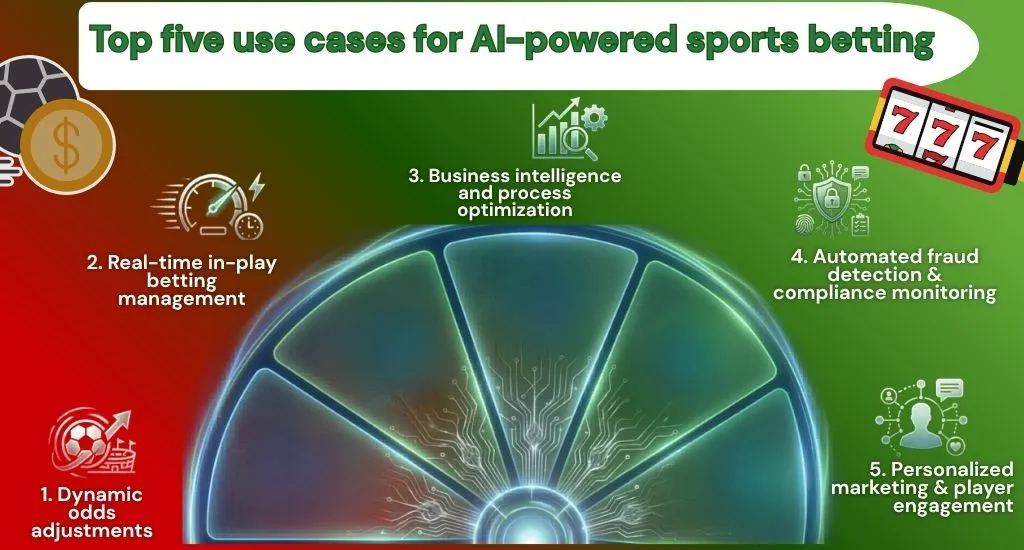
AI Betting Application
As the iGaming industry matures in 2026, the transition from manual odds making to autonomous systems represents the ultimate gold standard. For operators, learning to successfully deploy AI technology in sports betting is the difference between a highly profitable platform and a model that struggles with “sharp” action.
AI-Powered Match Predictions
Modern AI sports betting forecasts now go beyond simple statistical modelling. In 2026, sophisticated systems use Transformer-based engines that process thousands of variables at once, including player biometrics, rolling momentum averages (measuring the last 3, 5, and 8 games), and even high-resolution weather impacts.
Precision Accuracy: Today’s industry data shows AI models can achieve 75–85% accuracy in predicting outright winners across major leagues, far ahead of the 60% ceiling of traditional methods.
Contextual Forecasting: These tools can quantify subjective factors, showing users how a 15 mph wind specifically degrades a quarterback’s deep-ball accuracy by a calculated percentage.
Odds Optimisation and Dynamic Pricing
The heart of a lucrative sportsbook is the pricing engine. AI-based odds algorithms enable Autonomous Odds Engines to consume live match telemetry and global market movements to update lines in milliseconds.
Dynamic Adjustments: When there are “breaking” variables, a sudden injury or an unexpected spike in betting volume on one side, these systems respond rapidly, keeping the book balanced.
Margin Stability: AI eliminates human lag, minimising the window for arbitrage and optimising vigorish for maximum operator revenue.
Player Performance Analysis
Sports betting AI has revolutionized the “prop bet” market. By examining individual player metrics, AI can produce extremely accurate micro-markets (like a striker’s conversion rate on certain turf types or a pitcher’s fatigue levels).
Prop Bet Precision: Operators use these insights to set sharper lines on player-specific outcomes, which are often most susceptible to skilled bettors.
In-Play Impact: AI tracks real-time performance dips to suggest live betting opportunities that reflect real-time play conditions rather than just the scoreboard.
Live (In-Play) Betting with AI
In 2026, over 70% of all betting volume is in-play wagering. To address this, AI betting tools deploy Micro-Event Prediction Probability (MEPP) to forecast the outcome of the very next play.
Zero-Latency Processing: AI processes live optical tracking data to update odds before the broadcaster’s delay can catch up, providing a seamless and “fair” experience for the user while protecting the house.
Fraud Detection and Risk Management
The industry’s “silent” pillar is security. AI is expected to reduce sports betting fraud by up to 80% by 2026.
Pattern Recognition: ML algorithms identify “syndicate” behavior, multi-accounting, and bonus abuse by flagging atypical betting spikes or coordinated wagering patterns across different regions.
Integrity Monitoring: AI acts as a 24/7 watchdog, detecting potential match-fixing by comparing real-time on-field performance against historical anomalies and betting market fluctuations.
How Do Sportsbook Operators Use AI?
Sportsbooks today rely heavily on artificial intelligence. Today, operators use AI for sports betting to improve decision-making, manage risks, and deliver a more personalised betting experience to users. Utilising advanced AI betting systems, sportsbooks can read billions of betting and sports data feeds in real time to develop better trading strategies and manage the platform more effectively. As AI sports betting technology continues to mature, AI plays a rising role in sports betting operations for both better operational efficiency and high levels of user engagement.
Personalised Betting Recommendations
Most commonly used to introduce AI in sports booking services, sportsbooks send personalised betting recommendations. AI algorithms conduct a user’s betting history analysis, selecting favourite sports or markets, as well as predicting wagering behaviour, and making bets based on betting history. Using this data, platforms can make matches, bets or promotions recommendations relevant to that user. This personalisation enhances the user experience but also leads to more engagement and betting activity.
Customer Behaviour Analysis
AI models can analyze sportsbook user behavior on the various sportsbook platforms, like betting frequency, wager sizes, session time, and navigation patterns. This data gives operators insight into customer tastes and customer segments which are valuable. Using these insights sportsbooks can set up targeted marketing campaigns, better tailor promotions and make adjustments to product offerings.
Player Retention And Responsible Gambling Tools
Another key application of AI sports betting in the field of gambling is retaining the users and managing responsible betting through AI is player-management and betting in relation to responsible sport betting. If you track abnormal betting behaviour or rapid losses and excessive wagering patterns or a problem wager pattern, AI systems can recognise problems early, and provide help for dealing with abnormal betting behaviour. Then, operators may also activate alerts, limits on betting, safe playing, or responsibly regulated gaming services.
Automated Trading and Margin Control
The trade of goods and prices through technology is becoming increasingly complex. Sportsbook traders are taking advantage of AI betting systems to handle manual odds calculations and margin management. AI can be used to analyze betting volumes, market movements and real-time sports data, enabling them to dynamically shift odds. This enables operators to keep balanced books and minimise financial exposure while providing competitive pricing.
Prediction Platforms and AI Betting Tools
They have many sportsbooks integrating sophisticated AI betting tools and predictive analytics into their trading infrastructure. These systems produce data-related insight, match forecasts and probability models to help traders set correct lines and assess betting markets more efficiently as well.
Using AI-Generated Insights in a Responsible Way
Although AI offers compelling predictive power, operators need to think critically about how to utilise these AI-generated intuitions responsibly. AI predictions need to support decision-making, not replace humans. The responsible use supports transparency, fairness and adherence to gambling rules.
Mixing AI data with human judgment
Nevertheless skilled traders and analysts are still vital participants in sports betting, despite the increasing extent of AI in sports betting, despite the power of these days of AI. Such human interpreters explain the contextual dimensions — issues like a team spirit boost, a change in lineups due to last-minute changes or strategically adjusted moves — aspects that are not easily explained by AI’s models. The integration of AI analytics along with human judgment gives a more even, yet trusted sportsbook activity.
The human-AI Balance: Avoiding Common Errors
The balance of the human and AI: How to avoid common mistakes. While AI is powerful, effective operators don’t consider it the replacement for human judgment at all; they regard it as an “augmented intelligence” tool.
The “Black Box” Trap: Dependency on algorithms when you know too much and don’t know anything about the logic behind data. Operators should retain “human-in-the-loop” oversight to identify or prevent “hallucinations,” or data irregularities, that don’t happen during historically unprecedented circumstances.
Regulatory Neglect: Some operators fall short because they believe that AI-driven automation allows them to bypass local jurisdictions. In 2026, countries such as Germany require automated addiction detection to be conducted, and it is mandatory for authorities to control the use of the tools through legislation.
Ethical guardrails: Using AI to “nudge” a player into betting more while feeling emotional does, in the face of that player’s fear and distress, amount to short-term gain on their balance sheets that will translate into long-term regulatory fines and reputational damage, and it shouldn’t be used.
Read More – Create Your Own Sports Betting Platform
What are the Benefits of Using AI in Sports Betting?
Artificial Intelligence is providing real advantages for the betting industry in terms of prediction accuracy, operational efficiency and platform operations. Most operators have adopted AI for sports betting to work within huge datasets and extract insights that would be challenging to interpret by hand. Here are the main advantages of applying AI for sports betting:
Increased Accuracy and Efficiency
Fast, accurate, and well-structured data processing with big datasets is a major benefit of AI in sports betting. Through AI, betting managers can analyse all kinds of information, including player statistics, match records, performance by the teams and real-time game-live data, and use it to find a high-quality AI sports betting forecasts at short notice, enabling sportsbooks and bettors to better decide, faster and with greater precision.
Data-Driven Decision-Making
AI empowers sportsbooks to go beyond gutwatches and draw-based gambling decisions. With data analytics that are currently advanced and predictive models on the backend, operators can make decisions based on verified trends, probability models, and history of betting, leading to more strategic betting operations.
Reduced Operational Risk
AI also enables sportsbooks to monitor betting activity and predict unusual trends, making real-time amendments to odds and controlling financial risks. It mitigates the risk of losing your money on big bets, and it keeps betting markets even.
Better User Experience
The user interface can be personalized to enhance the betting experience such as personalized recommendations, faster odds updating and more pleasant betting experiences.
Legal and Responsible Use of AI in Sports Betting
In 2026, the regulatory landscape has shifted from “watching” AI to actively mandating its ethical use. Those who use AI for sports betting now also need to be compliant with themselves. Well-established legal mechanisms, such as the EU’s Artificial Intelligence Act, classify systems that impact financial access or the safety of players as high risk in their provision. Thereby mandating operators to present extensive documentation and independent checks upon their algorithms in a standardised manner.
Responsibility is the heart of modern AI sports betting. Instead of relying on data to reduce potential lost play time, ethical operators use predictive models to detect “markers of harm”, such as chasing losses or erratic betting, before things start to get bad.
Transparency matters as much; regulators impose “explainable AI” now, where platforms have to be able to disclose the reasoning behind automated decisions, from the limits of account sizes to personalised odds. These safeguards not only give sportsbooks legal authority and a certain level of comfort but also provide the long-term player trust to build a sustainable iGaming brand over time.
The Future of AI in Sports Betting: What Lies Ahead?
The role of sports betting AI is likely to increase in the future as technology continues to advance and data-driven betting becomes the norm. Sportsbooks are going to have more and more AI-based systems employed in the future to increase prediction accuracy, automate the trading process, and provide them with a higher level of personalized betting.
An understanding of how to use AI in sports betting will be crucial for operators in the current and upcoming sports betting world, which is continuously changing. One major development that will be made is the incorporation of deeper real-time analytics. AI will analyse live match data that includes all aspects of a game, players’ movement and game progression, and predict the odds in real-time based on this, and update the odds around real-time (or in essence a live prediction).
This will greatly add value to in-play betting markets and make for smarter decisions for sportsbooks and bettors alike. Hyper-personalization will be another major trend. AI will also analyse the behaviour of users, betting preferences, and engagement patterns to tailor recommendations, promotions, and betting intelligence.
In addition, AI will have a more powerful role in fraud detection, responsible gambling oversight, and regulatory compliance, providing safer betting platforms. Through the evolution of technology, the successful sportsbooks will embrace that fusion of sports betting AI features and human, data-driven oversight for more intelligent and balanced betting systems.
Conclusion
AI is transforming the sports betting industry by enabling quicker analysis, accurate predictions, and smarter strategies used in operational work. From predictive modelling and sports betting AI analytics to automated odds management to the detection of fraud, AI has its arms all over. This is how AI will help sportsbooks operate more efficiently than before while also providing the customer with a better betting experience.
Understanding how to use AI in sports betting helps operators to be more efficient – taking data-driven decisions, fine-tuning their strategy to make their odds higher or lower, and creating attractive betting platforms. But while AI may have significant predictive powers, it must be used ethically. AI-driven decisions that are backed and tempered by human judgment are a cornerstone of balanced decision-making, ethical wagering, sustainable growth, and a powerful mix of power and trust.

Uses of AI in Sports Betting
FAQs
-
Is AI legal in sports betting?
Yes. AI is legal in sports betting and is widely used by sportsbooks for odds calculation, risk management, and fraud detection, provided it complies with local gambling regulations.
-
Is AI better than human analysis?
AI can process large datasets and identify patterns faster than humans, but the best results often come from combining AI insights with expert human judgment.
-
How accurate are AI betting predictions?
AI predictions can be highly data-driven, but accuracy varies depending on the quality of data, model design, and changing real-world factors in sports.
-
Can sportsbooks detect AI-based betting strategies?
Yes. Modern sportsbooks use advanced monitoring systems to detect unusual betting patterns, automated strategies, or coordinated betting activity.
-
Is success guaranteed in AI-driven sports betting?
No. AI improves analysis and prediction capabilities, but sports outcomes remain uncertain, so guaranteed profits are not possible.

Jaya Swaroop is an enthusiastic content writer at PieGaming with a keen interest in the iGaming industry. With a strong foundation in copywriting and research, she brings clarity and structure to complex subjects. Jaya has a knack for simplifying complex iGaming concepts and turning them into clear, engaging content that informs and connects with industry audiences.
-

This blog walks you through the top eSports games, most played and watched by the audience. Stay tuned to find out about the best eSports betting games available worldwide.
-

This guide explains virtual sports betting in clear, easy language. It covers how virtual sports work, why players enjoy them, and how operators use them alongside live betting. The guide focuses on the basics without technical jargon, helping readers understand where virtual sports fit in today’s iGaming market.
-

Algeria is very restrictive in its online gambling laws, making it a difficult place for operators to operate under regulation. The position on the legal state of casinos and sports betting in Algeria and what businesses should know in the market are covered by this article.
-

Armenia has a regulated iGaming market with clear licensing and operational guidelines. This guide explores casino and sports betting regulations in Armenia, covering legal requirements, compliance standards, and how operators can establish a presence in this growing market.
-

Canada’s online gambling market is regulated under both federal laws and provincial regulations. The guide outlines Canada’s regulations regarding online casinos and sports betting, from licensing arrangements to access to legal terms for operators in a new market.
-

Mexico is one of the biggest iGaming markets in Latin America with evolving gambling regulations. The guide describes Mexico’s legal environment regarding online casinos and sports betting, licensing requirements and opportunities for operators to enter the market.
-

Planning to launch your iGaming business in Malta? This free guide covers sports betting and online casino regulations in Malta to help you run a safe and legal iGaming business.
-

This guide lists the top 10 sports betting odds providers in 2026, helping operators choose fast, accurate, and reliable data sources for their platforms.
-

In Spain, we have a structured iGaming framework guided by the Spanish Gambling Act. This guide covers the main regulations regarding online casinos and sports betting for Spain; licensing requirements, compliance rules, and regulatory authorities governing the market.
-

The world’s most regulated online gambling industry exists in the UK. This guide outlines all important regulations in place for online casinos and sports betting within the UK — from licensing requirements to regulatory compliance to responsible gambling principles.
-

South Africa has a complex gambling framework where online sports betting is regulated, but online casinos operate under strict limitations. This guide explains the legal landscape, licensing requirements, and key considerations for operators targeting the South African market.
-

Sports betting software development involves creating custom platforms. These platforms help manage bets, process payments securely, and provide live betting options. They also keep users engaged, which helps businesses grow.
-

Starting a sports betting business in the UK involves ensuring compliance, obtaining licenses, selecting software, setting up payment systems, and much more. Let’s explore this in greater detail.
-

The technology that supports modern sportsbooks comes from sports betting software providers. This article features leading providers and explains the capabilities operators should consider when picking the best platform to run their business.
-

Sports Betting in the iGaming Industry: A market finally getting its dues! Existing for over a century in various parts of the world,…
-

In the high-stakes sports betting world, fortunes can be made or lost as a result of a single match outcome. But what if…
-

This blog explores the world of sports betting, covering new sports betting trends like mobile apps and AI, key challenges, and future growth…
-

Odds on sports betting are the odds of an event as well as how much you get out of a winning bet. This easy-to-follow guide covers some of the basics on how odds function, how many ways sportsbooks format them—how they are presented—and how a game bettor can confidently read and interpret them.
-

The scope of Online sports betting in 2026 is growing fast, driven by new technology, better laws, and more players joining betting platforms worldwide. Read along to catch up with the changing trends.
-

This checklist covers everything your online sportsbook needs to succeed. From licensing and payment methods to odds providers and security. Use it to avoid costly oversights and stay ahead of your competition.
-

White label betting exchange solutions let you launch your own peer-to-peer betting platform easily and quickly. This guide covers how they work, key features, and benefits for operators.
-

See how white label sportsbook solutions make online sports betting better. Explore custom features, quick setup, and benefits for operators in 2025.
-

Discover the top 6 tips for selecting reliable turnkey betting platform providers to enhance the betting experience for your customers. Click to read now.
-

White label betting exchange platforms are becoming more popular in 2026. This list shows top providers that offer ready-to-use solutions with liquidity already included, custom branding options, and quick setup for casino operators.
-

Want to launch your own sportsbook? Learn how to create your own sports betting platform from scratch — from licensing to compliance. Start smart in 2026.
-

The growing popularity of sports betting is opening doors for operators. Read here the history, present and future of the global sports betting…

Voila!
See you in your inbox soon!

Stay ahead of the game. Subscribe for exclusive content, updates, and insiders!