
Provably fair technology enables players around the world to personally confirm that online game outcomes are fair and transparent.

Let’s be honest, “just trust us, the game is fair” doesn’t really cut it anymore.
As more players move toward crypto gambling, they’re asking a pretty reasonable question: “How do I actually know I wasn’t cheated?” That’s exactly the problem provably fair technology was built to solve.
Instead of crossing your fingers and hoping a third-party author did their job, provably fair systems hand the power directly to you. Using cryptographic algorithms, blockchain-based hashes, and transparent seed verification, you can check casino game results with no middleman needed.
In simple words, you get a way to confirm that whatever happened in your game wasn’t secretly tweaked or manipulated after you placed your bet. What you saw is what actually went down.
But before you can trust it, you need to understand how it works.
Provably Fair in iGaming Explained
Provably Fair in iGaming Explained
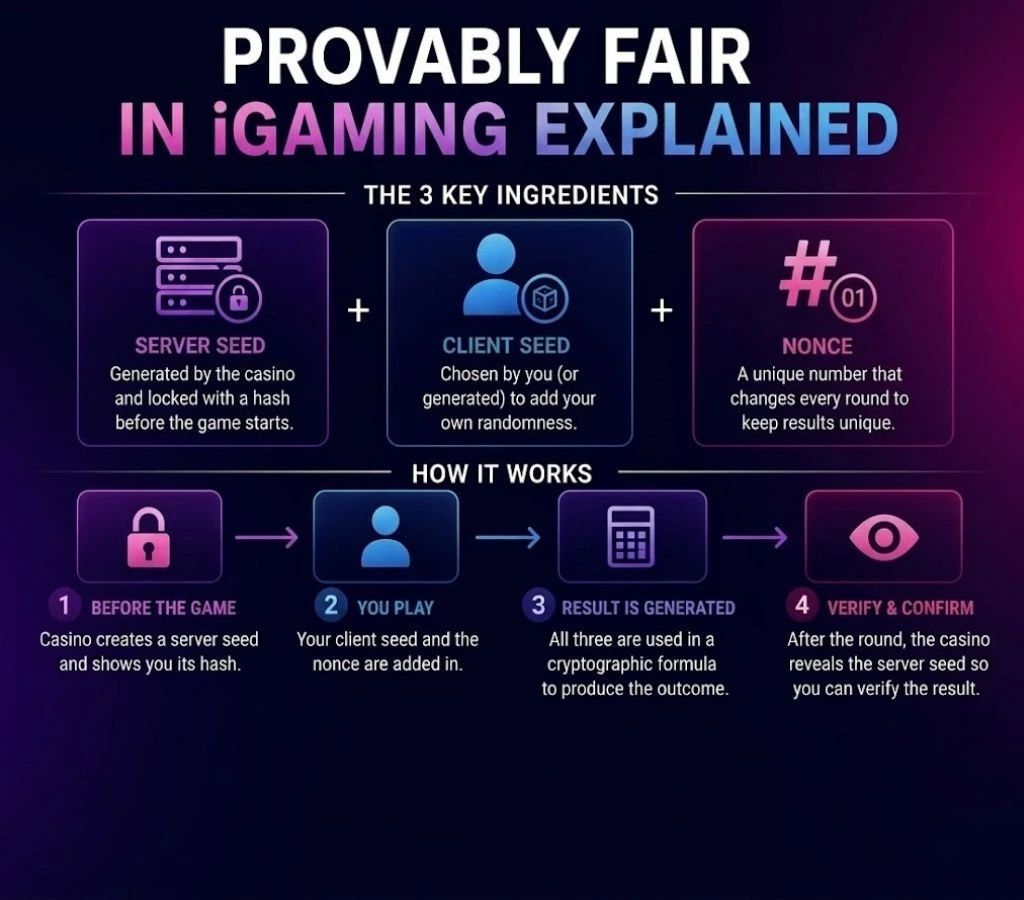
At its core, provably fair is a cryptographic verification system. It gives players a way to independently confirm that a game result wasn’t tampered with after a bet was placed. Rather than putting all your trust in a casino’s internal Random Number Generator (RNG), you get to check the math yourself.
The whole system runs on three building blocks:
Server Seed- a random value the casino generates before gameplay begins.
Client Seed- a random input that the player controls and influences.
Nonce- a numerical counter that ticks up with every single round or bet.
Before a game kicks off, the casino creates the server’s seed and locks it behind an encrypted hash using algorithms like SHA-256. You only see the hashed version upfront, and that’s intentional. It stops the casino from quietly swapping out the seed after your bet is in, while giving you a verifiable record to check against later.
The client seed adds another layer to the mix. Many provably fair casinos actually let you change this seed yourself, which introduces your own randomness into the outcome and keeps things transparent on your end, too.
The nonce keeps every round unique. Even if the same server and client seeds somehow end up being used again, the nonce makes sure the result comes out different every time.
When it’s time to generate the outcome, all three values get fed into a deterministic cryptographic formula, most commonly HMAC-SHA256
Because the formula is deterministic, the same inputs will always produce the same output. That’s what makes independent verification possible.
Once the round is over, the casino reveals the original server seed. From there, you can:
- Match the revealed seed against the hash you were shown at the start.
- Recalculate the result yourself.
- Confirm that nothing has changed.
Provably Fair Vs Traditional RNG: What’s the Difference?
Both systems are built to do the same thing: generate random outcomes in online casino games. But when it comes to transparency, they are worlds apart.
With a traditional RNG, you are essentially trusting the casino or a third-party auditor to confirm everything is above board. You never actually see the process. With provably fair technology, you don’t have to take anyone’s word for it because you can verify the outcome yourself.
Read More – Casino Game Providers
Here’s how the two stack up:
| Feature | Provably Fair Systems | Traditional RNG Systems |
| Transparency | Outcomes can be independently verified by players. | Verification is handled internally or by external auditors. |
| Trust Model | Based on cryptographic proof. | Based on trust in the casino and certification bodies. |
| Verification Process | Players can recalculate and validate results manually. | Players cannot directly verify outcomes. |
| Core Technology | Uses server seed, client seed, nonce, and hashing algorithms. | Uses internal Random Number Generators (RNGs). |
| Player Involvement | Players may customize client seeds. | No player involvement in randomness generation. |
| Outcome Validation | Publicly verifiable after gameplay. | Hidden from players. |
| Common Usage | Mostly used in crypto casinos and blockchain gaming platforms. | Common in traditional online casinos. |
| Third-Party Audits | Less reliance on external audits. | Strong reliance on independent testing agencies. |
| Level of Control | Greater transparency and visibility into game fairness. | Limited visibility into backend processes. |
| Popular Game Types | Dice, Crash, Plinko, Roulette. | Slots, Blackjack, Roulette, Video Poker. |
Both approaches aim to keep outcomes genuinely random. The real distinction is who gets to confirm that. Traditional RNG keeps that process behind closed doors. Provably fair opens it up, putting verification directly in the hands of the player rather than leaving it to operators or licensing bodies.
Advantages of Provably Fair Casinos
Provably fair casinos bring something traditional online casino platforms simply can’t offer: actual proof. Not promises, not certificates from a third party you’ve never heard of, but verifiable evidence that your game result was fair and wasn’t touched after you placed your bet.
Here’s what that looks like in practice:
Independent Result Verification
Using the server seed, client seed, and nonce, players can manually verify any game outcome themselves. You’re no longer fully dependent on what the casino tells you or what an audit report says.
Greater Transparency in Gameplay
Cryptographic hashing means the casino locks in a result before the round even starts. That commitment is visible and checkable, which takes a lot of the guesswork out of whether something sketchy happened after your bet went in.
Less Reliance on Third-Party Auditors
Traditional casinos lean heavily on external agencies to certify their RNG. Provably fair systems shift a chunk of that verification directly to players through calculations anyone can run.
Stronger Player Trust
When the process is open and checkable, confidence follows. This matters especially to crypto casino users who aren’t interested in trusting centralized systems in principle.
Player-Controlled Randomness
Many provably fair game providers let you set your own client seed. That means you’re actually participating in how randomness gets generated, not just watching it happen from the outside.
Instant Verification Instead of Periodic Audits
Traditional RNG audits happen on schedule. With provably fair systems, you can verify a result the moment a round ends. No waiting, no wonder.
A Natural Fit for Crypto Gambling
Provably fair aligns naturally with the principles behind blockchain: openness, transparency, and decentralization. It’s no coincidence these systems dominate the crypto casino space.
Lower Risk of Hidden Manipulation
When any player can independently recalculate an outcome, quietly altering results becomes a much harder thing to get away with.
Better Visibility into Game Integrity
Instead of trusting a black box, players actually get to see how outcomes are produced. That kind of visibility changes the relationship between player and platform.
Read More – How to Start An Online Casino
Limitations of Provably Fair Systems
Provably fair technology is a genuine step forward for transparency in online gambling. But it’s not a fix for everything, and it’s worth being clear about where it stops.
1) Does Not Remove the House Edge
Provably fair confirms that the results were generated fairly. It doesn’t improve your odds or change the mathematical advantage the casino has built into every game. The system is about integrity, not profitability.
2) Fairness Depends on Initial Seed Integrity
Players can confirm that the server seed wasn’t swapped out after gameplay. What they can’t do is independently verify whether that original seed was generated fairly to begin with. That part still requires some trust in the operator.
3) Limited Protection Against Biased Game Design
A game can pass every provably fair check and still have poor RTP percentages, high volatility, or payout structures that aren’t in your favor. The algorithm verifies randomness, not whether the game is actually worth playing.
4) Complex Verification Process for Casual Players
The terms hash, seed, nonce, and cryptographic formulas are not the stuff of children’s play. Most players who play games for fun won’t be doing the calculations by hand and will rely on automated verification tools instead, making self-verification somewhat redundant.
5) Not All Games Support Full Verification
Games such as Dice, Crash, Roulette, and Plinko are provably fair. Some formats, such as live dealer games and some slot features, might only provide a partial verification, or none at all.
6) Dependence on Operator Transparency
The system depends on operators fully disclosing their algorithms, seed generation methods, and verification processes. If a casino keeps any of that vague or inaccessible information, the transparency breaks down quickly.
7) Potential for Misleading Marketing Claims
Not every casino that calls its games “provably fair” actually gives players the tools to verify anything. If seed data is unavailable and there are no easy verification procedures, it’s marketing jargon, not a working system.
8) Verification Does Not Cover Platform Operations
Provably fair says nothing about withdrawal policies, bonus terms, account practices, or how the platform operates overall. A casino can have airtight game verification and still be a poor experience in every other way.
9) User Verification Is Often Ignored
The verification capability is there, but the reality is that most players never use it. That gap between what’s technically possible and what actually happens means transparency often exists in theory more than in practice.
10) No Universal Standard Across Casinos
Different platforms use different algorithms, seed structures, and verification methods. There’s no single consistent standard across the iGaming industry, which makes comparing or cross-checking provably fair systems between casinos genuinely difficult.
How Provably Fair is Used in Various Online Games?
Provably fair isn’t a one-size-fits-all system. How it gets applied depends entirely on the game and how its outcomes are generated. Simpler games are easier to verify. More complex ones require additional layers. Here’s how it plays out across the most common casino game formats.
1) Dice Games
Dice games are where provably fair systems feel most at home. The process is simple: The client seed, server seed, and nonce are multiplied together to generate a random number in a fixed range, typically 0 through 99.99. Once the round has been completed, you can try the same calculation again and verify that the result is the same as shown.
What players can verify:
- The roll generation formula
- The winning threshold calculation
- The hash after gameplay ends
If you’re looking for the easiest entry point into manual provably fair verification, dice games are it.
2) Crash Games
In crash games, the multiplier isn’t decided at the moment. It’s generated before the round even begins, using hashed seed values. Once the round ends, players can check whether the crash point was mathematically locked ahead of time or if something changed during gameplay.
What gets verified in crash games:
- How the crash multiplier was generated
- The randomness of each round
- Whether the revealed seeds match the displayed outcome
This matters a lot in crash games specifically, where rounds can end in seconds, and the stakes of manipulation are high.
3) Roulette
Provably fair roulette skips the visual wheel entirely when it comes to deciding outcomes. A cryptographic calculation determines the winning number, color, and odd/even result before the animation even plays out.
After the spin, players can verify whether the result lines up with the original seed combination that was set before the bet was placed. Unlike live dealer roulette, everything here runs through the algorithm, not a physical wheel.
4) Blackjack and Card Games
Card games are more complex since there are several actions that occur in a single round. A provably fair blackjack algorithm organizes the shuffle and decides the sequence of card distribution before play starts.
Once the server seed is revealed, players can reconstruct the entire shuffle sequence and confirm whether the cards came out fairly. It’s more involved than verifying a dice roll, but the process works the same way at its core.
What the algorithm determines:
- The deck shuffle sequence
- The order cards are distributed
- The final card outcomes
5) Plinko Games
In provably fair Plinko, the ball’s path is decided before it visually drops through the board. The algorithm generates the trajectory, peg interactions, and final payout slot in advance. The animation you watch is simply a reflection of a result that was already locked in.
6) Slot Games
Slots are the outlier here. The complexity of reel mechanics, bonus features, and symbol combinations makes full provably fair implementation significantly harder than in dice or crash games.
Some platforms do use algorithms to determine reel positions, bonus triggers, and symbol outcomes, but many traditional slot providers still rely on certified RNG systems rather than offering full player verification.
7) Live Dealer Games
Live dealer games are where provably fair technology runs into its clearest limitations. When real cards, physical roulette wheels, and human dealers are involved, full cryptographic verification becomes difficult to implement.
Fairness in live dealer environments typically comes from:
- Studio surveillance
- Third-party audits
- RNG integration for side bets or bonus features
It’s not the same level of transparency as a purely digital game, and that gap is worth knowing about.
How Do Players Verify Provably Fair Results?
Knowing the system exists is one thing. Actually using it is another.
Most provably fair casinos include a dedicated verification panel tied to each bet. A standard interface gives you everything you need to check a result:
- Hashed server seed shown before the round
- Revealed server seed after the round ends
- Your client seeds
- The nonce for that specific bet
- The final generated result
Verification starts with one simple check: does the revealed server seed match the hash you were shown before the bet? If it doesn’t, the seed is changed and the result can’t be trusted.
From there, players can reproduce the outcome using the same inputs. Most crypto casinos provide built-in calculators that do this automatically. What gets reproduced depends on the game:
- Dice games recalculate the roll number
- Crash games reproduce the exact multiplier
- Roulette games regenerate the winning number
- Card games reconstruct the full shuffle order
Some platforms let you verify entire betting histories in one go, which is especially useful for high-frequency games like crash and dice, where hundreds of bets can stack up in a single session.
Advanced users often skip the casino’s own calculator entirely and run verification through independent tools or open-source scripts, removing any reliance on the operator.
In practice, though, most players never check. The tools are there. Whether anyone uses them is a different story.
How Can Casino Operators Implement Provably Fair Technology?
Building a provably fair casino isn’t just a technical decision. It requires the right infrastructure, genuine operational transparency, and tools that actually let players verify what they’re being told. Here’s what that looks like in practice.
1) Selecting a Provably Fair iGaming Software Provider
Everything starts with the iGaming software provider. Most operators partner with iGaming platforms or game developers that already have cryptographic verification built into their architecture rather than building it from scratch.
What to look for in a provider:
- Integrated seed generation systems
- SHA-256 or HMAC-SHA256 support
- Nonce tracking infrastructure
- Real-time verification tools
- Access to provably fair game libraries
2) Integrating Secure RNG and Blockchain Technology
The RNG infrastructure needs to generate high-entropy server seeds that are genuinely unpredictable and tamper-resistant. That’s non-negotiable. Many crypto casinos go a step further by layering in blockchain integration, which adds:
- Immutable transaction records
- Public verification of betting activity
- Transparent payout tracking
- Decentralized game logic in some cases
At the core of outcome generation sits the same deterministic formula players use to verify results:
3) Providing Built-In Verification Tools
A provably fair system that players can’t easily access or understand isn’t really serving its purpose. Operators need to build verification interfaces directly into the platform, not bury them.
A solid verification interface lets players:
- View current and previous server seeds
- Access and customize client seed settings
- Review nonce history
- Recalculate completed game outcomes
- Verify entire betting sessions at once
For more technically experienced users, some platforms also offer API access or open-source verification scripts that allow independent validation completely outside the casino environment.
4) Meeting Regulatory and Fair Gaming Requirements
Provably fair technology improves transparency, but it doesn’t replace regulatory compliance. Operators still need to meet the requirements of the licensed jurisdictions in which they operate.
That typically means:
- Independent security testing.
- RNG certification.
- Where required.
- Data protection compliance.
- Transparent game rules and payout disclosures.
- Secure seed storage practices.
In most regulated markets, provably fair systems run alongside traditional auditing rather than replacing it entirely. Both serve different purposes and neither fully substitutes for the other.
5) Educating Players About Provably Fair Systems
Most casual players have never heard of cryptographic hashes, server seeds, or nonces. If operators want provably fair to mean something beyond a label on the homepage, they need to invest in player education.
Useful educational tools include:
- Step-by-step verification walkthroughs
- Interactive calculators
- Clear FAQ sections
- Seed explanation guides
- Video demonstrations of the verification process
The goal is to close the gap between technical transparency and practical usability. A system that works perfectly but confuses everyone who tries to use it isn’t delivering on its promise.
Piegaming’s white label casino software comes with provably fair games built right in. No complex integrations, no piecing together separate systems. Operators get a ready-to-launch platform where transparency and player trust are already part of the foundation.
Wrapping Up…
Online gambling has always asked players to take a leap of faith. Provably fair technology shortens that leap considerably. It won’t answer every question a player might have about a platform, but it answers the most important one: Was my game played straight? For a lot of players, that’s exactly where trust begins.

FAQs
-
Is Provably Fair Hackable?
Cryptographic hashing makes provably fair systems extremely difficult to break. Any tampering gets flagged across the network instantly. The system is secure, provided the casino has implemented it correctly from the start.
-
What are Top Provably Fair Game Providers?
BGaming, Hacksaw Gaming, and Spribe are among the leading names. NSoft and developers certified by ProvablyFair.org also offer verified games across formats like Plinko, slots, and instant win titles.
-
Is Provably Fair only for Bitcoin games?
Not anymore. It started in Bitcoin casinos but has expanded to any platform supporting cryptographic verification. The system runs on seeds and hashes, not specific currencies, making it currency-agnostic.
-
How do I check a game’s fairness?
Grab the server seed hash, your client seed, and nonce. Run them through the casino's verifier tool. After the round, reveal the server seed, recalculate, and confirm the result matches. Most platforms provide a built-in calculator.
-
What are the technological requirements for employing PF systems?
Core requirements include SHA-256 hashing, server and client seeds, nonce tracking, and a pre-game seed commitment scheme. Open-source verifier tools, reproducible game logic, and round-by-round verification capability are also essential for full transparency.


Palak Madan has been writing about the iGaming industry since 2024. She focuses on helping operators and founders understand their options when launching an online casino, from choosing the right software provider to figuring out costs and compliance requirements across different markets. At PieGaming, she covers topics like white label casino solutions, platform selection, and market entry, turning complex industry information into practical guidance for people building iGaming businesses. She also keeps a close eye on licensing and regulatory changes; particularly how new rules shape the way operators enter and grow in different jurisdictions.

Self-exclusion tools in iGaming help operators improve responsible gambling practices. It lets operators protect players from harmful gambling behavior and strengthen regulatory compliance.
To obtain a gambling license in Romania, operators should register a local company and submit financial documents and fulfill ONJN requirements. Obtaining a Romanian iGaming license gives operators a significant opportunity to legally offer gambling services to other European countries as well.

Slot tournaments are a time-limited game that allows players to compete to add points instead of just winning. Points accumulate based on wins, multipliers, and bonus rounds, and are displayed on a live leaderboard which constantly changes as the game progresses. The winners at the end of the game get cash prizes, free spins, bonuses, and even tickets for bigger games.

Poker game development is one of the biggest revenue engines for online casino businesses in the modern era. It helps companies increase player engagement, retention, and revenue. The evolution of poker services through multiplayer poker and real-time tournaments, white label and turnkey poker solutions, make for faster penetration into and scalable operations within the marketplace.

See you in your inbox soon!

Stay ahead of the game. Subscribe for exclusive content, updates, and insiders!

