
This blog is a detailed guide on “how to secure a gaming license.” From definition to types of gaming license, steps involved and more – read here everything.
The global iGaming market is a million-dollar industry, and it is projected to reach USD 153.57 billion by 2030, as per the Grand View Report on Online Gambling Market (2025-2030). The whooping number opens a lucrative opportunity for operators to start an iGaming business. .
But before you start an online casino or sportsbook business, securing the gaming license is undeniably important for any operator. It is the foundation of your casino or sportsbook business. From accepting players & accepting bets to partner with payment & game providers, a gaming license helps you build trust in the market.
In this write up, we will explain how to secure a gaming license, compare cost, timelines, and how to pick the best jurisdiction.
What is a Gaming License & Why It’s Mandatory?
An iGaming license is an official permit issued by a regulatory authority, which allows you to run an online casino or sportsbook business legally. It ensures that your company meets all legal requirements, financial and fairness standards.
An iGaming license is mandatory in most jurisdictions. According to one expert, ‘launching an iGaming business without a permit not just means you’re taking a risk, but risking the complete collapse of your business.’
Regulators across the world require operators to get proper licensing before launching an iGaming business.
Understand this way, if you want to launch online casino business in South Africa, you need to be licensed by that country’s regulator or an internationally recognized regulator that permits activity there.
Therefore, having a gaming permit is mandatory in many jurisdictions as unlicensed gambling is a criminal offense.
What Does a Gaming License Allow You to Do?
For any online casino or sportsbook operators, having a gaming license means having all the legal rights to run a gambling business without any complexities. Here are the ‘perks’ operators can enjoy with an iGaming permit.
Operate legally
Every licensed iGaming operator gets the right to offer casino games and sports to players under regulatory supervision. Legal status means you can accept payments from players without breaking local gambling laws.
Process payments
Banks and payment platforms such as e-wallets, credit cards, and crypto wallets only work with licensed operators. For partnering with payment providers, a permit is essential because ‘only a licensed operator can legally process payments.’
Partner with providers
Leading casino game providers, sportsbook data providers, and affiliate networks usually prefer working with licensed casino or sportsbook operators. A gaming permit allows you to integrate top titles and data feeds from industry leaders.
In fact, regulators themselves rely on certified test labs like GLI or eCOGRA to analyze game fairness.
Advertise
Any licensed operator can advertise their business on major channels like Google Ads, social media, etc., – all LEGALLY. In fact, players also want to see a permit badge on a site before considering it to play games. A key factor in trust!
Risks of Operating Without a License
What risks can you face if you run an iGaming business without a permit? Read on to know…
Payment gateway bans
In many countries like South Africa or Turkey, regulators block gambling sites/ domains if not found licensed. Without an iGaming license, you cannot connect to major payment solution providers. Banks, Mastercard/ Visa, and crypto platforms will restrict you from accepting payments.
Legal penalties
In many jurisdictions like Turkey, China, and South Africa, running an unlicensed gambling operation is a crime. Fines can reach millions, and companies may face criminal investigations or asset freeze. In fact, your corporate accounts and bank relations will be at risk.
Brand reputation loss
Operating a casino/ sportsbook business without a license means reputational damage. Without legal protection, your players may fear blocked payouts and stolen funds. In short, you’ll struggle to scale or exit unless you secure a license.
Types of Gaming Licenses (Casino, Sportsbook, Lottery)
Are you planning to launch an online casino? Or a sportsbook business? Whichever business you want to launch, there is a specific type or gaming license you will require to run your respective business. The license is categorized by game type and market. Common categories include:
Online Casino License
Casino games like Slots, live dealer, poker, baccarat, roulette, and RNG games fall under this category. For instance, Malta’s MGA Type 1 license covers casino and lottery games. If you want to run a virtual casino with RNGs or live streaming tables, you will need a casino license.
Sportsbook License
This allows you to offer sports events, integrate real-time odds data feeds, and settle bets. Sportsbooks often require specialized risk monitoring and data provider agreements.
Lottery License
For offering lottery draws or instant lottery tickets online. Lottery activities are sometimes bundled with casino licenses (e.g. under MGA Type 1), depending on jurisdiction’s rules.
White Label Gaming License
Some providers offer a white-label solution, where you operate under their master license such as Malta, Curacao, Isle of Man, etc. White label iGaming solution provider offers a ready-to-launch software, which allows you to go live within 2 weeks.
Each license type comes with its own cost and compliance requirements. When planning, make sure to align your business model with the correct license category.
Step-by-Step Process to Secure a Gaming License
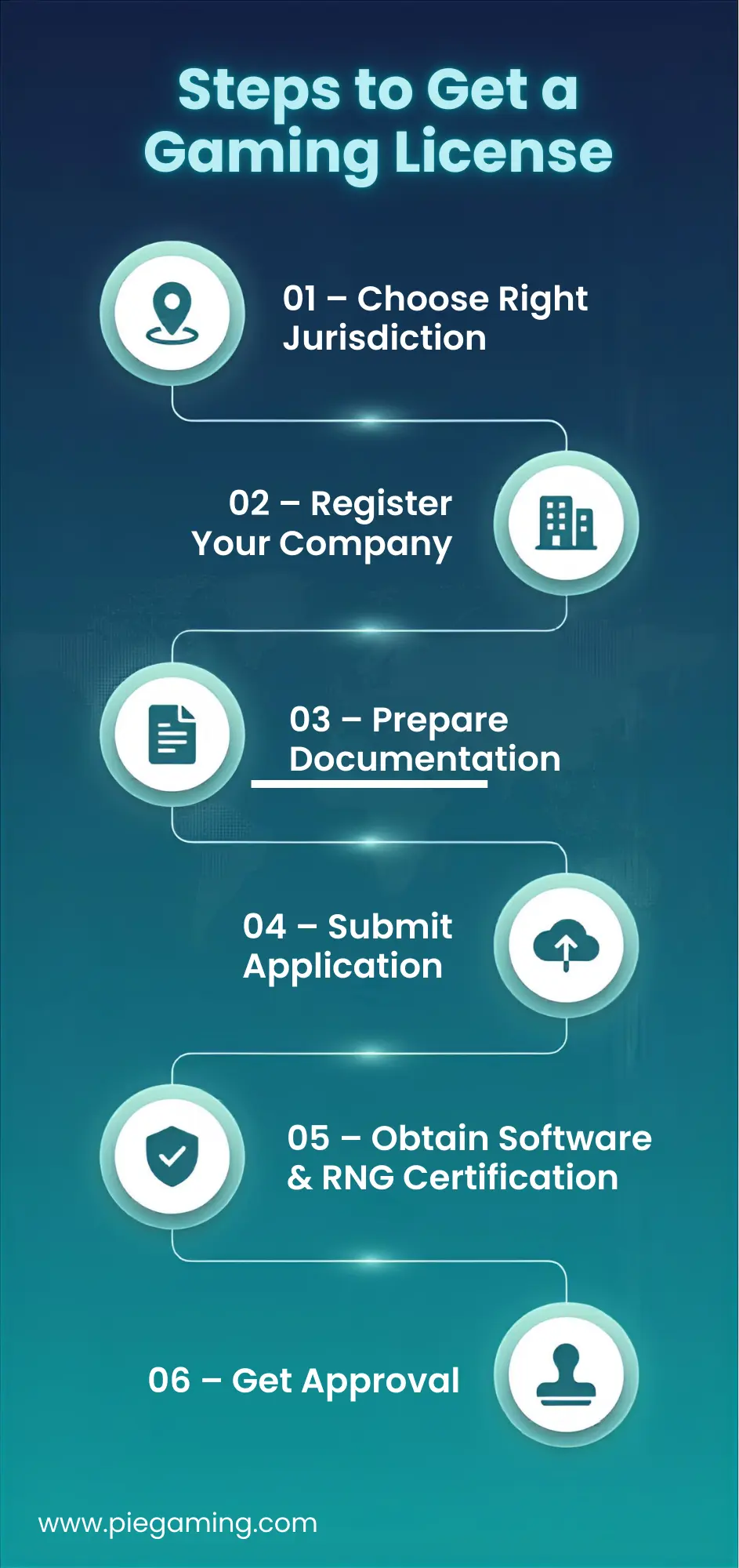
iGaming License Process
How to get a gaming license? What is the gaming license process? This section is the answer to your questions below.
Step 1 – Choose the Right Jurisdiction
The first critical decision is where to get licensed. There are many popular international iGaming jurisdictions including Curacao, the UK, Malta, Anjouan, and Kahnawake. Each jurisdiction offers a mix of different costs, speed, and prestige. Let’s understand each jurisdiction requirements below:
Curacao
Known to be among the most affordable and fastest, Curacao iGaming licenses cover all gambling activities (Casino, Sportsbook, Lottery) under a single license. The online gaming license process takes around 4-6 weeks maximum to get a license.
Malta
Malta (MGA) maintains a very high regulatory standard and grants operators’ European markets access. Despite this advantage, Malta iGaming license is much stricter and expensive than other jurisdictions. MGA jurisdiction is best for established operators who want to target regulated EU markets.
UK
The United Kingdom iGaming License is extremely well-respected but involves a lengthy vetting process and can take around 4 months to issue.
Anjouan
Anjouan is an offshore iGaming license, which is very cost-effective and very quick to procure within 2-4 weeks. Startups or crypto casino operators targeting emerging markets, Anjouan iGaming license is ideal for them.
Kahnawake
Kahnawake in Canada offers 0% tax and moderate fees with a timeline of roughly four months. Operators who want long-standing offshore licenses with structured compliance with lower taxation than EU markets, Kahnawake iGaming license is best for them.
Before choosing any jurisdiction, consider your target market and budget. Jurisdictions like the UK or Malta helps in building player confidence while newer offshore jurisdictions like Anjouan or Curacao can get you started faster and in an economical way.
Step 2 – Register Your Company
Most regulators will require you to hold a legal entity in that jurisdiction or a popular jurisdiction. Here, you will start by establishing a registered company. For instance, to get a Curacao license, you register for a Curacao B.V. In Malta or the UK, you set up a Malta Ltd. or UK PLC.
Furthermore, you must prepare corporate documents like financial statements, a detailed business plan, software details, etc.
Step 3 – Prepare Compliance Documentation
Regulators in any jurisdiction require detailed paperwork which you must submit. So, be ready with:
Business Plan: A detailed plan for your iGaming operations and projections.
KYC/ AML: Full anti-money laundering and KYC policy documents highlighting how you will verify players and monitor transactions.
Software Agreements: A list of your gaming and casino/ sportsbook software providers as regulators require certification of game providers and your platform provider.
Specifically, bring everything required to prove your integrity and planning. Missing or weak documentation is a common reason for delays or rejections.
Step 4 – Submit Application to Regulatory Authority
Once you have gathered all the files, it’s time to submit the full application package and pay fees, if any. After submission, the regulators will review your application. The processing time may vary depending on the jurisdiction.
For instance, a UKGC application takes around 16 weeks whereas the Curacao iGaming board may issue you a license in roughly 4-6 weeks. Anjouan can be as quick as 2-4 weeks.
Regulators also do ‘back-and-forth’ queries for clarification and additional information. Operators must respond promptly to get everything done without any difficulty.
Step 5 – Software & RNG Certification
Almost all regulators require your gaming platform to be independently tested. It involves obtaining RNG certification and platform audits from prominent labs like eCOGRA, GLI, etc.
Casino running games must be RNG-certified (Random Number Generator), which ensures fairness in games. The tests take a few weeks, and you get a signed certificate as part of your submission.
Since your iGaming software will be thoroughly scanned, make sure you get connected with a leading test lab to avoid early delays.
Step 6 – Approval & License Issuance
Once the regulators are done reviewing your application, they will grant the license. Then you will get an official license certificate (often valid 1-5 years based on the jurisdiction you choose). At this point, you can go live. Also, forget not to budget for annual renewals and compliance audits.
Read Blog – How to Get an Isle of Man iGaming License?
Gaming License Cost Breakdown (2026 Updated)
Different jurisdictions have different licensing costs. Here is a detailed comparison listed in the table below:
| Jurisdiction | Application fee | Annual fee | Typical timeline |
| Curacao | €8, 900 (company setup) + €61,700 (one-time) | €61,700 one-time | 4-6 weeks |
| Malta (MGA) | €5,000 (one time) | €25,000 (Type 1 B2C ) | 4-6 weeks |
| UK (UKGC) | Starting from £4,224 (for small operators) | Starting from £4,224 (for small operators) | 4-6 weeks |
| Anjouan (Comoros) | €17,000 (all inclusive)
|
€2,000 (annual fee for compliance officer)
€13,300 (renewal fee) |
2-4 weeks |
| Kahnawake (Canada) | $30,000–$40,000 (based on license type) | $15,000–$20,000 (after 1 year)
$5,000 (renewal cost) |
4 months |
The above-mentioned figures are official fees. Don’t overlook other costs like technology audits, hiring compliance staff, etc. In short, total project costs often lead to six figures (USD even for small operators and can be higher for major licenses.
How Long Does It Take to Get a Gaming License?
The time to obtain an iGaming license usually depends upon the jurisdiction and the completeness of your application.
Curacao: Takes around 4–6 weeks after submission if all documents are in order.
Malta: Typically takes around 3–6 months. Here the process involves fit-and-proper checks, a technical audit, and system approval stages (60+ days for system audit).
UK: 4–6 months is the time to get a license, only if your application and documents are strong. Missing information can extend the time.
Anjouan: 2-4 weeks for a simple straight application. It is a fast process due to its streamlined review process.
Kahnawake: It takes around 4 months on average. The KGC grants a provisional 6-month permit after initial review before issuing a full 5-year license.
| Note for operators: Every mentioned timeline is estimated. Real-world timelines can extend if jurisdictions require information or if your paperwork isn’t fully ready. Starting preparations early is key to reducing delays. |
Best Jurisdiction for Gaming License (Comparison Guide)
Choosing the ‘best’ jurisdiction can be subjective as it depends upon your business model, target audience, and cost. Here is a detailed comparison guide for you to identify the best jurisdiction for getting an iGaming license.
| Jurisdictio | Cost | Tax rate | Reputation | Speed |
| Curacao | Low | 2% corporate tax | Moderate (well-known offshore) | Fast (4-6 weeks) |
| Malta | High | 5% | High (EU-regulated) | Slow (months) |
| UK | Very High | 19% (corporate + gambling taxes) | Very high | Slow ($-6 months) |
| Anjouan | Very low | 0% on gaming revenue | Low (new jurisdiction) | Very fast (2-4 weeks) |
| Kahnawake | Moderate | 0% corporate, no GGR tax | Medium | Moderate (4 months) |
Pros and Cons
Here are a pros and cons table of every jurisdiction:
|
Jurisdiction |
Pros |
Cons |
| Curacao |
|
|
| Malta |
|
|
| UK |
|
|
| Anjouan |
|
|
| Kahnawake |
|
|
Common Mistakes to Avoid When Applying for a Gaming License
Choosing an iGaming license is the most critical decision iGaming operators make. Often operators make mistakes while choosing a license which puts their business at risk. Here are the top common mistakes to avoid when applying for a gaming license.
Choosing wrong jurisdiction
Picking a license without matching your target market or jurisdiction can doom your business. Let’s understand, a UK license won’t let you serve U.S. players and an “offshore” license might stop you from advertising in major markets. It’s important to analyze markets and player expectations before planning.
Ignoring compliance
Why do most operators fail to obtain an iGaming license? Because they fail to meet compliance requirements. Incomplete documentation is a primary cause of rejection. Regulators of any jurisdiction require rock-solid compliance with anti-fraud and responsible gambling measures. Missing any important document leads to delays in test audits.
Underestimating cost
Many startups or new ventures focus on license fees but forget other expenses like corporate setup, legal advice, nominee services, and auditing. According to iGaming experts, a full license can require $50k-$150k upfront plus annual cost. It’s important to budget extra for compliance staff, marketing delays, and payment integration.
Not planning for payment integration
Operators ignore the fact that no merchant account works without a license. As mentioned earlier, ‘without a license, businesses can’t accept deposits or process payments.’ Make sure to plan your payment providers as they will require proof of license.
White Label vs Independent License – Which is Better?
One of the key decisions for many operators is to choose between a white label and an independent (standalone) license. Let’s understand one by one below:
Independent License
An independent license refers to a license which is directly applied by a casino or sportsbook operator. As an operator, you hold 100% control on your gaming license directly from a regulator. That means you’re fully responsible for operations, compliance, reporting, and audits.
Perks
- Full legal ownership
- You keep all your revenue
- Complete control over operations
Downside:
- Higher risk and overhead
- Takes 3-6 months to get
White Label License
A white label license means you operate under another company’s master license. You don’t need to apply for your own license, rather you collaborate with a licensed provider who lets you run your casino or sportsbook business under their own regulatory approval.
Perks
- Fast setup (2 weeks)
- Initial investment is much lower
- Fast market entry
- Ideal for startups
- Less entry barriers
Downside:
- Limits your flexibility
Which is best for you?
If you’re a new operator with low capital, a white label license can get you live almost instantly. Whereas if you have funds and want to maximize long-term value, you can obtain your own gaming license.
For startups looking to enter new markets, PieGaming offers turnkey iGaming solutions and white label iGaming solutions. At PieGaming, we help operators launch fully licensed white-label casinos and sportsbooks with faster go-to-market timelines. Our team takes care of all third-party integrations (games and payment providers) so you can focus on growth.

FAQs
-
How much does a gaming license cost?
A gaming license costs somewhere between $15000 (for white label) and $300,000+ (Independent license). However, the cost depends on the jurisdiction, compliance requirements, B2B, and B2C. Further, ongoing renewal fees also apply.
-
Which country is easiest to get a gaming license?
Curacao and Anjouan are known to be the easiest jurisdictions due to faster processing time, lower costs, and simplified compliance requirements compared to Malta and the UK.
-
How long does a Curacao gaming license take?
A Curacao gaming license takes around 4-6 weeks from company setup to approval, making sure all documentation and compliance checks are properly completed.
-
Can I operate globally with one license?
No, there is no license which grants you access to operate across the world. Most offshore licenses allow operations in many regions, including restricted regions.
-
Do I need RNG certification?
Yes, if you offer online casino games then RNG certification is important to prove game fairness.
-
What is the cheapest gaming license?
Currently, Anjouan and Curacao are among the cheapest gaming licenses with lower application fees, and annual cost compared to European regulators.

Monika Gola is an iGaming content specialist at PieGaming. Since 2020, she has been researching and developing content around software selection, online casino & sports betting regulations, and operator growth strategies. Her research includes analyzing market opportunities in regions like Europe, Africa, and Southeast Asia, as well as evaluating regulatory frameworks and entry barriers. She is actively monitoring industry trends, compliance updates, and evolving player demands across global iGaming markets to help operators navigate this industry seamlessly.
Online casino gaming is not allowed in Australia under Interactive Gambling Act 2001. But operators can still apply for an internet gaming license via specific jurisdictions like the Northern Territory, which allows them to offer gambling services legally- generally outside Australia.
Bulgaria’s iGaming license enables operators to legally provide services in the areas of online casino, betting, poker, and bingo in accordance with the regulations of the EU. Typically, a licensing process can take 60 to 90 days, and it will need to be approved by the NRA, technical certification, AML compliance, and data storage in the local area. Minimum capital requirements range from BGN 50,000 for betting operators to BGN 1.5 million for online casino operators.
To obtain the Anjouan Gaming License, applicants must collect and submit all the important documents. Learn the process of obtaining Anjouan iGaming license.
Algeria has no online casino or sports betting regulation to speak of — instead, the country enforces a near-total gambling ban rooted in civil law and Islamic principles. Yet despite the prohibition, offshore platforms continue to pull in millions of users every month, driven by high demand and a near-total absence of legal local alternatives.
A Kahnawake iGaming license is a credible and cost-effective licensing solution for online casinos and sportsbook operators. The process to obtain this license includes multiple steps, key benefits, and licensing costs.
Malta pays attention to the credibility of the regulatory framework and to access regulated markets, which is more conducive to long-term growth and industry reputation. However, Curaçao places a strong emphasis on speed and affordability, making it a good choice for startups and businesses focused on cryptocurrencies that are keen to establish a presence rapidly and at a lower cost. If you are constructing a major operation, select Malta. Pick Curaçao when you are just getting started and have to get your product to market quickly.
Discover the top 5 iGaming markets to watch in 2026. Learn about their rules, growth potential, and why they matter for operators planning to expand.

Voila!
See you in your inbox soon!

Stay ahead of the game. Subscribe for exclusive content, updates, and insiders!