
Learn how to start a sportsbook in 2026 — licensing, software, costs, payments, and launch timelines, laid out step by step for new operators.

Planning to start your sportsbook business? A successful sportsbook launch involves more than just choosing the right platform. It involves the right business model, procuring necessary licenses, integration of payment solutions, implementation of risk management, and the sportsbook software that holds the whole stack together. The global sports betting industry is racing toward $187 billion by 2030, creating massive opportunities for new operators to start sportsbook businesses.
But many operators face a big challenge, which is how and where to begin. Without having a clear roadmap, launching a sportsbook business can become overwhelming. Therefore, this write-up is a step-by-step process on how to start a sportsbook business, helping operators understand crucial stages from planning to choosing, launching, and growing a sportsbook business.
7 Steps to Starting a Sportsbook Business
We have thoroughly examined our 7-step approach that will help operators launch a sportsbook business and contribute to their success.
Step 1: Choose Your Sportsbook Business Model (White Label vs. Turnkey)
One of your first and most critical decisions is how your sportsbook will be built and operated. This choice impacts everything: licensing, launch timeline, costs, control, and scalability. Today’s sportsbook business models fall into three categories: White label, turnkey, and custom.
Understanding the trade-offs between these models early helps you avoid costly lock-ins and strategic mistakes when planning how to start your own sportsbook business successfully.
1) White Label Sportsbook Model
The fastest route to market is a white-label sportsbook solution. The provider supplies the software, gaming license, payment integrations, risk management, and customer support. You operate under their regulatory umbrella, allowing launches in 4 to 6 weeks.
This model works for teams strong in marketing or traffic acquisition but without technical expertise. White label setups have lower upfront fees, but higher ongoing revenue shares, typically 20% to 40% of net gaming revenue, which can be attractive during an early-stage online sportsbook setup.
The trade-off becomes clear over time. Branding flexibility is limited, customization is shallow, and the provider controls player data and risk systems. Scaling into new markets or preparing acquisitions becomes difficult because you don’t control critical parts of the operation. White label works for short-term market testing, not long-term growth, if your long-term plan involves mastering how to start a sportsbook with ownership and scalability.
2) Turnkey Sportsbook Model
Quicker market access without losing long-term control is the appeal of a turnkey sportsbook solution. The brand, the player relationships, and the license belong to you, whereas the provider manages the technical infrastructure. The most important one is flexibility.
In contrast to the white label setups, turnkey solutions allow configuring risk parameters, bonus structure, and third-party integrations according to your business requirements. You can enter new markets, accommodate regulatory changes, and change your monetization strategy without renegotiating the platform.
Expenses are also designed in the form of platform or service charges rather than high revenue shares, and thus, your margins remain healthy as you expand. For a fuller breakdown of how the model is deployed and priced, see our turnkey sportsbook guide.
3) Custom Sportsbook Development
Starting from scratch requires complete mastery of technology and product design, but it is the very costliest and riskiest to start with. The cost of development begins at 500,000 to 1M+ without licensing, data feeds, compliance tools, and infrastructure. It’s suitable only for operators who already understand how to start a sportsbook at an enterprise scale.
Projects take longer than 12 months and are associated with delays. It will require several specialized teams: developers, traders, risk managers, compliance officers, and infrastructure engineers.
This strategy is only effective in large companies with high capitalization and with experience in iGaming. Most operators cannot implement this model due to a lack of resources. Without scale and expertise in place, it is hard to make the case for building up.
| Model | Pros | Cons | Best For |
| White Label Sportsbook | Fastest launch (4–6 weeks), minimal setup, license, and payments included | Limited control, high revenue share, weak scalability | Fast market entry, minimal control, suited for short-term validation plays. |
| Turnkey Sportsbook | Typically, 2 to 4 months; Brand and license ownership, scalable, balanced cost, and speed | Requires upfront planning and licensing | Balanced ownership and speed, built for scalable, regulated sportsbook growth.
|
| Build from Scratch | Full control, custom architecture | Very high cost, long timelines, high execution risk | Maximum control with high cost, long timelines, and operational risk. |
Which sportsbook model works right for you?
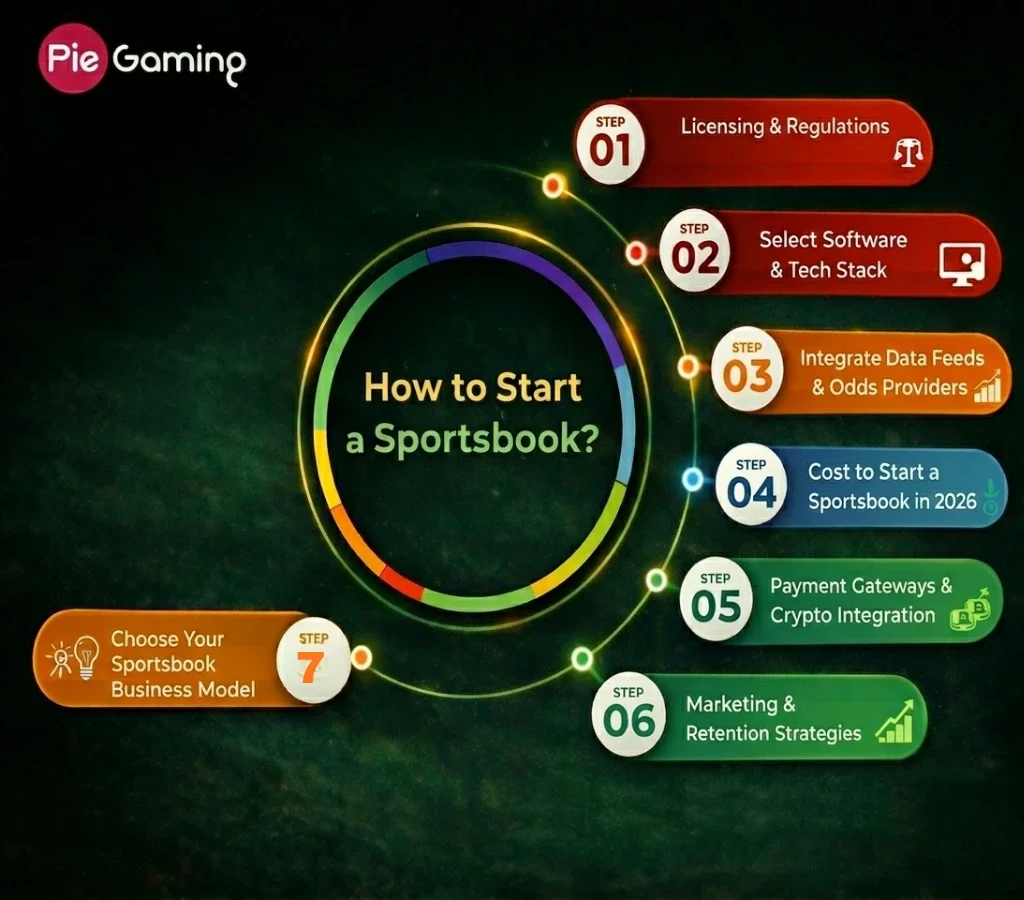
Steps to start a sportsbook
For most operators, turnkey sportsbook solutions offer the strongest long-term position. They provide enough speed to enter the market competitively while preserving control, flexibility, and exit options.
White label works for short-term plays, and building from scratch is rarely justified unless scale and capital are already secured.
Choosing the right sportsbook business model early is not just a technical decision. It shapes how far your sportsbook can grow.
Read More – Top White-Label Sportsbook Providers
Step 2: How Sportsbook Licensing and Regulations Actually Work (2026 Update)
To be precise, for first-time operators, offshore licenses such as Anjouan or Curaçao LOK often provide the fastest compliant entry. While Tier-1 markets only make sense once capital, compliance teams, and long-term scale are secured.
In 2026, sportsbook licensing ceased to be the trade-off between speed and credibility. The scope of regulatory expectation, cost of compliance, and operational risk are now considerably different across jurisdictions and market levels.
Rapid license issuers like Anjouan and Tobique are still gaining new operators because license approval times are as short as 3-4 weeks, and the stance is crypto-friendly. Low entry costs and less compliance are both characteristic of these jurisdictions, which are appropriate to offshore launches and early market testing, but are less accepted in highly regulated areas.
Meanwhile, the regulatory picture has shifted at the other end of the scale. Curaçao’s transition to the LOK framework has raised its regulatory standing. The new regime comes with even more severe AML audit, licensing supervision, and continuous reporting requirements. Although this makes Curaçao licenses more bank-friendly and reputable than in the past, they can no longer be easily licensed and must have appropriate compliance infrastructure.
Well-capitalized operators are the only ones that can sustain tier-1 markets like the UK and the U.S. Extensive taxes, long approvals, and large financial guarantees are the norm. In the U.S., recent developments, such as the city of Chicago trying to introduce new local taxes on sports betting and licensing requirements, demonstrate that the pressure on regulation and costs may even continue after entering the market.
In every jurisdiction, KYC and AML compliance is not optional, but is obligatory. The sportsbook sites need to facilitate verification of identity, monitoring of transactions, and reporting of regulations at the initial stages to prevent cases of delays, fines, or risk of loss of license.
Step 3: How to Select the Best Sportsbook Software & Tech Stack
Picking the right sportsbook software platform is not about appearance, but rather about the technical reliability, speed, and scalability. The most appropriate sportsbook platforms in 2026 will be designed to manage large amounts of betting, real-time information, and adherence without resistance. User retention, trading efficiency, and revenue per player are directly influenced by your tech stack.
Mobile-First Architecture Is Mandatory
According to industry statistics, 75-80 percent of sportsbook betting takes place on smaller screens, and therefore, performance on these screens is of utmost importance. Progressive Web Apps (PWAs) have become a new standard feature, with the speed of apps and push notification without the latency, charges, and security risk associated with the app store. Reduced load time is directly related to increased engagement and bet frequency.
The Player Account Management (PAM) System
While frontends can be redesigned, it is the player account management layer that controls the core of your operation:
- Wallets and payment flows
- Bonus logic and campaign management
- Player segmentation and VIP tracking
- Limits, risk profiles, and responsible gaming controls
A weak PAM restricts growth, complicates compliance, and limits personalization, regardless of how polished the UI looks. This system is the real backbone of your sportsbook.
Latency Decides Whether Players Stay or Leave
Live betting now drives the majority of sportsbook handle. If odds updates lag, bet slips fail, or markets suspend too often, players abandon the platform instantly. Low-latency architecture is essential when planning how to start a sportsbook that retains users:
- Real-time odds feeds with minimal delay
- Fast bet settlement and confirmation
- Stable APIs that handle peak traffic without breaking
Zero latency may be aspirational, but getting close to it keeps you competitive.
Other Critical Factors to Evaluate
Beyond these fundamentals, your tech stack should support:
- Scalability across markets and player growth
- Third-party integrations for payments, data, and tools
- Data ownership and detailed reporting capabilities
- Regulatory compliance features built in, not bolted on
The best sportsbook software supports growth across markets and regulations without forcing platform migrations later. In the long run, a strong tech stack is not a cost. It’s a competitive advantage.
Read More – How to Choose White-Label Sportsbook Software
Step 4: Integrate Data Feeds and Odds Providers for Sportsbook
The data of a sportsbook is only as good as the sportsbook itself. There will be no markets to provide, no bets to accept, and no risk of control without reputable sports betting data providers and odds feeds. The results of poor data quality or insufficient risk controls can cause losses and reputational damage both in the short term and in the long term.
Why You Need Professional Odds Providers
The odds of today’s sportsbooks are not computed manually. Rather, they combine real-time odds and event data feeds supplied by professional sports betting odds providers. These providers offer pre-match betting, live betting, results and settlement information on thousands of sports and leagues.
Most operators are not in a position to attempt to deal with odds internally without extensive trading knowledge and infrastructure. The integration of feed enables sportsbooks to be launched fast with competitive markets without incurring expensive pricing mistakes.
What Separates Good Feeds from Bad Ones
To compete seriously, your sportsbook needs breadth, depth, and speed. Top sportsbooks rely on feeds delivering 75,000–100,000+ pre-match events and 30,000–45,000+ live events monthly.
Minimal latency is essential. Delayed or incomplete feeds result in bad pricing, suspended markets, and frustrated players.
High-quality odds feed integration ensures:
- Accurate and timely odds updates
- Broad sports and league coverage
- Stable in-play betting during peak events. Players notice when markets are missing or when odds lag behind competitors.
How Risk Management Protects Your Bottom Line
Odds feeds alone are not enough. Without proper risk management, sportsbooks are exposed to professional bettors, arbitrage strategies, and late betting fraud. This is where automated risk management becomes essential.
Modern sportsbook software should automatically:
- Flag and limit sharp or professional bettors.
- Detect arbitrage across markets and providers.
- Monitor suspicious betting patterns in real time.
- Adjust limits and odds exposure dynamically.
These systems protect your margins while allowing recreational players to bet freely.
A strong sportsbook software partner handles odds feed integration, automated risk controls, and liability management as part of the platform.
This allows you to focus on growth, marketing, and player experience, while your provider safeguards the operational and financial risk behind the scenes.
Step 5: Cost to Start a Sportsbook in 2026
Before launching, you need clear answers to two questions: How much does it cost to start a sports betting platform, and how a sportsbook generates profit? Many operators underestimate the financial side of this business, and that mistake alone can shut down a promising project.
The Budget Breakdown
The cost of starting a sportsbook depends largely on your operating model and licensing choice.
A lean turnkey sportsbook can typically launch with initial capital between $50,000 and $100,000. This covers:
- Set up fees and platform access
- Basic licensing in cost-efficient jurisdictions
- Payment and odds feed integrations
- Early-stage marketing
If you aim for a fully licensed Tier 1 operation with stronger regulatory compliance, expanded payment infrastructure, and in-house staffing, the required investment can range between $500,000 and $2 million.
These numbers are not just about launch. They must also support operations for at least six to twelve months while you build volume.
Liquidity and Bankroll Requirements
One of the most overlooked aspects of sportsbook financial planning is liquidity. You need a reserve fund, often between $100,000 and $500,000, depending on projected betting volume, to ensure that winning players are paid immediately.
In sports betting, cash flow is critical. Even profitable sportsbooks can fail if they cannot cover large payouts during peak events. Delayed withdrawals damage trust quickly and can permanently hurt your brand.
Liquidity is not optional. It is operational survival.
Understanding the Vig and Sportsbook Profit Margins
Sportsbooks usually work with a hold of 5 to 10 percent. This implies that, given a one-million-dollar wager, the sportsbook will have about 50,000 to 100,000 in cash before operation costs are incurred.
High margins do not make profits. It comes from volume. Betting odds have competitiveness, which attracts more bettors, hence premium wagering activity. The bigger the volume, the better the margin.
Firm financial planning in 2026 implies balancing start-up expenses, healthy liquidity, and long-term betting volumes over short-term profits.
| Cost Category | Typical Range (USD) | Source Notes |
| Curaçao License Setup | $20,000–$25,000 (base) | One-time licensing cost before compliance adds more to first-year budget. |
| First-Year Curaçao Total | $43,000–$80,000+ | Inclusive of corporate, hosting, compliance, payments. |
| White Label Sportsbook Platform | $10,000–$25,000+ initial | Setup cost for basic white label platform |
| Turnkey Sportsbook Solution | $50,000–$300,000+ | Includes platform licensing, integration, go-live support |
| Custom / In-House Build | $150,000–$1,100,000+ | Full development, PAM, backend, compliance, integrations |
| Game / Data Integrations | $30,000–$80,000+ | Integrating third-party sportsbook/data services |
| Payment Gateway Setup | $10,000–$30,000+ | Cards, wallets, crypto, risk & fraud tools |
| KYC/AML Implementation | $15,000–$50,000+ | Third-party compliance tooling |
Step 6: Sportsbook Payment Gateways & Crypto Integration
Payments are the backbone of any sportsbook. If deposits fail or withdrawals drag on, players won’t stick around. In 2026, setting up the right sportsbook payment gateways isn’t a nice-to-have. It’s foundational for your entire operation.
And because gambling sits in the high-risk category, payment processing takes more planning than your average online business.
The right payment mix
A competitive sportsbook needs to support both fiat and crypto.
On the fiat side, that means debit and credit cards, bank transfers, and trusted e-wallets. These remain essential in regulated markets where players expect familiar, proven options.
On the crypto side, support for assets like BTC, USDT, and platform tokens such as FTN is increasingly critical, which is what dedicated crypto sportsbook software is built around. Crypto sports betting works well in markets where traditional banking is limited. It also unlocks faster withdrawals, lower transaction fees, and access to a truly global player base.
Offering only cards won’t cut it anymore. A strong payment mix builds trust, lifts conversion rates, and keeps you from relying too heavily on any single channel.
Local payment methods drive market success
Planning to enter specific regions? Localization isn’t optional.
In Brazil, PIX is make-or-break. Across many African markets, Mobile Money dominates. In parts of Asia and Latin America, regional bank transfers and alternative wallets outperform international cards every time.
You can’t launch globally with just Visa and Mastercard and expect strong results. Players use what they trust and what’s common where they live. Payment localization directly impacts deposit success rates and long-term retention.
High-risk merchant accounts and processing reality
Gambling businesses fall into the high-risk category for most traditional financial institutions. That means standard processors like Stripe or PayPal often reject sportsbook applications outright or freeze accounts without warning.
To operate legally and reliably, you need a specialized high-risk merchant account built for gambling payment processing. These providers understand compliance requirements, chargeback risks, and the regulatory frameworks unique to betting operations.
Approval takes time and demands detailed documentation: licensing proof, compliance policies, projected transaction volumes, the works.
Choosing the right payment processing partner minimizes operational disruptions and protects your revenue flow. In sports betting, smooth deposits and fast withdrawals aren’t just technical features. They’re a competitive edge.
Step 7: Sportsbook Marketing & Player Retention Strategies
Launching a sportsbook is only half the battle. The real challenge is attracting players consistently and keeping them active. A strong sportsbook marketing strategy balances aggressive acquisition with smart, data-driven retention.
In 2026, growth isn’t about who spends the most on ads. It’s about who manages traffic and player relationships better.
Acquisition versus retention
Most new operators focus heavily on acquisition: traffic matters, but long-term profitability lives in retention.
Affiliates remain the number one traffic driver in sports betting. These partners bring targeted players through SEO sites, tipster platforms, and comparison portals. In return, you typically pay a 20 to 50 percent revenue share. That might sound steep, but affiliates reduce upfront marketing risk and deliver performance-based growth.
Still, leaning only on acquisition gets expensive fast. The cost of acquiring a new player always outpaces the cost of retaining an existing one. Sustainable sportsbooks invest equally in keeping users active.
Bonuses 2.0 and gamification
Deposit matches and other traditional sportsbook bonus types don’t move the needle anymore, especially with younger audiences. Gen Z players expect engagement, not just promotions.
Modern retention strategies include gamification features like missions, leaderboard competitions, daily challenges, free-to-play tournaments, and prize wheels. These tools increase session time and create habit-driven engagement.
Instead of constantly throwing cash bonuses at players, successful sportsbooks design interactive experiences that reward activity, loyalty, and consistent betting behavior.
CRM and AI-driven personalization
Retention in 2026 runs on data. A proper CRM system combined with AI lets you segment players based on behavior, betting patterns, and value.
VIP players need personalized offers, higher limits, and dedicated support. Casual bettors respond better to smaller free bets or event-based reminders. High-risk players may need responsible gaming messaging instead of promotions.
Automated retention campaigns are essential. Sending a targeted SMS or push notification saying “Your team is playing tonight” can significantly lift reactivation rates.
The goal is simple: deliver the right message to the right player, at the right time.
A scalable sportsbook marketing strategy doesn’t just focus on bringing players in. It builds long-term relationships through affiliates, gamification, and AI-powered retention systems that maximize lifetime value.
How to Choose a Sportsbook Software Provider?
Choosing the right software provider is a strategic decision that will affect your business in the long run. Therefore, before making a decision, operators must consider the following things in the software provider while choosing:
Experience
The provider you’re choosing to work with must have proven experience in developing and managing a sportsbook platform. An experienced provider is more likely to understand the industry regulations, business requirements, betting operations, and evolving market trends. Review their portfolio, client base, and capabilities. Our comparison of the top sports betting software providers sets out the criteria in more detail.
Customization
Every client is different, and so are their requirements. Look for the software provider that offers you flexible customization options for branding, UI/UX, features, betting markets, odds, payment methods, and operational workflows. A customizable platform allows operators to offer players a unique betting experience.
Odds integrations
A sportsbook platform is known for odd feeds. Make sure the operator offers reliable pre-match and live odds feeds. Apart from this, the platform should also support smooth integration with reliable odds providers. Make sure the odds are fast and accurate, which can enhance players’ betting accuracy and overall player experience.
Security
Security is paramount in the iGaming industry. The provider you’re choosing should be ISO-certified. Following industry-standard security protocols like SSL-encrypted transactions, AML controls, etc., is also crucial.
Technical support
Technical and operational issues are inevitable. Make sure your provider offers round-the-clock technical support to resolve the issues quickly. From software updates to system monitoring and responsive post-launch support, the software provider must ensure everything is aligned with your business operations.
Why Rely on PieGaming for Sportsbook Software?
Working with the right sportsbook software provider is important for overall business success. A right provider understands the business requirements and offers scalable technology, flexible deployment options, bespoke features, and 24/7 technical support that adapts to business growth.
That’s where PieGaming comes in. We offer ready-to-launch white-label sportsbook software to operators who venture into the market quickly. Our platform comes pre-integrated with PAM, odd feeds, payment integrations, multiple markets, quick bets, a bonus engine, risk management tools, back-office support, and multiple third-party solutions. Whether you’re launching a sportsbook business or scaling it, our sportsbook models, such as turnkey and white-label, can best fit your budget and operational goals.
Operators can trust us for the following:
- Quick deployment
- Scalable infrastructure
- A detailed sportsbook ecosystem
- Flexible customization
- Support for fiat and cryptocurrency payments
- A completely dedicated support
Wrapping Up…
Building a sportsbook in 2026 takes more than ambition. It takes clarity, discipline, and the right setup from the start.
From picking your business model to securing data feeds, managing payments, controlling risk, and running smart marketing campaigns, every choice you make builds on the last. The operators who win aren’t always the fastest movers. They’re the best planners who truly understand how to start a sportsbook strategically.
If you go in with a solid strategy, the right partners, and realistic financial expectations, your sportsbook can grow into something strong and profitable. When you’re ready to compare deployment models, the team behind our sportsbook platform can walk you through the options.

FAQs
-
Why Choose a Sportsbook Software Provider Instead of In-House Development?
Providers save you 70–80% compared to building in-house (which can run $500K+), delivering vetted odds feeds, risk management tools, and ongoing support. This is critical in a mobile-heavy betting landscape where over 75% of wagers come from phones. For startups, it eliminates development risk entirely.
-
Can I start a sportsbook without a license?
No. Unlicensed operations face shutdowns, fines, and payment processor blocks in regulated markets. White-label sub-licenses (like Curacao, starting around $20K+) offer a legal, sustainable path to launch without the full licensing burden upfront.
-
How much does it cost to start a sportsbook?
The cost of a sportsbook solely depends on the business model, software type, licensing, third-party integrations, and customization requirements. But a white-label solution is typically less costly than turnkey or custom platforms.
-
What are the essential features of a modern sportsbook?
Features of a modern sportsbook include pre-match, live betting, real-time odds management, PAM, real-time odds management, risk management tools, reporting and analytics, etc.
-
White Label vs Turnkey Sportsbook – Which Is Better?
White label gets you live faster (2–6 weeks) with lower upfront costs through revenue share, making it ideal for startups. Turnkey gives you full customization and profit control, but takes longer (4–12 weeks). Your choice depends on budget and how much scalability you need from the start.
-
How Long Does It Take to Launch a Sportsbook?
Expect 1–3 months for turnkey or white-label setups, covering integration, testing, and licensing. Delays usually come from compliance hurdles and payment approvals. Building in-house? Plan for 6–18 months minimum.
-
How long does it take to launch a sportsbook?
The launch timeline of the sportsbook depends on the type of solution. A white-label sportsbook platform can be launched within 2 weeks, while turnkey software can be launched within 4-6 weeks. A fully custom platform can be launched within a few months, depending on the requirements.

Palak Madan has been writing about the iGaming industry since 2024. She focuses on helping operators and founders understand their options when launching an online casino, from choosing the right software provider to figuring out costs and compliance requirements across different markets. At PieGaming, she covers topics like white label casino solutions, platform selection, and market entry, turning complex industry information into practical guidance for people building iGaming businesses. She also keeps a close eye on licensing and regulatory changes; particularly how new rules shape the way operators enter and grow in different jurisdictions.

Micro betting is a type of live sports betting that focuses on the small moments within a game. Instead of wagering on the final result, bettors place bets on what happens next, such as the outcome of the next pitch in baseball, point in tennis, possession in basketball, or ball in cricket. Because these events are settled almost instantly, micro betting offers a faster and more dynamic experience than traditional sports wagers.
Esports betting offers a major opportunity to operators, and choosing the right partner can greatly impact profitability, player engagement, and operational efficiency.
Learn what retail sports betting is, how on-premise sportsbooks operate, and what the retail model costs and returns compared with going online only.
Read about what horse racing betting software includes — tote and fixed-odds markets, race feeds, and payments — plus what a build or a full license costs.

Learn how automated sports betting software handles odds, bet acceptance, risk, and payouts – what operators can automate and what still needs a trader.
Learn about how sports betting algorithms price odds and manage risk, plus the leading algorithm software compared on data, models, and integration options.
Learn how esports betting works as a vertical — titles, markets, odds feeds, and the software operators need to add esports to an existing sportsbook.





See you in your inbox soon!

Stay ahead of the game. Subscribe for exclusive content, updates, and insiders!