
I problemi dei casinò online possono colpire gli operatori in ogni fase, dall'ingresso nel mercato e dai pagamenti alla fidelizzazione dei giocatori, alla tecnologia e alla redditività. Scopri le principali sfide e le soluzioni pratiche per affrontarle.
The online casino industry is lucrative, offering operators an exciting opportunity to grow their business. But every opportunity comes with a lot of challenges. Operators face numerous challenges like licensing & compliance, fraud and bonus abuse, higher player acquisition cost, weak player retention, game content gaps, and technology limitations.
In fact, the challenges become more complex when operators expand across jurisdictions. The key is not simply identifying problems but planning for them before they affect operations.
Whether you’re a startup or an established operator, challenges in the online casino business can put you behind in the competition. So, let’s learn about common online casino problems operators face and how to solve them.
Common Online Casino Operator Challenges from Pre-Launch to Scale
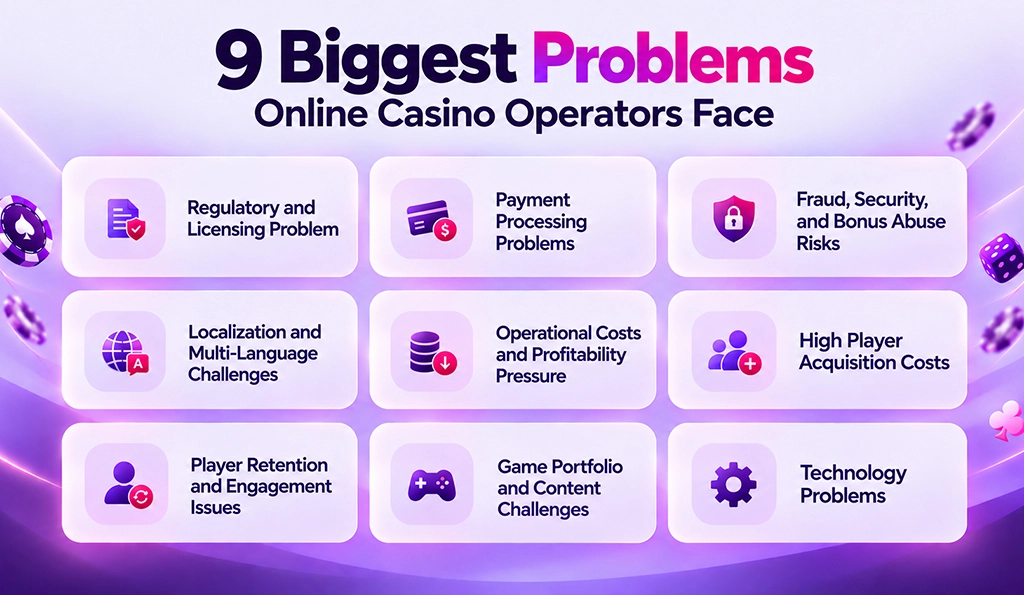
Problems Online Casino Operators Face
While entering the settore dei casinò online, every operator faces challenges (familiar or unfamiliar); knowing these challenges and overcoming them is crucial to running casino operations seamlessly. Let’s understand these challenges.
1. Regulatory and Licensing Problems in Online Casinos
Licensing is one of the first challenges to be addressed by an operator. The requirements can be different for each jurisdiction, including matters of licensing, gioco responsabile, KYC, AML, customer funds, advertising, and reporting.
There is a total of 195 countries in the world, and among them, 77 countries are iGaming-friendly. Each country has different laws and regulations, and constant regulatory changes mean compliance is an ongoing task (even within Europe or the U.S.). What challenges do operators face here?
- Aggiornamenti normativi costanti
- Costi iniziali elevati
- Processo di approvazione lungo
- Regole KYC/AML
- Implementazione di politiche di tutela dei giocatori
Soluzioni:
- Gli operatori devono tenersi aggiornati sulle nuove leggi e adattarsi per rimanere conformi.
- È necessario prevedere un budget che includa tempo e denaro per gestire i costi di licenza e il processo di approvazione.
- Applica tutte le regole di tutela dei giocatori per evitare pesanti sanzioni
- Monitor regulatory changes after launch
- Work with qualified legal and compliance professionals for jurisdiction-specific advice
Responsible gambling and player protection: Regulators are now requiring operators to go beyond licensing. In some cases, they must provide deposit and loss limits, opzioni di autoesclusione, reality checks, and identity and age verification tools, as well as staff training on spotting risky behaviors. All of these have an impact on the design and implementation of bonuses, VIP programs, and retention strategies, which is why they must be considered at the conceptual stage and integrated into the product and marketing strategies.
2. Payment Processing Problems for Online Casinos
Payments can directly impact the player’s journey. Failed deposits, slow withdrawals, a limited range of metodi di pagamento, transaction friction, and disputes can all contribute to additional support overhead and a poor user journey.
Operators need to consider the risk of PSP (Fornitore di servizi di pagamento) termination or account restrictions. A payment provider can impose restrictions or terminate the operator’s account based on risk assessments, contractual requirements, compliance with regulations, or the markets and transaction types that the operator is operating in. Having dependency on one provider can put operators at risk.
In Great Britain, for example, casino operators can only accept a set of customer payments through qualifying payment service providers, and the Gambling Commission has raised concerns over third-party funding and open-loop processes.
Soluzioni:
- Offer payment methods relevant to the target market
- Avoid unnecessary concentration on a single PSP
- Monitor deposit failure, withdrawal processing time, declines and chargebacks
- Carry out appropriate customer and payment-method checks
- Make the deposit and withdrawal process clear to customers before launch
3. Fraud and Bonus Abuse Risks
Fraud is not limited to stolen card details. It can involve identity fraud, money laundering, bonus abuse, account takeover, and payment fraud. According to Sumsub’s State of Identity Verification in the iGaming Industry 2025 report, 41.9% of surveyed operators identified deposits as their primary fraud flashpoint, with 23.8% selecting onboarding/registration and 22.9% selecting withdrawals.
Further, Poor registration and onboarding UX also create unnecessary friction. If players face unclear verification requirements, they may leave the platform before completing registration.
The operators identified identity fraud, money laundering, and bonus abuse as their most pressing fraud threats. The operators’ primary fraud dilemma involves the balance between the friction in the customer journey and the level of verification and control needed to prevent fraud.
Soluzioni:
- Applying risk-based KYC and verification processes
- Monitoring suspicious deposits, withdrawals, and account activity
- Detecting pattern frauds such as multiple accounts and bonus abuse
- Transaction and risk monitoring combined with customer verification
- Periodic fraud rule reviews due to the dynamic nature of abuse patterns.
4. Localization and Multi-Language Challenges
Launching in a new market involves more than translating website content. Giving a localized feel to their players is key to this business. Operators must consider registration flows, customer expectations, payment preferences, game preferences, support, and local market requirements.
A multinational business should offer language-specific support and make sure the processes for payments, account management, verification, and bonuses are well-documented and localized.
Soluzioni:
- Simplify the account opening and onboarding processes.
- Test the mobile version’s performance in the targeted markets.
- speciale! supporto multilingue
- Review player behavior by market and adjust the experience accordingly
- Localize payment methods and currencies as per each targeted market.
5. Operational Costs and Profitability Pressure
La maggior parte degli operatori crede che gestire un casinò online sia un investimento una tantum, il che è assolutamente sbagliato. Gestire un casinò online is a continuous investment that can eat into profits. For instance, maintenance costs, marketing, and affiliate expenses put profitability pressure on operators. Operators forget about maintenance costs and don’t spare money, due to which they face cash flow problems.
Gaming taxes and license fees also cut into margins, and the rates and structure (for example, a percentage of gross gaming revenue) vary significantly by jurisdiction, so operators should take them into account when selecting a market to operate in.
Soluzioni:
- Search for budget-friendly casino models like software per casinò white label
- Ottimizza il marketing con strategie incentrate sul ROI.
- Creare canali di marketing interni per ridurre la dipendenza dagli affiliati
- Investi in un programma fedeltà e in offerte personalizzate per migliorare la redditività
- Diversify revenue stream via sports betting, giochi con croupier dal vivo, and VIP programs
6. High Player Acquisition Costs and Marketing Challenges
L'acquisizione di nuovi giocatori è uno dei problemi più comuni per gli operatori di casinò online. Perché? Perché i canali pubblicitari e di marketing sono perlopiù limitati. Ad esempio, i mercati del gioco d'azzardo online in Europa o negli Stati Uniti sono saturi, il che comporta elevati costi pubblicitari.
Some iGaming industry data suggest that acquiring new players can cost 250-500. Further, many casinos rely on affiliate partners to bring in traffic, who often demand 30-50% of new revenue share. These commissions eat significantly into margins.
Soluzioni:
- Sfrutta i canali di acquisizione organica come blog, guide e pagine di comparazione.
- Run geo-focused campaigns to target emerging markets like Asia and LATAM, where permitted by local regulations and where CAC is often lower than in the EU/US.
- Investi nel marketing del ciclo di vita del cliente, come email, SMS e notifiche push, perché sono più economici delle pubblicità a pagamento.
- Costruire internamente programmi di affiliazione
- Investire nella costruzione del marchio e nelle strategie di pubblicità nativa
7. Player Retention and Engagement Issues
Acquisire nuovi giocatori è metà dell'opera; fidelizzarli è molto difficile. Un sito di casinò medio perde la maggior parte dei nuovi giocatori quasi immediatamente. Secondo alcuni esperti di iGaming, gli operatori di casinò potrebbero perdere oltre il 90% delle nuove iscrizioni entro una settimana se non riescono a coinvolgerli.
Some case studies conducted on online casino operators reveal that personalized rewards can boost engagement by 20%, but operators fail to implement these engagement tools on the platform.
Soluzioni:
- Offer instant rewards on first deposit, first bet, and first win
- Segmentare i giocatori in base al comportamento e al valore
- Implementare la personalizzazione basata sull'intelligenza artificiale
- Costruisci una solida strategia per i giocatori VIP e di alto valore tramite vantaggi esclusivi
- Utilizzare il coinvolgimento omnicanale
8. Game Portfolio and Content Challenges
Una piattaforma di casinò è nota per avere una varietà di giochi da casinò popolari. And some operators choose to compromise with a game library. Having limited games on the casino platform, operators may face issues with player acquisition, engagement, and retention.
Some operators prefer integrating high-demand casino games like poker, slots, giochi d'arresto, live dealers, scratch cards, etc., and they face integration issues. Leading casino platforms partner with numerous gaming studios.
Soluzioni:
- Usa il aggregatori di giochi da casinò per semplificare le integrazioni anziché connettere ciascun fornitore individualmente.
- Aggiungiamo regolarmente nuovi giochi (uscite settimanali/mensili).
- Feature “New Arrivals” and “Trending Games” sections
- Rimani aggiornato sulle tendenze di mercato e sulle offerte della concorrenza.
- Implementa suggerimenti basati sull'intelligenza artificiale (Giochi che potrebbero piacerti)
- Evitate la grafica pesante, che rallenta il gioco.
9. Technology Problems Faced by Online Casinos
Selezionando il giusto software per casinò online È importante, poiché qualsiasi problema tecnico nel software può paralizzare le operazioni da un giorno all'altro. Se scegliete di collaborare con un fornitore di software inesperto, potrebbe non aggiornare rapidamente i vostri sistemi o non correggere tempestivamente i bug.
Also, if a platform doesn’t let you do easy UI customization or quick feature changes, it will limit marketing or product strategies. Many operators face issues with adding new game providers or localizing content, which leads to heavy deployment.
Soluzioni:
- Collabora con un fornitore di software affidabile ed esperto.
- Opta per una piattaforma scalabile e pronta per il futuro.
- Ottieni un'architettura modulare o basata su API
- Ottimizzare l'esperienza utente (UX) su tutti i dispositivi.
- Scegli la piattaforma in base alle preferenze dei giocatori e alle tendenze di mercato.
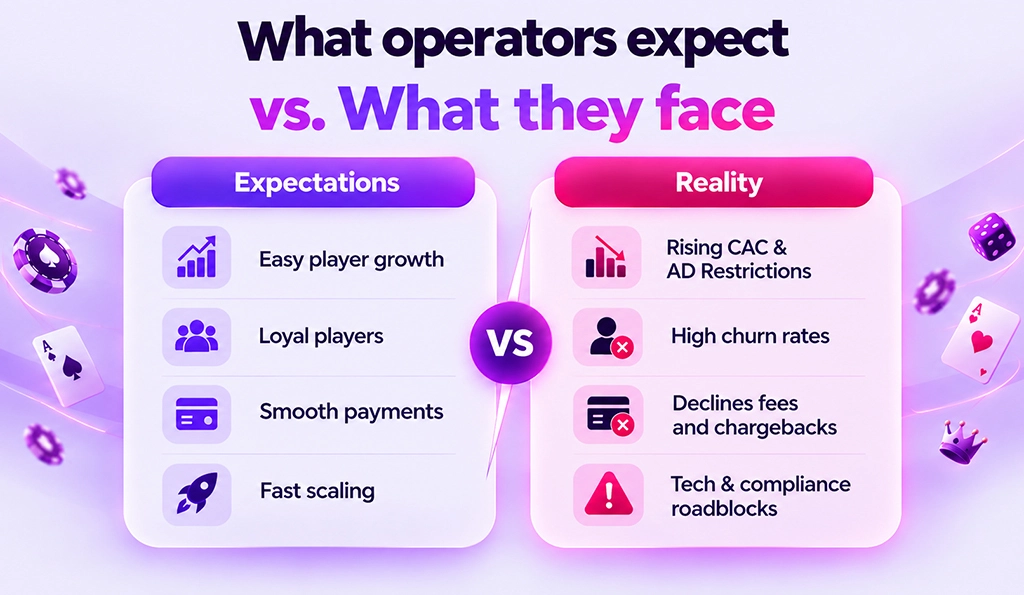
Casino operators’ problems
Mistakes Online Casino Operators Should Avoid
Below are the common mistakes that operators should avoid making.
Choosing software on price alone
The cheapest software option may not offer the required payment integrations, PAM capabilities, game coverage, reporting, scalability, and support.
Invece: balance the operational requirements and long-term costs before selecting a provider.
Not planning for scalability and load before launch
A system that works under low traffic may experience issues as the number of registrations, transactions, games, and markets increases.
Invece: estimate the expected traffic, transaction volumes, integrations, and market expansion before launch.
Depending on a single payment provider or platform vendor
A single-provider dependency can expose the operator to risks in the event of downtime, restrictions, or termination by the provider.
Invece: understand the alternatives and the integration requirements for each provider.
Launching without KPIs, a baseline, and unit economics targets
Without predefined targets, operators may realize that revenue is growing, but acquisition and retention are not being driven profitably.
Invece: set targets for CAC, LTV, conversion, retention, churn, GGR & NGR, and payment performance.
No support process before go-live
Payment, verification, account, and bonus queries can begin as soon as the casino launches.
Invece: establish customer support channels, escalation procedures, FAQs, and ownership before the first player joins.
Choosing a business model without understanding licensing
White-label, turnkey, and other models can have significantly different levels of customization, control, and responsibility. The business model should therefore also be balanced against the regulatory requirements of the target market.
Invece: understand the licensing requirements and responsibilities before choosing the operating and marketing model.
Come PieGaming Helps Operators Address Common Online Casino Problems?
No software can remove regulatory challenges, but it can definitely reduce operational complexities in areas that operators manage every day. That’s what PieGaming software does.
Payment challenges → payment integrations
PieGaming’s casino software offers integrazioni di pagamento that let operators connect relevant payment options for their target markets.
Player management → PAM
Migliori Sistema di gestione degli account dei giocatori can help operators manage registration, player accounts, wallets, payments, KYC-related workflows, player activity, segmentation, and other player-management processes.
Retention → CRM/Segmentation
The software’s CRM and segmentation capabilities can help operators organize player data and deliver more personalized engagement based on player behavior.
Operational management → Back office
Migliori strumenti di back-office can provide operators with a central environment to manage operational activities, reporting, configurations, and other administrative functions.
Game availability → Pre-integrated game providers
La disponibilità di pre-integrated game providers can help reduce the operational burden of sourcing and connecting individual game suppliers.
Conclusione
Most online casino issues come from decisions made before launch — what markets to enter, which license to obtain, what payment processors and software to use, and what metrics to track. Operators who make the right choices before launching avoid most of the issues affecting their growth and profitability.
Some problems never go away. For instance, regulations, fraudulent schemes, and acquisition and retention strategies require constant attention. The best way to approach such operators’ issues is to have them on the radar at all times and respond promptly.
In particular, prior to launch, operators should research and comply with the licensing requirements in all target jurisdictions, select a reliable platform able to scale with the business, integrate multiple payments processors, and set up a customer support system.
At launch, operators should optimize the onboarding and KYC procedures, localize the product for each market, and prepare an appropriate game catalog.
Post-launch activities should involve analyzing such metrics as customer acquisition cost (CAC), lifetime value (LTV), retention rates, and payment performance, reviewing and updating anti-fraud measures, and adapting to regulatory and market changes.
Contattaci
DOMANDE FREQUENTI
-
Is starting an online casino profitable in 2026?
Profitability depends on various factors like the target market, licensing and operating costs, player acquisition costs, retention, game content, revenue per player, etc.
-
Why do so many online casinos fail within the first two years?
Online casino businesses can struggle because of high acquisition costs, poor retention, unsuitable software, regulatory issues, payment problems, weak fraud controls, underestimating ongoing costs, insufficient market research, etc.
-
Turnkey vs. white-label online casino: which has fewer operational problems?
White label software generally uses a more standardized setup, which enables faster deployment. Whereas a turnkey solution allows greater customization and control over the technology and integrations. The operational technologies depend on the provider, business model, and target jurisdiction.
-
What is the biggest operational mistake new online casino operators make after launch?
One common mistake is focusing too much on player acquisition while overlooking the operational systems. Payment issues, weak customer support, poor onboarding, limited game choice, and the lack of clear KPIs can quickly affect player experience and operating costs.
-
How can online casino operators reduce player churn and increase retention?
Operators can reduce player churn by identifying changing player behavior and responding with relevant, timely engagement. CRM and player segmentation can help operators personalize promotions and communication.

Monika Gola è una specialista di contenuti iGaming presso PieGamingDal 2020 si dedica alla ricerca e allo sviluppo di contenuti relativi alla selezione del software, alla regolamentazione dei casinò online e delle scommesse sportive, nonché alle strategie di crescita degli operatori. La sua ricerca comprende l'analisi delle opportunità di mercato in regioni come Europa, Africa e Sud-est asiatico, oltre alla valutazione dei quadri normativi e delle barriere all'ingresso. Monitora attivamente le tendenze del settore, gli aggiornamenti in materia di conformità e l'evoluzione delle esigenze dei giocatori nei mercati globali dell'iGaming, al fine di aiutare gli operatori a orientarsi con successo in questo settore.
Avviare un casinò online "chiavi in mano" significa ottenere una piattaforma già pronta con software preconfigurato e giochi preintegrati, ma personalizzabile a proprio piacimento. I passaggi fondamentali includono la ricerca di mercato, la definizione del budget, la scelta dei partner, l'ottenimento di una licenza di gioco, la configurazione dei metodi di pagamento e altro ancora.
Il Kenya vanta un mercato del gioco d'azzardo online in crescita, supportato dalla crescente diffusione di Internet e dei sistemi di pagamento mobile. Questa guida chiarisce i passaggi e i protocolli da seguire per avviare un'attività di casinò online in Kenya, inclusi i regolamenti e i requisiti di licenza.

Le componenti chiave per incrementare il numero di utenti dei casinò online possono essere riassunte in quattro aree: i giusti canali di acquisizione, un'esperienza personalizzata, lo sviluppo di programmi fedeltà e decisioni basate sui dati. Creare un'esperienza mobile efficace, mantenere alto il coinvolgimento dei giocatori e raggiungere i mercati di riferimento sono tutti elementi altrettanto cruciali per una crescita sostenibile.

Questo blog analizza le strategie chiave dei principali operatori di iGaming nel 2026 e come puoi crescere come loro diventando leader di mercato. Restate sintonizzati fino alla fine.
Avviare un casinò online sembra entusiasmante. Ma molti nuovi operatori falliscono nel giro di pochi mesi a causa di errori evitabili. Ecco i 10 errori più comuni da evitare.

Scopri come aprire un casinò online in Turchia nel 2026. Ricevi semplici consigli su leggi, licenze, pagamenti e altro ancora per gestire la tua attività senza intoppi.
GGR e NGR sono le due metriche di ricavo che ogni operatore di casinò deve monitorare. Il GGR è dato dal totale delle scommesse meno le vincite dei giocatori, e riflette le prestazioni di gioco prima di qualsiasi detrazione. L'NGR è il GGR dopo la detrazione di bonus, tasse, commissioni di pagamento, royalty dei fornitori e chargeback. La differenza tra i due valori rivela dove si sta accumulando pressione sui margini.

Ci vediamo presto nella tua casella di posta!

Stai al passo con i tempi. Iscriviti per l'esclusiva
contenuti, aggiornamenti e addetti ai lavori!