
The best jurisdiction depends on your target market. Malta suits operators who want a credible European base with strong banking. The UKGC is required for Great Britain. The Isle of Man suits B2B and platform-led operators. Curaçao is the usual low-cost route for global launches. Anjouan is typically quoted as the cheapest and fastest, but with limited banking and lower recognition.
Anjouan’s Internet Gaming Regulatory Authority has a public register of licensed operators and there were well over 1,000 in operation in 2026. The LOK (Luxury Tax on Gambling) on Curaçao has been in effect since 24 December 2024, while Malta’s new gaming tax rules have been in effect since 1 October 2026.
Online gambling jurisdictions are nations and territories where the government’s gambling regulatory agency grants permission to operate real money games. Ottenere una licenza iGaming does not guarantee access to all markets. The best option is based on target markets, budget, availability of banking solutions, and the configuration of the platform; not the lowest fee. Fit matters most.
Best Jurisdictions for an Online Gambling License at a Glance
There isn’t a single best online gambling license. The best one to choose depends on where your players are, what you will be offering, how much you’re willing to invest, and what fornitori di pagamento will support you. Having a license in one jurisdiction does not mean that you have automatic access to all markets. This table correlates common operator goals with jurisdictions that will fit them.
What Online Gambling License Actually Covers?
A license is a right to provide specific types of gambling within a regulator’s jurisdiction. It includes KYC and AML, gioco d'azzardo responsabile, and regulatory reporting. Gambling taxes and levies differ from market to market. It’s more like a permit than a passport for the entire map.
Target-market licenses
- UKGC: Great Britain (England, Scotland, Wales).
- Arabia Saudita: I Paesi Bassi.
- Spelinspektionen: Sweden. Gambling tax is 22% of GGR (stakes less payouts).
- DGOJ: Spain. A general license plus a singular license for each game type.
Operating-base licenses
- No EU passport: Malta and Estonia do not authorize travel to the rest of the EU. Gambling laws remain at the national level in the EU.
- Local rules apply: A foreign license is not valid in a target country without a local authorization.
- Territorial limits: The Isle of Man has territorial restrictions on where you can take players. A legal opinion per country makes sense when the rules are not clear.
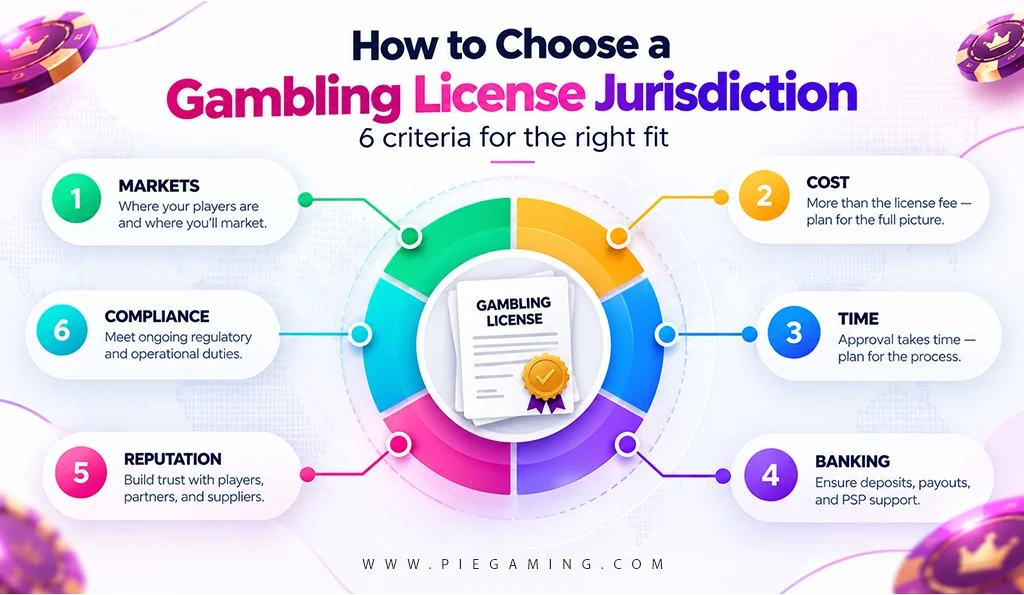
How to Choose a Gambling License Jurisdiction: 6 Judgement Criteria
Choose a Gambling License Jurisdiction
The cheapest license is rarely the best fit. Even a quick, inexpensive route can fall short if it prevents you from reaching your target markets, or your payment provider won’t support it, or you can’t sustain the compliance requirements. Take the time to consider these six points before you commit. If the legal situation is not well understood, seek counsel on each target market.
1. Mercati di riferimento
Start with where your players are and where you’ll market. Your license must permit the activity, but it doesn’t override the laws of the countries you target.
License conditions, regulator guidance, and local law can all limit where you accept players or advertise. A license from one jurisdiction also doesn’t replace authorization in a locally regulated market. Great Britain is the classic case, because you need a UKGC license even if you’re licensed elsewhere. If your main market needs its own license, settle that first.
2. Total budget
The headline fee is only one line in the budget. Most operators need to plan for:
- The application fee and the annual fee to keep the license are required.
- Gaming tax or revenue share, often one of the highest regulatory costs over time.
- Compliance contributions, including levies, testing expenses, or payments of funds.
- Staff, officers, directors, or key function holders from the area.
- Legal and advisory support for the application, market opinions, and ongoing advice.
- From platform and game suppliers to AML, fraud tools and payment processing.
3. Timeline
Treat every estimate here as a guide. Timing depends on complete documents, ownership checks, product scope, technical certification, and regulator workload.
Testing, certification, game integrations, bank accounts, and PSP underwriting come on top. Don’t treat approval day as launch day.
4. Banking and PSP acceptance
Without deposits and payouts, a license is not very good. Before you get onto a route, consult banks, acquirers, PSPs and crypto casino providers. Have each one determined if they would accept your jurisdiction, structure, products and markets.
After that look for fees, settlement times, rolling reserves, and chargeback, fraud, and AML requirements. Lower recognition or offshore licenses may require more stringent underwriting, less availability, or higher reserves. These are achievable and not guaranteed, so seek written assurances early.
5. Reputazione
Your license is another sign of trust. It is looked at by players, affiliates, suppliers, investors and PSPs before they do business with you. Partner due diligence will be eased by a recognized regulator.
A lower-recognition license may require more explanation and more proof. Reputation is important, but ultimately, it is your model, your markets and your budget that will make the final decision.
6. Ongoing compliance
Approval is a beginning, not an end. Once launched, it will be necessary to maintain:
- Key function holders, such as a compliance officer or MLRO, depend on the license type.
- Audits and testing your systems, controls, and game fairness.
- Scheduled reports, incident notices, and change notifications to the regulator.
- AML and KYC procedures such as customer screening and transaction surveillance.
- Safer gambling tools, such as limits, autoesclusione, and harm detection.
- Gambling taxes, levies, and annual charges.
Before you apply, verify that you have the resources and people in place to carry out these responsibilities.
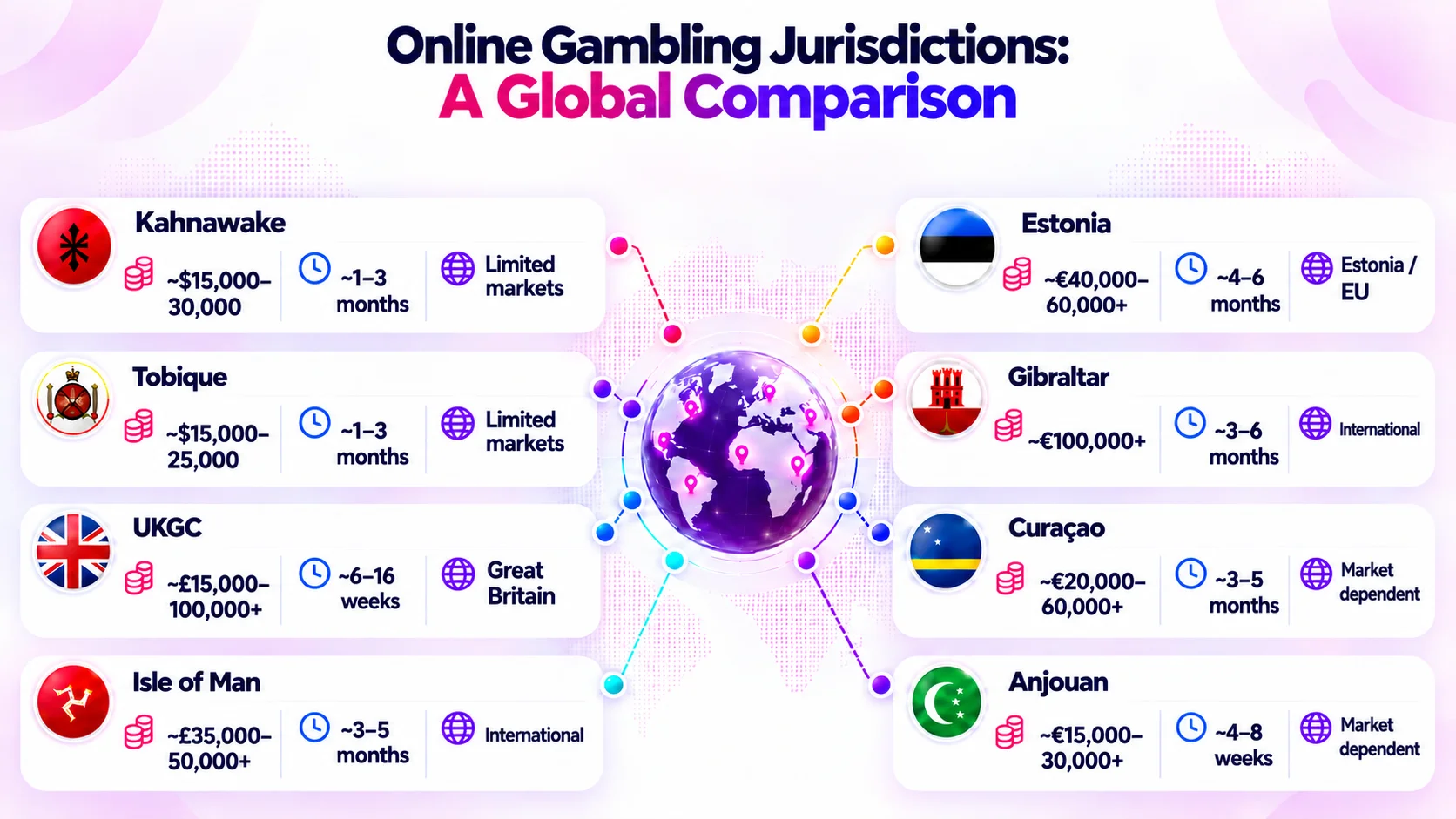
Online Gambling Jurisdictions Reviewed: Cost, Tax, Timeline and Market Access
Online Gambling Jurisdictions: A Global Comparison
Nota: Le tasse, timelines, tax rates and regulations displayed on this page vary frequently according to the type of license and license structure. Some figures are adviser estimates, not official prices. Always verify information with the regulator and consult legal and tax counsel prior to application and/or launch in target markets. This information is general in nature and not a legal, tax or financial statement.
The jurisdictions below are each considered with the points that pertain to their journey – who do they serve, cost, timing, tax and market access (where available). Prices, schedules, and tax rates vary, and a license does not guarantee that you can accept players in all markets. Verify with a regulator and consult with the legal team for your target markets before budgeting or launching.
Malta (MGA)
Malta suits funded operators building a long-term European brand.
- Costo: The B2C application fee is €5,000. The standard annual fee is €25,000, or €10,000 for Type 4 only. A separate compliance contribution is based on gaming revenue.
- Timeline: Allow for several months. The MGA does not specify an approval timeframe and has 90 days after the issuance of the license to go live.
- IVA Until 30th September 2026, players in Malta were taxed on gaming income at 5%. Since 1 October 2026, the rate is 15% on Type 1 and 10% on Types 2-4. This is apart from the license fees and complicity of contribution.
- Requisiti: Depending on your model, you’ll need to get fitness and propriety checks, plan a business plan, hire key function holders, do audited system testing, and have the right number of financial resources.
- Accesso al mercato: It’s a respected EU license, but not an EU-wide gambling passport.
- Platform impact: Your platform must pass audited system testing and support key function holders’ reporting.
United Kingdom (UKGC)
The UKGC suits brands with a dedicated UK strategy and mature compliance.
- Costo: Application and annual fees are banded by revenue.
- Timeline: The Commission’s current average for a complete application is 16 weeks, or about four months. That isn’t guaranteed, and complex cases take longer.
- IVA Remote Gaming Duty is 40% on remote gaming profits for accounting periods beginning on or after 1 April 2026. Betting has separate duty rules.
- Requisiti: You must comply with the LCCP, including AML, safer gambling, customer interaction, and advertising rules. You’re also responsible for the marketing of affiliates who act for you.
- Accesso al mercato: The license covers Great Britain only (England, Scotland and Wales).
- Platform impact: Your platform needs affordability and safer gambling tooling, LCCP-compliant advertising controls, and oversight of affiliate marketing.
Isola di Man
The Isle of Man suits credibility-first operators and B2B platform providers.
- Costo: The application fee is £5,250 and the annual fee is £36,750.
- Timeline: Expect about 3-5 months.
- IVA Gambling yield is taxed at banded rates, ranging from 0.1% to 1.5%. Before you budget, check the precise levels and limits with the Gambling Supervision Commission.
- Requisiti: You need local management, technical work, and ongoing compliance.
- Accesso al mercato: The license doesn’t authorize you in other countries’ markets. Review the gambling, advertising, tax and payment laws for each target market and obtain legal counsel if uncertain.
- Platform impact: Your platform needs market eligibility checks per country, backed by legal opinions where the rules are unclear.
Gibilterra
Gibraltar is ideal for existing operators who wish to base themselves in a trusted location with an active B2B community.
- Stato legale: The Gambling Act 2025 has been substantially implemented on 1st April 2026. Please refer to the official commencement notice for provisions that remain to commence.
- Costi e tempi: Check any existing fees and processing times with the Gibraltar Gambling Division. They rely on the type and structure of the license.
- IVA Tax will vary depending on your entity type and group structure – please seek tax advice prior to selecting Gibraltar.
- Accesso al mercato: License does not provide local authorization in your target markets.
- Platform impact: Check how your structure affects reporting and data segregation before you build.
Estonia
Estonia suits tech-focused operators that want an EU-based license for the Estonian market.
- Costo: You need €1 million in minimum share capital. The activity license fee is €47,940 and the operating permit fee is €3,200.
- Timeline: The decision on the activity license comes within 4 months of complete documents, and within 6 months of the application at the latest. You also need a separate operating permit, so this isn’t your full launch timeline.
- IVA Remote games have been taxed at 5.5% of stakes received less winnings paid since 1 March 2026.
- Crypto: An Estonian license isn’t a crypto-payment approval. Get advice on AML, sanctions, virtual asset rules and payment provider acceptance first.
- Platform impact: Your platform needs tax tracking on stakes, less winnings, plus AML and payment-provider checks for any crypto payments.
Curaçao (CGA)
Curaçao suits cost-sensitive operators looking for an offshore route, as long as their target markets allow it.
- Struttura: The LOK has been in operation as of 24 December 2024. The Curaçao Gaming Authority is responsible for the licensing of a qualifying B2C operator and supplier business.
- Requisiti: You need a Curaçao legal entity, a local seat, qualifying resident management, AML and technical compliance, and audit and reporting duties.
- Timeline: Give 3-5 months for a properly prepared file. Once your documents are complete, the CGA reviews in two stages (approx. 8 weeks each) that may be extended.
- Costo: Advisers often estimate €24,500 to €47,500 a year. These are estimates provided by the commercial sector and do not represent CGA prices.
- Data chiave: From 24 December 2026, suppliers of critical services and/or products originating from and in Curaçao will need a CGA supplier license. Typically, offshore critical suppliers are required to register.
- Attenzione: Be careful about additional PSP oversight. A Curaçao license is not a substitute for the local license if there is one required by the target market.
- Platform impact: You should have geo-blocking for excluded markets, AML and technical compliance, and PSP-ready reporting.
Anjouan and Other Offshore Routes
These routes can mean lower headline costs and quicker setups. Their recognition with banks, PSPs, suppliers, affiliates, and regulated markets can be much weaker. Check bankability and target market legality before you commit.
- Angiòan: Advisers generally estimate that it takes somewhere in the range of €17,000 to €25,000 a year and 4-8 weeks to issue, but the authority does not provide a time frame. Be prepared for diminished recognition and tough PSP underwriting. Ensure the tax position is correct, and the authority is in current state before you make an application.
- Kahnawake: First nations gaming authorization in Canada. It isn’t an Ontario, AGCO or Canada-wide license. Check permitted activities and market limits with the Kahnawake Gaming Commission.
- Tobique: A First Nations Road. It does not provide automatic access to North American regulated markets, consult its scope, as well as its commercial acceptance.
- Nevis: A new framework came into force on 1 July 2025 in Nevis. Ensure the legislation, license classes, position and tax is correct and up to date.
- Vanuatu: Interactive gaming is in place. Check the fees, products that may be sold, local presence requirements and market caps with the authority and a legal advisor.
Newer Regimes to Watch
These regimes are not fully established, so please verify their status prior to planning activities around them.
Single License or License Stack: Which One to Choose?
One license is typically easier to operate and more cost-efficient to maintain. While a license stack can open additional markets, each additional license comes with its own fees and taxes, reporting and compliance requirements. Finite number of early-stage operators begin with one jurisdiction and expand as their market plan dictates.
Begin by getting a license for your priority market. A typical route is to launch the product on Curaçao, a place where it is legal to be in the market and then get the MGA or UKGC.
Another starts on Anjouan for a lean launch, then adds Estonia or the MGA. A Curaçao or Anjouan license will not cover Great Britain; thus, the UKGC license must be obtained first. Estonia is not an EU-wide passport. Consider each additional license as a separate project.
Build your platform for expansion from day one, because retrofitting can be slow and expensive. It should:
- Segment player, transaction, and compliance data by jurisdiction where rules require it.
- Check location and market eligibility before registration or deposit.
- Control which games, bonuses, and payment methods are live in each market.
- Produce separate reports for each regulator.
Budget the full cost of every license in the stack:
- Application, renewal, and regulatory fees.
- Gaming tax, levies, or revenue shares.
- Local substances, such as entities, directors, and key function holders.
- Banking and PSP terms, including fees and reserves.
- Legal, compliance, testing, and audit costs.
A second license won’t always cost more than the first. Once staff, technology, tax, and payments are included, though, total costs can run well above the headline fee.
Own License or a Provider’s License?
Some operators launch under a provider’s license first, then apply for their own once the model is proven. This can be faster and cheaper to start, but you have less control, and the arrangement depends on the provider’s terms.
Your own license gives you full control and a stronger standing with banks and partners, but it costs more and takes longer. Check out what each regulator allows before you decide.
Avvolgendo…
In 2026, there is no definitive winner as to which jurisdiction is the best for an online gambling license. The option you choose will depend on the location of your players, your budget, and of course, whether your bank and/or PSP are willing to support you.
Malta, the UKGC, and Estonia suit regulated markets. Curaçao/Anjouan has quicker, lighter routes, but closer to PSP eyes. No license replaces local authorization in a target country. Begin with the most important market and budget the total cost, then check all figures with the regulator.
Contattaci
DOMANDE FREQUENTI
-
Which online gambling jurisdictions are most beginner-friendly for new operators?
The islands of Curaçao and Anjouan are considered to be the most convenient to enter due to the reduced expenses and rapid setup. Be prepared for more rigorous examinations by PSP than the MGA or UKGC.
-
UKGC vs MGA: Which license carries more credibility with payment providers?
They're both well known. The UKGC is obligatory in Great Britain, and the MGA is a valid EU license. PSPs are also considering your markets and compliance, so reach out to them early on.
-
Do license costs vary by game type (casino, sports betting, poker)?
Yes. There may be different fees, taxes, and requirements depending on the type of license (e.g. casino, betting, B2B supply). For instance, a Type 1 is taxed differently in Malta as compared to Types 2-4.
-
How do I apply for an online gambling license step by step?
Select your markets and jurisdiction, setup the company, draft paperwork and policies, file the application, pass due diligence and testing, and then pay fees. Check each step with a regulator.
-
What happens if my gambling license gets revoked?
You must stop accepting players, and banks, PSPs, and partners may cut ties. Player funds still need proper handling. Fines or appeals may follow, so get legal advice quickly.
-
Where can I get help selecting the right gambling license for my business?
Start with the regulator's official guidance, then speak to a gambling lawyer or licensing adviser who knows your target markets. Check banking and PSP to fit with providers before you commit.

Palak Madan scrive del settore iGaming dal 2024. Si concentra nell'aiutare operatori e fondatori a comprendere le loro opzioni quando lanciano un casinò online, dalla scelta del fornitore di software giusto alla valutazione dei costi e dei requisiti di conformità nei diversi mercati. PieGamingSi occupa di argomenti come le soluzioni white label per casinò, la selezione delle piattaforme e l'ingresso nel mercato, trasformando informazioni complesse del settore in una guida pratica per chi desidera avviare un'attività nel settore dell'iGaming. Monitora inoltre attentamente le modifiche normative e di licenza, in particolare come le nuove regole influenzano l'ingresso e la crescita degli operatori nelle diverse giurisdizioni.
Per operare nel settore del gioco d'azzardo commerciale negli Emirati Arabi Uniti, inclusi casinò online e scommesse sportive, è necessaria una licenza di gioco rilasciata dalla GCGRA. Gli operatori stranieri possono presentare domanda, ma devono soddisfare i requisiti di idoneità, finanziari, di conformità e operativi della GCGRA prima di poter avviare l'attività.
In Australia, il gioco d'azzardo online nei casinò non è consentito ai sensi dell'Interactive Gambling Act del 2001. Tuttavia, gli operatori possono comunque richiedere una licenza per il gioco online tramite specifiche giurisdizioni, come il Territorio del Nord, che consente loro di offrire legalmente servizi di gioco d'azzardo, generalmente al di fuori dell'Australia.
La licenza iGaming bulgara consente agli operatori di fornire legalmente servizi nei settori di casinò online, scommesse, poker e bingo, in conformità con le normative UE. In genere, la procedura di rilascio della licenza può richiedere dai 60 ai 90 giorni e prevede l'approvazione dell'Autorità Nazionale di Regolamentazione (NRA), la certificazione tecnica, la conformità alle normative antiriciclaggio (AML) e l'archiviazione dei dati a livello locale. I requisiti minimi di capitale variano da 50,000 BGN per gli operatori di scommesse a 1.5 milioni di BGN per gli operatori di casinò online.
Per ottenere la licenza di gioco di Anjouan, i candidati devono raccogliere e presentare tutti i documenti importanti. Scopri la procedura per ottenere la licenza di gioco di Anjouan.
In Algeria non esiste una vera e propria regolamentazione per i casinò online o le scommesse sportive; il Paese applica invece un divieto quasi totale del gioco d'azzardo, fondato sul diritto civile e sui principi islamici. Ciononostante, nonostante il divieto, le piattaforme offshore continuano ad attrarre milioni di utenti ogni mese, spinte dall'elevata domanda e dalla quasi totale assenza di alternative legali a livello locale.
La licenza iGaming di Kahnawake è una soluzione affidabile ed economicamente vantaggiosa per casinò online e operatori di scommesse sportive. Il processo per ottenere questa licenza prevede diverse fasi, vantaggi chiave e costi di licenza.
Malta presta particolare attenzione alla credibilità del quadro normativo e all'accesso a mercati regolamentati, elementi più favorevoli alla crescita a lungo termine e alla reputazione del settore. Curaçao, invece, pone una forte enfasi sulla velocità e sulla convenienza, risultando una scelta ideale per startup e aziende focalizzate sulle criptovalute che desiderano affermarsi rapidamente e a costi contenuti. Se state pianificando una struttura di grandi dimensioni, Malta è la scelta migliore. Se invece siete agli inizi e avete bisogno di lanciare rapidamente il vostro prodotto sul mercato, Curaçao è la soluzione più adatta.

Ci vediamo presto nella tua casella di posta!

Stai al passo con i tempi. Iscriviti per l'esclusiva
contenuti, aggiornamenti e addetti ai lavori!