
Certified RNG uses independent labs like GLI and eCOGRA to test game software before launching. Provably fair uses server seeds, client seeds, and a nonce, so players can verify individual round outcomes cryptographically after each bet.
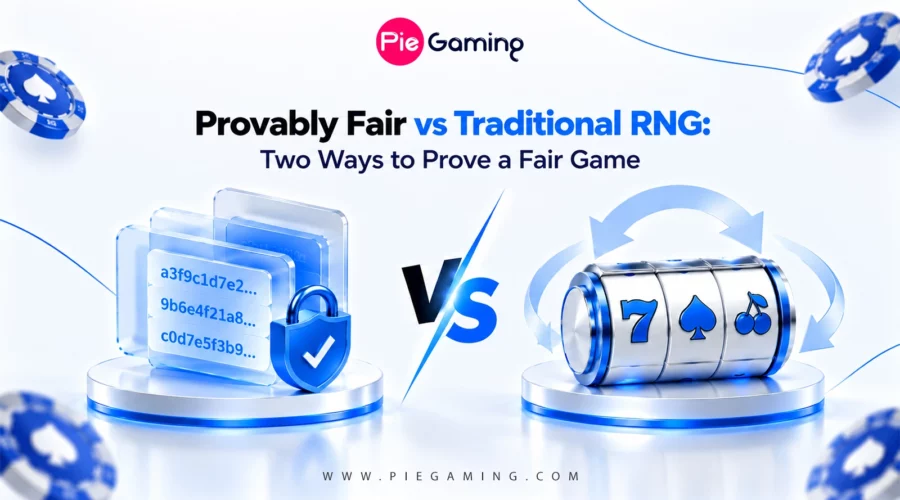
You spin the reels. The result appears in less than a second. But here’s the question most players never think to ask: how do you actually know that outcome was fair?
Cada software de casino online claims its games are fair. That part is easy to say. What’s harder to explain is the evidence behind that claim, and that’s where the two approaches in online gambling diverge completely.
The traditional route relies on certified RNG. An independent testing lab like eCOGRA or GLI reviews the game software, runs statistical analysis on the RNG, and certifies it meets regulatory standards before a single player ever bets on it.
You don’t verify anything yourself. You rely on the regulator, the test house, and the certification process to have done that work on your behalf.
The second approach is provably fair. Here, the casino commits to a cryptographic seed before your round begins. Once it’s over and the seed data is made available, you can run the same calculation yourself and check that the result matches what was committed to in advance.
Ambos provably fair vs traditional RNG approaches can provide real evidence of fairness. But they do it differently. This guide breaks down how each system works, what each one actually verifies, and the blind spots both leave uncovered.
What is a Traditional RNG?
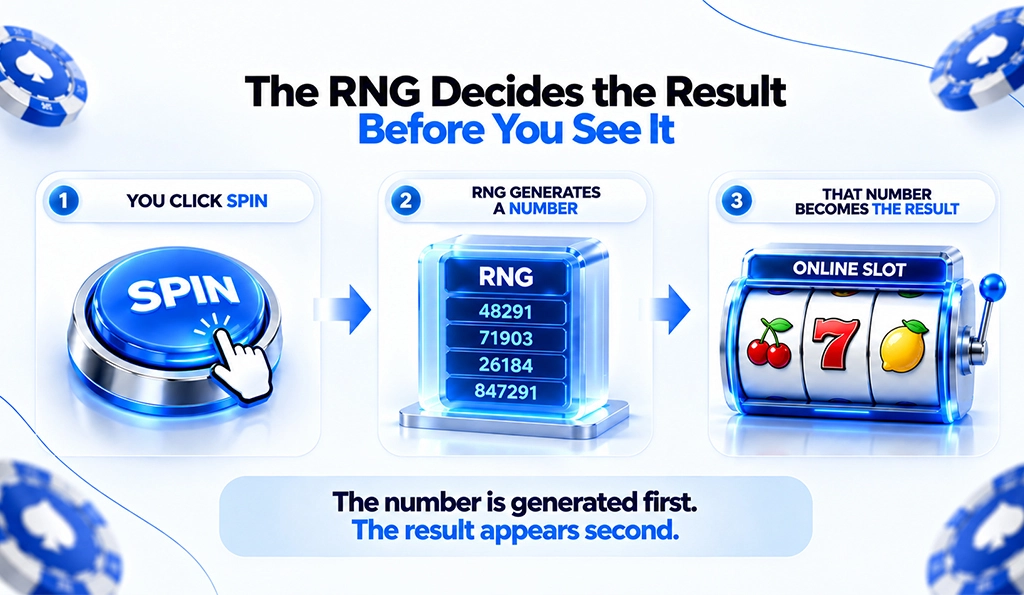
The RNG Decides the Result Before You See It
A Random Number Generator, or RNG, is a deterministic algorithm that uses entropy to produce statistically unpredictable number sequences. The entire process runs on the game provider’s server.
By the time a result reaches your screen, the outcome is already calculated. You receive a finished output: reels stopping on symbols, cards being dealt, a number on the roulette wheel. How it got there is never visible to you.
This is the system powering virtually every slot online, blackjack table, and digital roulette game in the industry.
Because players cannot see the RNG in action, independent testing labs verify it on their behalf. Labs like GLI, eCOGRA, BMM Testlabs, and iTech Labs simulate millions of game rounds, check that outcomes are statistically distributed as expected and confirm that the declared RTP is accurate. The MGA, UKGC, and Licenciamento de Curaçao quadro all require a valid RNG certificate as a condition of holding a gaming license.
A few things are worth understanding about what that certificate actually covers:
- It is issued to a specific game version, not to individual spins. Your spin is not certified. The game build was.
- Certification happens before launch. There is no continuous live monitoring after the game goes live.
- As a player, you can verify that the certificate exists. What you cannot do is use it to confirm your specific round produced a fair result.
The certificate is institutional proof that the system was tested. It is not round-level proof that your game was fair.
What is Provably Fair?
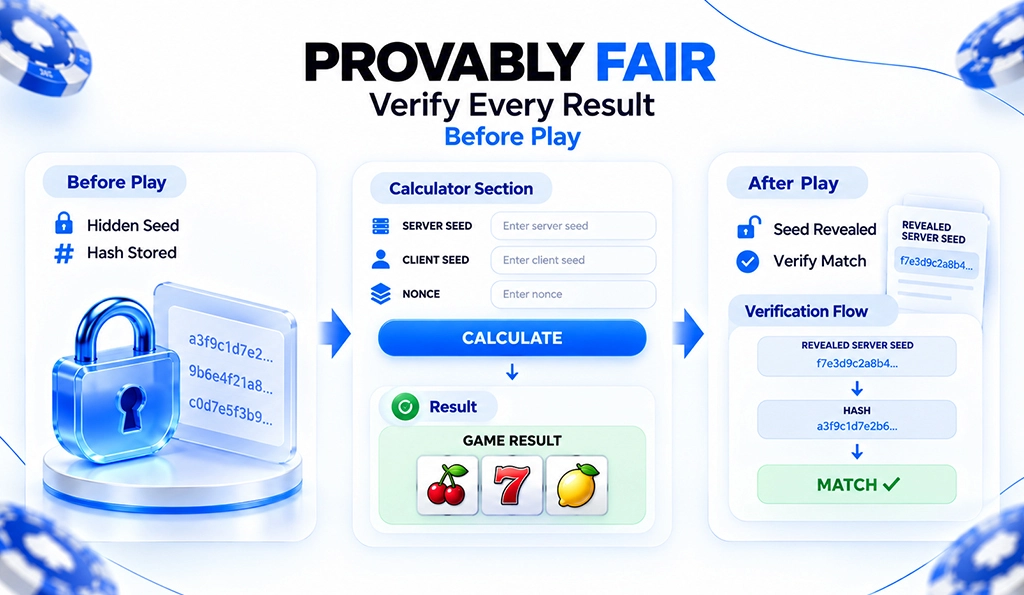
Provably Fair Verify Every Result
Provavelmente justo is a way for you to check a game round yourself, without taking the casino’s word for it. After the round, you can confirm the result came from seeds that the casino locked in before you played.
Three ingredients go into every result: a server seed from the casino, a client seed from you, and a nonce, which is a counter that goes up with each bet. There’s one catch worth knowing. Provably fair shows that a result was calculated honestly from those inputs, but it can’t tell you whether the game’s odds or payout table are fair. That’s why published probabilities and RTP still matter.
Here’s how the 4-Step Verification Process works:
- The casino locks its seed. Before you bet, it publishes a SHA-256 hash of its secret server seed. The hash can’t be reversed, but it exposes any later attempt to swap the seed.
- You add your client seed. It’s yours to set, so the casino can’t tailor its seed to yours.
- The result is calculated. The server seed, client seed, and a nonce (a counter that rises with each bet) go through a fixed formula.
- You verify. After you rotate seeds, the casino reveals the old server seed. Hash it to confirm it matches the published hash, then rerun the formula.
It works best on games with simple numerical outcomes, like dice, crash, plinko, mines, limbo, and roulette, where each round comes down to a single number. Slots are harder, since multiple reels and bonus features are difficult to encode without exposing a studio game logic.
That is starting to change: in April 2026, Stake added provably fair verification to 1,200+ games built on its own Stake Engine, publishing every possible result and its probability up front. You’ll also find it often in crypto casinos and Mini aplicativos do Telegram.
Provably Fair vs Traditional RNG: Side-by- Side Comparison
Both approaches give players evidence that a game is fair, but at different levels. Certified RNG em iGaming offers independent, system-level assurance that a game was tested. Provably fair lets you check individual results yourself.
With certified RNG, a lab and a regulator process show the system was tested for random, unpredictable outcomes, but you can’t recreate a single spin yourself. It’s worth checking that the certificate is current, covers your game, and comes from a lab the regulator recognizes.
With provably fair, you hash the revealed server seed, confirm it matches the fingerprint published before you played, then rerun the calculation with your client seed and nonce.
That check has limits. It won’t tell you about borda da casa, RTP, licensing, or withdrawal speed.
The strongest setup combines both: independently tested games, clear RTP disclosures, and provably fair verification where it’s supported.
Provably Fair and RNG Certification: What Each System Leaves Unverified
Both approaches give you real evidence of fairness, but neither covers everything. Knowing where each one stops helps you tell a genuine fairness check from a bigger claim that a casino is completely trustworthy.
What Provably Fair Doesn’t Cover
In a typical setup, the casino commits to a server seed before you bet and reveals it later, so you can reproduce an eligible result yourself. What that check proves depends on what the casino makes verifiable.
Provably fair checks one thing: that the random number behind your result was generated from seeds the casino committed to before you bet. It doesn’t check what the game does with that number afterward.
- The check stops at random numbers. Say a dice game produces a roll of 42. Verification confirms the 42 is genuine, but it doesn’t confirm how the game pays a 42. If the payout for that roll is lower than the casino advertised, the check would still pass.
- Payout rules need to be published to be checked. A result can only be verified from end to end if the casino also publishes the pay table and the rules that convert the number into a win or lose, and its verifier uses them. If those rules aren’t part of the check, they’re unverified.
- A casino’s own verifier means trusting the casino. The tool is built and run by the casino, so it only shows that the result matches the casino’s own formula. Look for a published specification that anyone can follow, and ideally an independent verifier or audit.
- Complex games need more disclosure. A slot with bonus rounds and multiple features involve far more than a seed and a number. Real verification needs the game rules, paytable, and bonus mechanics to be published for the specific game version you’re playing.
- A hash mismatch is a red flag. Before you bet, the casino publishes a hash of its server seed. After the seed is revealed, hashing it should give you the same hash. If it doesn’t, the revealed seed isn’t the one the casino committed to. First, make sure you’re using the right seed pair, nonce, and hash function.
What RNG Certification Doesn’t Cover
A certificate shows that a specific game or RNG version was assessed within a defined scope at a particular point in time. Testing can include source-code review, seeding checks, and statistical randomness tests.
- It’s not a live check. A certificate doesn’t monitor every spin or hand as it happens.
- You can’t recreate a round. It won’t let you verify one completed spin or hand.
- It won’t confirm the live build. You can’t confirm from the certificate alone that the game you’re playing is the exact version tested or that its RTP setting hasn’t changed.
- Regulation adds a safety net. Regulated operators often face change-control, audit, and re-testing requirements, and UK licensees must submit game and RNG test results. Even so, a certificate is one layer of assurance, not continuous monitoring.
What Neither System Tells You
Verification shows a game that behaves as designed, not that the design is generous. RTP, bonus terms, obtenção de uma licença de jogo, and payment policies are separate questions from whether a result can be verified.
Resumindo
In the provably fair vs traditional RNG debate, neither label makes a casino safe on its own. What matters is what sits behind it.
Numa cassino licenciado, look for a named testing lab on the certificate — GLI, eCOGRA, iTech Labs, or BMM — and a valid license from the MGA, UKGC, or Curaçao. A badge that doesn’t name either is worth nothing.
Numa plataforma de cassino cripto with provably fair algorithm, check whether the game logic has been independently audited, not just the RNG layer. A casino running its own verifier is only confirming its own work.
The actual risk in online gambling is neither system failing. It’s unlicensed casinos with no certification and no accountability at all. That’s where players lose money with no recourse.
One rule covers both: a named lab or a named audit report always outweighs a generic badge.

Contato
FAQ
-
How does provably fair gaming actually work behind the scenes?
Before each round, the casino locks a server seed using a SHA-256 hash. Combined with your client seed and a nonce, it generates the result. You verify it after.
-
Crypto casino RNG vs provably fair: Which is better for player trust?
Provably fair gives you direct mathematical proof per round. RNG relies on third-party certification. Neither is inherently safer, it depends on whether the casino behind it is legitimate.
-
Do Provably Fair games offer better winning chances?
No. Provably fair verifies how a result was generated, not how generous the game is. House edge and RTP exist in provably fair games exactly as they do in RNG-certified ones.
-
What types of casino games commonly use Provably Fair technology?
Dice, crash, plinko, mines, limbo, and roulette are the most common. Slots have historically been harder to implement, but that is gradually changing across crypto casino platforms.
-
Are Provably Fair games becoming more popular in online casinos?
Yes. Adoption is growing steadily, particularly in crypto casinos and Telegram mini apps. Provably fair verification is also expanding beyond simple in-house games into more complex slot content.


Palak Madan escreve sobre a indústria de iGaming desde 2024. Ela se concentra em ajudar operadores e fundadores a entenderem suas opções ao lançar um cassino online, desde a escolha do provedor de software certo até a análise de custos e requisitos de conformidade em diferentes mercados. PieGamingEla aborda temas como soluções de cassino white label, seleção de plataforma e entrada no mercado, transformando informações complexas do setor em orientações práticas para quem está construindo negócios de iGaming. Ela também acompanha de perto as mudanças nas licenças e regulamentações, principalmente como as novas regras moldam a forma como as operadoras entram e crescem em diferentes jurisdições.

Os melhores jogos de loteria para incluir em uma plataforma de loteria online são: Jogos de Loteria, Jogos de Ganho Instantâneo, Raspadinhas, Jogos de Números Diários, Keno, Bingo, Jogos de Sorteio, Bolões e Apostas Progressivas. Esses jogos atraem diversos segmentos de jogadores, aumentam o engajamento e impulsionam o crescimento da receita a longo prazo.

Big Data no iGaming é a agregação e análise de grandes quantidades de informações sobre jogadores, transações e jogabilidade para embasar uma tomada de decisão mais inteligente. Isso permite que os operadores ofereçam experiências personalizadas, otimizem probabilidades, identifiquem fraudes e aumentem a fidelização. Veja como o Big Data é crucial para se manter competitivo no iGaming, um mercado orientado por dados. Informação é a moeda mais valiosa no mundo dos jogos de azar online.

Os principais fornecedores de PAM para iGaming em 2026 incluem PieGamingAs empresas Pragmatic Solutions, EveryMatrix, SoftSwiss, Playtech, Digitain, BetConstruct, GammaStack, Tecpinion e Skilrock oferecem gerenciamento avançado de jogadores, pagamentos, CRM, prevenção de fraudes e infraestrutura de jogos escalável.

As ferramentas de autoexclusão são uma parte importante do jogo responsável, pois permitem que os jogadores restrinjam seu acesso às plataformas de jogos, possibilitando a autoexclusão ou até mesmo o bloqueio total do acesso. Este artigo descreve como essas ferramentas funcionam e como afetam as plataformas de iGaming em termos de conformidade, proteção do jogador e credibilidade da plataforma a longo prazo.
RTP, ou Retorno ao Jogador, é a porcentagem do total apostado que um jogo de cassino se propõe a devolver ao jogador. Para os operadores, o RTP influencia diretamente a vantagem teórica da casa, enquanto para os jogadores, oferece uma maneira comum de comparar os retornos matemáticos a longo prazo de diferentes jogos de cassino.

Descubra como um sistema de back office de cassino aumenta os lucros por meio de gerenciamento eficaz, análise de dados e eficiência operacional, impulsionando o sucesso no setor de jogos.
Um motor de bônus de cassino online é um sistema de software especializado. Ele é projetado para automatizar a criação, o gerenciamento, a distribuição e o rastreamento de recompensas promocionais para plataformas de iGaming. Em vez de fornecer rodadas grátis ou bônus de depósito manualmente, o motor de bônus do cassino executa regras automatizadas que oferecem incentivos direcionados aos jogadores em tempo real.

Vejo você em sua caixa de entrada em breve!

Fique à frente do jogo. Assine com exclusividade
conteúdo, atualizações e informações privilegiadas!