
Los casinos online y los criptocasinos ofrecen juegos similares, pero difieren en cuanto a métodos de pago, divisas, procesamiento de transacciones, regulación y requisitos operativos. La comparación entre casinos online y criptocasinos destaca las principales diferencias para operadores y jugadores.

The choice between a traditional online casino and a crypto casino involves more than just the payment methods. Both for the operator and the player, there are additional differences – be it in the transaction process, KYC/AML requirements, legal aspects, or the target audience’s specific requirements. While both these types of platforms can provide almost the same sets of games, they still differ significantly in their features and benefits. So, operators need to understand what each model requires before choosing their payment and software setup, while players need to know how the differences can affect their overall casino experience.
In this guide, we compare online and crypto casinos across payments, transaction speed, privacy, security, regulation, bonuses, currency, and accessibility.
Online Casino vs Crypto Casino Comparison
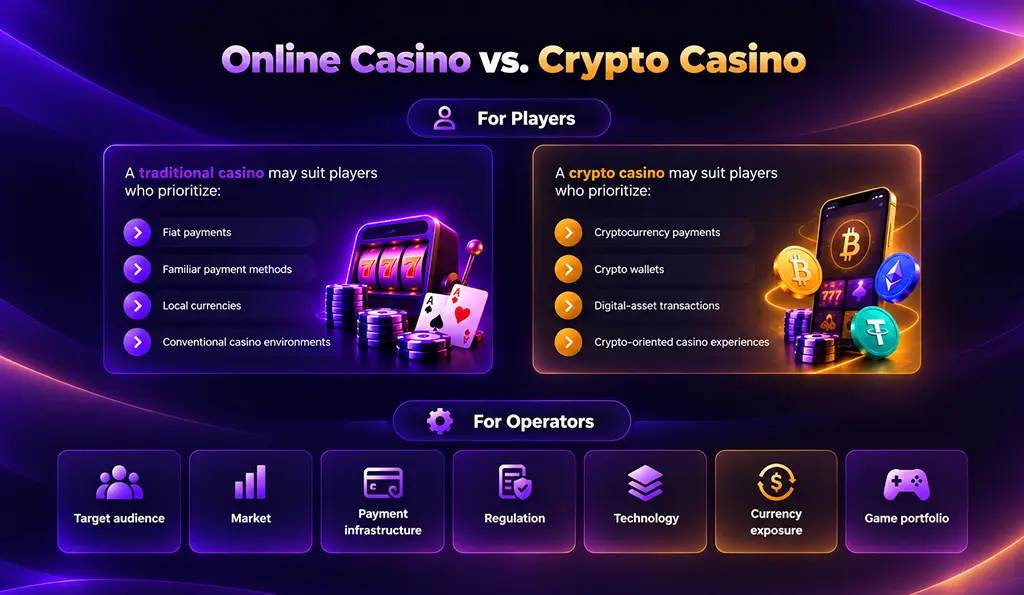
Casino online vs. Casino de criptomonedas
Knowing the differences between these two models is what enables operators and players to make informed decisions. Here is a breakdown of the areas that matter the most.
Payment Methods and Banking Systems
Software de casino en línea runs on fiat currencies. Depending on the market, this may include debit cards, bank transfers, e-wallets, and other regulated payment services. Crypto casinos eliminate all those layers by implementing blockchain payments such as Bitcoin, Ethereum, Litecoin, USDT, and Solana.
Players can make and withdraw funds via banks, credit cards, wire transfer, or e-wallets and can fund the account in USD, EUR, GBP, etc.
For operators, this makes payment architecture an important consideration. The payment stack must support deposits, withdrawals, transaction monitoring, reconciliation, and fraud controls.
Las diferencias estructurales son significativas:
- Los casinos que aceptan moneda fiduciaria dependen de los sistemas de aprobación bancaria.
- Soluciones de criptocasino use direct wallet-to-wallet transfers.
- Los métodos de pago tradicionales permiten contracargos y reversiones.
- Las transacciones en blockchain son irreversibles una vez confirmadas.
- Payment gateway delays are a common reality in fiat systems.
Para los operadores, este último punto es más importante de lo que parece. Los retrasos en los pagos afectan la confianza del jugador, y la confianza del jugador influye en su retención.
Velocidad de transacción
Aquí es donde los casinos de criptomonedas tienen una clara ventaja. Los retiros en los casinos tradicionales suelen tardar:
- De 24 horas a varios días hábiles.
- A esto hay que sumarle un tiempo adicional para la verificación bancaria.
Crypto casino withdrawals are usually processed with:
- De minutos a unas pocas horas.
- Dependiendo de la congestión de la cadena de bloques y los requisitos de confirmación.
Los jugadores se dan cuenta de la rapidez con la que cobran. Los operadores también deberían hacerlo.
Privacidad y anonimato
Online casinos require full KYC verification before withdrawals. That means ID proof, banking documents, and a process that adds friction for players who just want to cash out. Whereas crypto casinos have historically allowed wallet-based gambling with minimal verification.
Diferencias clave a tener en cuenta:
- Algunos casinos de criptomonedas aún ofrecen opciones de juego anónimas.
- Los casinos que aceptan Fiat operan con sistemas de jugadores verificados.
- Los estándares de cumplimiento varían significativamente entre las distintas jurisdicciones.
Infraestructura de seguridad
Both models take security seriously, but the approach is different. Online casinos use encrypted banking systems and centralized payment security. Crypto casinos rely on blockchain transparency and smart contract-based transactions.
So, account protection, transaction monitoring, fraud detection, access controls, and secure integration with payment providers—all ensure overall security architecture. This is important for both players and operators.
Regulación y licencias
Los casinos tradicionales suelen operar bajo marcos regulatorios bien establecidos. Autoridades como la Comisión de apuestas del Reino Unido La Autoridad del Juego de Malta establece estándares claros en materia de protección del jugador, juego limpio y cumplimiento financiero.
Cryptocurrency brings in a number of additional considerations. For instance, the Apuestas en el Reino Unido Commission, in particular, requires operators to take into account factors such as the volatility of the crypto-asset against fiat currency and how customer deposits will be handled.
As the requirements vary depending on the jurisdiction, operators should research the target market to choose the payment or software model.
Estructuras de bonificación
Both online casino and crypto casinos can offer bonuses, free spins, loyalty rewards, and other promotional mechanisms.
But crypto casinos have expanded the playbook:
- Programas de reembolso de tokens.
- Bonos por depósito en criptomonedas.
- Membresías VIP basadas en NFT.
- Sistemas de recompensas por staking y sistemas de fidelización en la cadena de bloques.
For operators looking to differentiate, this is one area where crypto casinos offer genuinely creative rooms. This is something players also love in casino platforms.
Monedas admitidas
Las monedas fiduciarias se aceptan en los casinos tradicionales a través de las redes bancarias locales. Además, los criptocasinos ofrecen diversas opciones de pago y stablecoins, lo que facilita transacciones más rápidas y económicas a través de diferentes fronteras internacionales. Bitcoin, Ethereum, USDT y Solana son algunas de las criptomonedas más populares.
Accessibility and Geographic Restrictions
Online casinos are often restricted by regional banking laws and iGaming regulations. Crypto casinos have an advantage here. Blockchain payments bypass many of the banking limitations that restrict fiat platforms, making global access more achievable.
Dicho esto, el acceso no es incondicional. Los operadores aún deben tener en cuenta lo siguiente:
- Leyes locales sobre juegos de azar con criptomonedas en los mercados objetivo.
- Las regulaciones regionales sobre criptomonedas están evolucionando rápidamente.
- Requisitos de licencia específicos de cada jurisdicción, que varían según el país.
Bonus: Key Factors to Consider in Online and Crypto Casino
A broader comparison must consider both the player experiences and operator’s infrastructure as highlighted in the table below:
Responsible Gambling in Online and Crypto Casinos
Everyone knows that gambling is risky and to protect players’ interest and money, the Consejo de juego responsable requests operators to promote safe gambling platform by integrating the following tools:
- Límites de depósito
- Autoexclusión
- Límites de sesión
- Comprobaciones de la realidad
- Controles de cuenta
For example, in Great Britain, the Gambling Commission’s updated requirements state that, from 30 2026 septiembre, operators must offer gross “deposit limits” and prevent further deposits once the applicable limit is reached, subject to the specified rules.
Del mismo modo, el La autoridad del juego de Malta requires online casino operators to offer Autoexclusión and either deposit or wagering limits, as well as reality checks. They also encourage additional tools like loss and betting limits.
For crypto operators, responsible gambling controls also take into account the volatility of cryptocurrency against fiat. The Gambling Commission explicitly states that this factor is taken into account when crypto assets are accepted directly.
Provably Fair and Crypto Volatility: What Operators and Players Need to Know
Two areas stand out when we compare crypto casinos with traditional online casinos: provably fair gaming and crypto volatility.
What Does Provably Fair Mean in Crypto Casinos?
Probablemente justo is a cryptographic approach that allows players to verify whether a game outcome was generated according to the stated mechanism.
Usually, this involves elements such as:
semilla del servidor: a value generated by the casino system;
Semilla de cliente: a value provided or influenced by the player;
nuncio apostólico: a varying value between game rounds
Hashing: cryptographic operation(s) to generate or verify the result.
The player can use the disclosure of information as inputs to verify the outcome once the game is finished. This is contrasted with the conventional RNG model, where randomness is derived from an RNG, and the gaming system is subject to testing, technical controls and, depending on the jurisdiction and product, independent certification or auditing.
For operators, provably fair technology can provide transparency around specific game outcomes. It should not, however, be regarded as proof of an entire casino being licensed, secure, and compliant.
How Crypto Volatility Affects Players and Operators?
Crypto volatility refers to fluctuating market values of a cryptocurrency against fiat currencies or other assets.
For players, this means the fiat value of a crypto deposit or withdrawal has the potential to change while the transaction is being processed or while funds are held in a crypto balance.
For operators, the issue extends to treasury management. An operator accepting crypto needs to determine how balances are stored, converted and settled, and how fluctuations are reflected in accounting and customer-facing balances.
Stablecoins can be one mechanism to mitigate some exposure to price volatility, though the use of these introduces its own considerations in terms of payment, liquidity, and regulatory aspects.
Network fees are another consideration: the final cost and processing experience will depend on the blockchain, network, and payment infrastructure utilized.
The UK’s Gambling Commission specifically expects operators that accept crypto-assets to consider how fluctuations against fiat currency will be handled, including the impact on juego responsable tools and AML triggers.
Security Risks in Online and Crypto Casinos
Toda plataforma conlleva riesgos. La diferencia radica en dónde reside ese riesgo y quién es responsable de gestionarlo. Para los operadores, comprender ambas partes es fundamental. Es esencial para construir una plataforma en la que los jugadores puedan confiar.
Where Online Casinos Are Vulnerable
Los casinos online tradicionales se basan en sistemas centralizados. Esto significa que los datos de los clientes, la información bancaria y los documentos KYC se almacenan en un solo lugar. Y los sistemas centralizados son vulnerables.
Dado que los jugadores deben proporcionar información personal y financiera antes de poder retirar sus fondos, una sola filtración puede exponer una cantidad significativa de datos confidenciales.
Los riesgos que los operadores deben tener en cuenta incluyen:
- Fraude de pagos que involucra tarjetas de crédito robadas o transacciones no autorizadas
- Filtraciones bancarias dirigidas a procesadores de pagos de casinos o bases de datos de clientes.
- Robo de identidad mediante la filtración de documentos KYC, como pasaportes o facturas de servicios públicos.
- Abuso de contracargos donde los jugadores revierten fraudulentamente transacciones completadas
Los proveedores de servicios de pago de terceros añaden un nivel adicional de riesgo, especialmente para los operadores que operan en múltiples mercados internacionales con varios procesadores involucrados.
Dónde son vulnerables los criptocasinos
Los criptocasinos eliminan la dependencia bancaria, pero conllevan riesgos diferentes. Dado que las transacciones en blockchain son irreversibles, la seguridad es fundamental. Si se roban los fondos, recuperarlos rara vez es sencillo y, a menudo, resulta imposible.
Los riesgos más importantes en este caso incluyen:
- Robo de cartera causado por claves privadas comprometidas o dispositivos pirateados
- Explotizaciones de contratos inteligentes que aprovechan las vulnerabilidades en los sistemas de casino descentralizados.
- Ataques de phishing a través de sitios web de casinos falsos o solicitudes de conexión de billetera maliciosas.
- Exposición a activos volátiles donde las fluctuaciones de precios de las criptomonedas afectan el valor del capital y las ganancias reales.
Para los operadores que gestionan plataformas de criptomonedas, esto también implica ser transparentes con los jugadores sobre cómo se custodian los fondos y qué medidas de seguridad se han implementado. Esa transparencia forma parte del producto.
Online Casino vs. Crypto Casino: Which One Is Better?
No existe una respuesta universal. Ambos modelos tienen ventajas y limitaciones reales. La elección correcta dependerá de las expectativas de tus jugadores y del tipo de plataforma que estés creando para ellos.
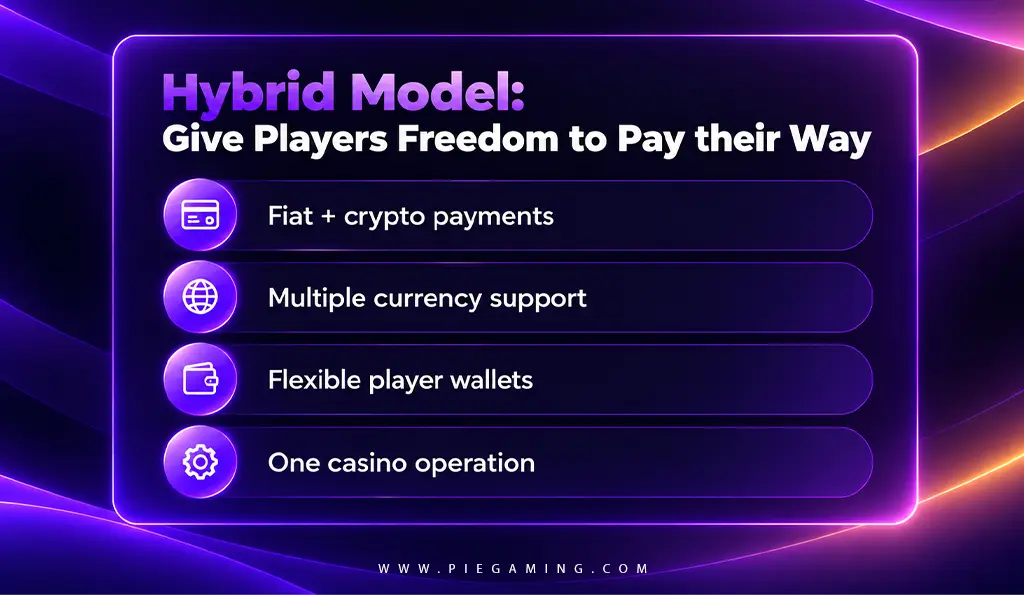
Hybrid casino model
Conclusión
The debate on online casino vs. Crypto casino extends beyond the type of currency for placing bets. It includes variations in the payment stack process, means of payment, KYC approach, and regulatory differences and, for operators, impacts the treasury and operations.
For players, the differences are likely to relate to Métodos de pago, withdrawal experience, privacy, currency support, and security, and accessibility.
For operators, the question is more involved and depends on factors such as the relevant licensing, target markets, payment infrastructure, KYC/AML controls, responsible gambling solutions, currency exposure, and the technology required to support both fiat and crypto transactions.
For businesses looking to appeal to both customer segments, a hybrid fiat-and-crypto casino could be considered if permitted by the target jurisdiction.

Contáctenos
Preguntas frecuentes (FAQ)
-
Can I run both online and crypto payment options on the same casino platform?
Yes. A simple casino platform can be designed to support both fiat and crypto payment options. The operator is required to manage various transaction flows, currencies, reconciliation requirements, and risk controls.
-
Do Online casinos or crypto casinos have higher operating margins?
There is no universal margin advantage. Operating margins depend on factors like game provide fees, payment costs, customer acquisition costs, bonus, taxes, compliance, fraud losses, etc.
-
How much does it cost to set up an online casino and crypto casino?
There is no single setup cost for either model. The budget covers the factors like licensing, software, payments integration, game content, KYC/ AML tools, etc. A crypto casino may also require crypto payment processing, wallet infrastructure, conversion, or settlement capabilities. The costs are determined by the target market and the technology required.
-
What should operators look for in an online & crypto casino software provider?
Operators must look for the following: Casino and sportsbook software capabilities, where relevant Fiat and crypto payment support KYC/AML integrations Player account and wallet management Game-provider integrations Back-office controls Responsible gambling tools Reporting and transaction management Scalability across target markets Support for the operator's licensing and compliance requirements The provider should also disclose what capabilities are provided, and what licensing, compliance, or other third-party services are the responsibility of the operator.
-
What are the biggest regulatory risks of running a crypto casino in 2026?
The risks will vary depending on the jurisdiction, but operators should consider licensing, AML/KYC, payment control, responsible gambling, treatment of customer funds and crypto-specific transaction risks and restrictions by geography. Regulators may also request further information concerning crypto payment terms. For example, the UK Gambling Commission requires licensees to report any changes in payment methods and processors and to assess the AML impact of new payment methods. Operators should therefore check the requirements of each target market before launching rather than treating crypto acceptance as a separate avenue around gambling regulation.
-
How does KYC/AML compliance differ between crypto and traditional casino operations?
Both are subject to KYC and AML controls, depending on the jurisdiction and model of operation. Crypto assets can raise additional transaction-monitoring considerations because funds flow through crypto exchanges, processors or other virtual asset service providers. FATF standards require that those providing virtual asset services apply measures including customer due diligence, record keeping and suspicious transaction reporting.


Monika Gola es especialista en contenido de iGaming en PieGamingDesde 2020, se ha dedicado a investigar y desarrollar contenido sobre selección de software, regulaciones de casinos en línea y apuestas deportivas, y estrategias de crecimiento para operadores. Su investigación incluye el análisis de oportunidades de mercado en regiones como Europa, África y el Sudeste Asiático, así como la evaluación de marcos regulatorios y barreras de entrada. Monitorea activamente las tendencias de la industria, las actualizaciones de cumplimiento y la evolución de las demandas de los jugadores en los mercados globales de iGaming para ayudar a los operadores a desenvolverse con éxito en este sector.

Los casinos de Telegram son un nuevo canal de juegos donde los usuarios acceden a juegos de casino directamente a través de bots de Telegram o miniaplicaciones. Esta guía explica cómo funcionan los casinos de Telegram, incluyendo su estructura, sus características principales, su razón de ser y por qué muchas empresas desean explorar esta plataforma en auge.
Poner en marcha un casino de criptomonedas implica varios pasos. Desde elegir el mercado objetivo hasta obtener una licencia, definir el modelo de casino, integrar los juegos y gestionar el cumplimiento normativo, tendrás que tener en cuenta muchos aspectos.
Elegir el proveedor de software adecuado para casinos Bitcoin es fundamental para construir un negocio de casino en línea seguro, escalable y rentable. A continuación, presentamos un breve resumen de los principales proveedores y cómo elegir el más apropiado.

Los casinos de Bitcoin son casinos en línea que ofrecen tragamonedas, blackjack, ruleta y juegos de casino en vivo, y aceptan pagos con Bitcoin. Esta guía explica cómo funcionan los casinos de Bitcoin, sus ventajas y desventajas, métodos de pago, medidas de seguridad, requisitos de licencia y los pasos necesarios para lanzar un criptocasino en 2026.

Las soluciones de criptojuegos están transformando el mundo de las apuestas online gracias a los pagos basados en blockchain, las transacciones más rápidas y una mayor transparencia. A medida que las criptomonedas siguen evolucionando, nuevas tendencias están configurando la forma en que los jugadores interactúan con las plataformas de juegos digitales.

Los 10 principales proveedores de software para casinos de criptomonedas en 2026 son: PieGamingSoftGamings, Digient, Slotegrator, NuxGame, GR8 Tech, TRUEiGTECH, Tecpinion, BetConstruct y KodeDice. Cada una se clasifica según seis factores, entre los que se incluyen los pagos con criptomonedas, la profundidad del juego, el cumplimiento normativo y la velocidad de implementación.

La velocidad, la privacidad y la seguridad de Bitcoin son algunas de las razones por las que se está convirtiendo en un método de pago popular en las apuestas en línea. El objetivo de esta guía es revelar las principales ventajas y desventajas de usar Bitcoin para las apuestas en línea, ayudando tanto a operadores como a jugadores a decidir si las criptomonedas son la opción adecuada para sus transacciones de juego.

¡Nos vemos pronto en tu bandeja de entrada!

Manténgase a la vanguardia del juego. Suscríbete para exclusivo
¡Contenido, actualizaciones y información privilegiada!