
Los problemas en los casinos online pueden afectar a los operadores en todas las etapas, desde la entrada al mercado y los pagos hasta la fidelización de jugadores, la tecnología y la rentabilidad. Descubra los principales desafíos y las soluciones prácticas para abordarlos.
The online casino industry is lucrative, offering operators an exciting opportunity to grow their business. But every opportunity comes with a lot of challenges. Operators face numerous challenges like licensing & compliance, fraud and bonus abuse, higher player acquisition cost, weak player retention, game content gaps, and technology limitations.
In fact, the challenges become more complex when operators expand across jurisdictions. The key is not simply identifying problems but planning for them before they affect operations.
Whether you’re a startup or an established operator, challenges in the online casino business can put you behind in the competition. So, let’s learn about common online casino problems operators face and how to solve them.
Common Online Casino Operator Challenges from Pre-Launch to Scale
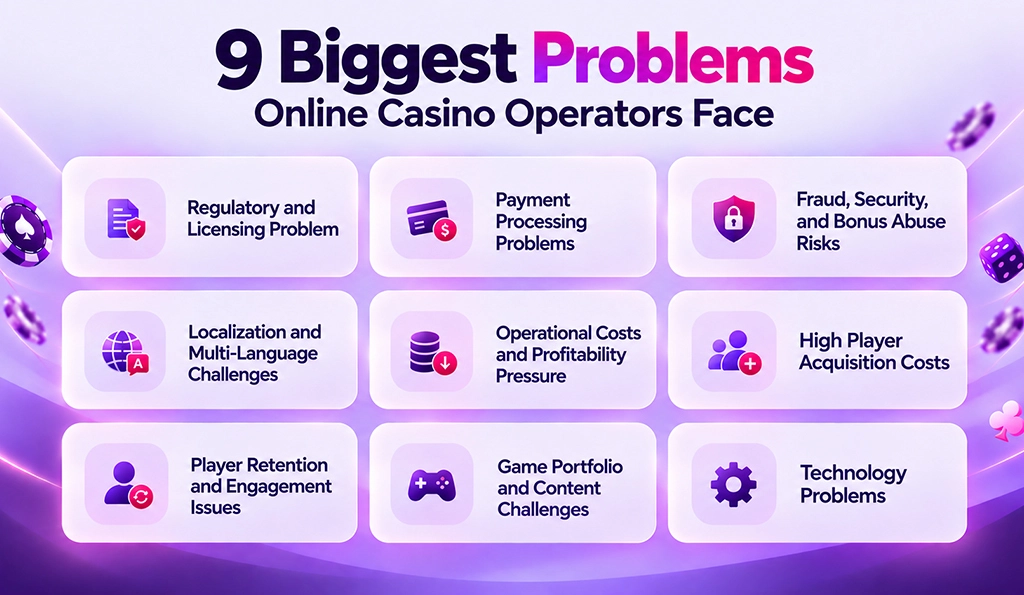
Problems Online Casino Operators Face
While entering the industria de los casinos en línea, every operator faces challenges (familiar or unfamiliar); knowing these challenges and overcoming them is crucial to running casino operations seamlessly. Let’s understand these challenges.
1. Regulatory and Licensing Problems in Online Casinos
Licensing is one of the first challenges to be addressed by an operator. The requirements can be different for each jurisdiction, including matters of licensing, juego responsable, KYC, AML, customer funds, advertising, and reporting.
There is a total of 195 countries in the world, and among them, 77 countries are iGaming-friendly. Each country has different laws and regulations, and constant regulatory changes mean compliance is an ongoing task (even within Europe or the U.S.). What challenges do operators face here?
- Actualizaciones regulatorias constantes
- Altos costos iniciales
- Proceso de aprobación prolongado
- Normas KYC/AML
- Implementación de políticas de protección al jugador
Soluciones:
- Los operadores deben estar al tanto de las nuevas leyes y adaptarse para cumplirlas.
- Presupuesta tanto tiempo como dinero para gestionar los costes de las licencias y el proceso de aprobación.
- Implementa todas las reglas de protección del jugador para evitar sanciones severas.
- Monitor regulatory changes after launch
- Work with qualified legal and compliance professionals for jurisdiction-specific advice
Responsible gambling and player protection: Regulators are now requiring operators to go beyond licensing. In some cases, they must provide deposit and loss limits, opciones de autoexclusión, reality checks, and identity and age verification tools, as well as staff training on spotting risky behaviors. All of these have an impact on the design and implementation of bonuses, VIP programs, and retention strategies, which is why they must be considered at the conceptual stage and integrated into the product and marketing strategies.
2. Payment Processing Problems for Online Casinos
Payments can directly impact the player’s journey. Failed deposits, slow withdrawals, a limited range of Métodos de pago, transaction friction, and disputes can all contribute to additional support overhead and a poor user journey.
Operators need to consider the risk of PSP (Proveedor de Servicios de Pago) termination or account restrictions. A payment provider can impose restrictions or terminate the operator’s account based on risk assessments, contractual requirements, compliance with regulations, or the markets and transaction types that the operator is operating in. Having dependency on one provider can put operators at risk.
In Great Britain, for example, casino operators can only accept a set of customer payments through qualifying payment service providers, and the Gambling Commission has raised concerns over third-party funding and open-loop processes.
Soluciones:
- Offer payment methods relevant to the target market
- Avoid unnecessary concentration on a single PSP
- Monitor deposit failure, withdrawal processing time, declines and chargebacks
- Carry out appropriate customer and payment-method checks
- Make the deposit and withdrawal process clear to customers before launch
3. Fraud and Bonus Abuse Risks
Fraud is not limited to stolen card details. It can involve identity fraud, money laundering, bonus abuse, account takeover, and payment fraud. According to Sumsub’s State of Identity Verification in the iGaming Industry 2025 report, 41.9% of surveyed operators identified deposits as their primary fraud flashpoint, with 23.8% selecting onboarding/registration and 22.9% selecting withdrawals.
Further, Poor registration and onboarding UX also create unnecessary friction. If players face unclear verification requirements, they may leave the platform before completing registration.
The operators identified identity fraud, money laundering, and bonus abuse as their most pressing fraud threats. The operators’ primary fraud dilemma involves the balance between the friction in the customer journey and the level of verification and control needed to prevent fraud.
Soluciones:
- Applying risk-based KYC and verification processes
- Monitoring suspicious deposits, withdrawals, and account activity
- Detecting pattern frauds such as multiple accounts and bonus abuse
- Transaction and risk monitoring combined with customer verification
- Periodic fraud rule reviews due to the dynamic nature of abuse patterns.
4. Localization and Multi-Language Challenges
Launching in a new market involves more than translating website content. Giving a localized feel to their players is key to this business. Operators must consider registration flows, customer expectations, payment preferences, game preferences, support, and local market requirements.
A multinational business should offer language-specific support and make sure the processes for payments, account management, verification, and bonuses are well-documented and localized.
Soluciones:
- Simplify the account opening and onboarding processes.
- Test the mobile version’s performance in the targeted markets.
- Oferta soporte multilingue
- Review player behavior by market and adjust the experience accordingly
- Localize payment methods and currencies as per each targeted market.
5. Operational Costs and Profitability Pressure
La mayoría de los operadores creen que gestionar un casino online es una inversión única, lo cual es un grave error. Gestionar un casino en línea is a continuous investment that can eat into profits. For instance, maintenance costs, marketing, and affiliate expenses put profitability pressure on operators. Operators forget about maintenance costs and don’t spare money, due to which they face cash flow problems.
Gaming taxes and license fees also cut into margins, and the rates and structure (for example, a percentage of gross gaming revenue) vary significantly by jurisdiction, so operators should take them into account when selecting a market to operate in.
Soluciones:
- Search for budget-friendly casino models like software de casino de marca blanca
- Optimiza el marketing con estrategias centradas en el retorno de la inversión.
- Desarrollar canales de marketing internos para reducir la dependencia de los afiliados.
- Invierta en un programa de fidelización y ofertas personalizadas para mejorar la rentabilidad.
- Diversify revenue stream via sports betting, juegos en vivo distribuidor, and VIP programs
6. High Player Acquisition Costs and Marketing Challenges
Captar nuevos jugadores es uno de los problemas más comunes para los operadores de casinos online. ¿Por qué? Porque los canales de publicidad y marketing suelen ser limitados. Por ejemplo, los mercados de juegos de azar online en Europa o Estados Unidos están saturados, lo que genera altos costes publicitarios.
Some iGaming industry data suggest that acquiring new players can cost 250-500. Further, many casinos rely on affiliate partners to bring in traffic, who often demand 30-50% of new revenue share. These commissions eat significantly into margins.
Soluciones:
- Aprovecha los canales de adquisición orgánica, como blogs, guías y páginas de comparación.
- Run geo-focused campaigns to target emerging markets like Asia and LATAM, where permitted by local regulations and where CAC is often lower than in the EU/US.
- Invierte en marketing del ciclo de vida del cliente, como correo electrónico, SMS y notificaciones push, ya que son más baratos que los anuncios pagados.
- Construir internamente programas de afiliados
- Invierta en métodos de creación de marca y publicidad nativa.
7. Player Retention and Engagement Issues
Captar nuevos jugadores es solo la mitad del trabajo; retenerlos es muy difícil. Un casino online promedio pierde a la mayoría de sus nuevos jugadores casi de inmediato. Según algunos expertos en iGaming, los operadores de casinos podrían perder más del 90 % de los nuevos registros en una semana si no logran captar su atención.
Some case studies conducted on online casino operators reveal that personalized rewards can boost engagement by 20%, but operators fail to implement these engagement tools on the platform.
Soluciones:
- Offer instant rewards on first deposit, first bet, and first win
- Segmentar a los jugadores en función de su comportamiento y valor.
- Implementar la personalización impulsada por IA
- Desarrolle una sólida estrategia para jugadores VIP y de alto valor mediante beneficios exclusivos.
- Utilice la interacción omnicanal.
8. Game Portfolio and Content Challenges
Una plataforma de casino es conocida por tener una variedad de juegos de casino populares. And some operators choose to compromise with a game library. Having limited games on the casino platform, operators may face issues with player acquisition, engagement, and retention.
Some operators prefer integrating high-demand casino games like poker, slots, juegos de choque, live dealers, scratch cards, etc., and they face integration issues. Leading casino platforms partner with numerous gaming studios.
Soluciones:
- Usar agregadores de juegos de casino para simplificar las integraciones en lugar de conectar cada proveedor individualmente.
- Se añaden juegos nuevos con regularidad (lanzamientos semanales/mensuales).
- Feature “New Arrivals” and “Trending Games” sections
- Manténgase al día con las tendencias del mercado y las ofertas de la competencia.
- Implementar sugerencias basadas en IA (Juegos que te pueden gustar)
- Evita los gráficos pesados, ya que ralentizan el juego.
9. Technology Problems Faced by Online Casinos
Seleccionar la software de casino en línea Es importante, ya que cualquier problema técnico en el software puede paralizar las operaciones de la noche a la mañana. Si elige trabajar con un proveedor de software sin experiencia, es posible que no actualicen sus sistemas con rapidez ni corrijan los errores con prontitud.
Also, if a platform doesn’t let you do easy UI customization or quick feature changes, it will limit marketing or product strategies. Many operators face issues with adding new game providers or localizing content, which leads to heavy deployment.
Soluciones:
- Asóciate con un proveedor de software fiable y con experiencia.
- Opta por una plataforma escalable y preparada para el futuro.
- Obtenga una arquitectura modular o basada en API.
- Optimizar la experiencia del usuario (UX) en todos los dispositivos.
- Elige una plataforma en función de las preferencias de los jugadores y las tendencias del mercado.
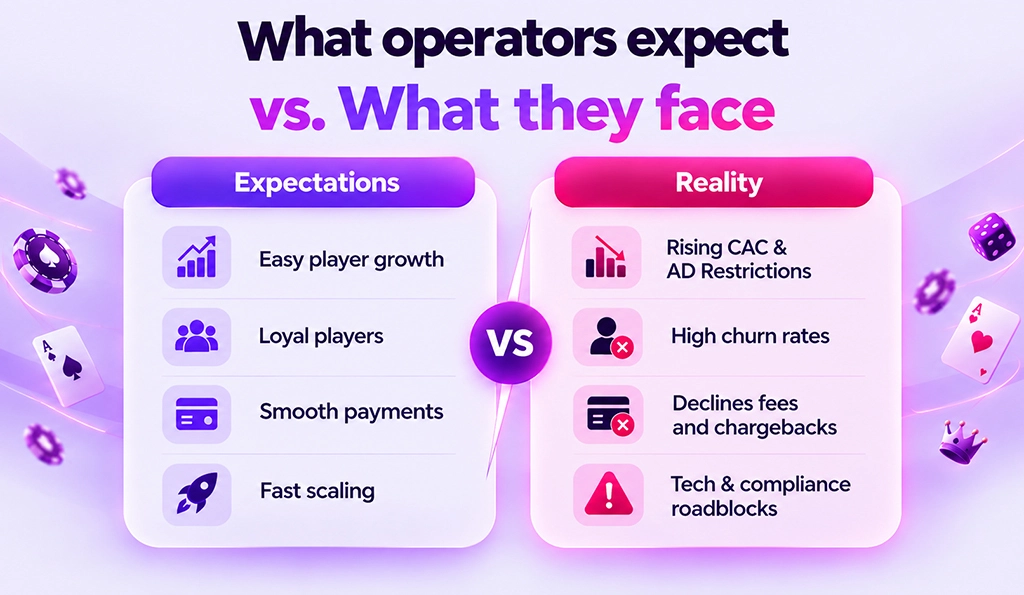
Casino operators’ problems
Mistakes Online Casino Operators Should Avoid
Below are the common mistakes that operators should avoid making.
Choosing software on price alone
The cheapest software option may not offer the required payment integrations, PAM capabilities, game coverage, reporting, scalability, and support.
En su lugar: balance the operational requirements and long-term costs before selecting a provider.
Not planning for scalability and load before launch
A system that works under low traffic may experience issues as the number of registrations, transactions, games, and markets increases.
En su lugar: estimate the expected traffic, transaction volumes, integrations, and market expansion before launch.
Depending on a single payment provider or platform vendor
A single-provider dependency can expose the operator to risks in the event of downtime, restrictions, or termination by the provider.
En su lugar: understand the alternatives and the integration requirements for each provider.
Launching without KPIs, a baseline, and unit economics targets
Without predefined targets, operators may realize that revenue is growing, but acquisition and retention are not being driven profitably.
En su lugar: set targets for CAC, LTV, conversion, retention, churn, GGR & NGR, and payment performance.
No support process before go-live
Payment, verification, account, and bonus queries can begin as soon as the casino launches.
En su lugar: establish customer support channels, escalation procedures, FAQs, and ownership before the first player joins.
Choosing a business model without understanding licensing
White-label, turnkey, and other models can have significantly different levels of customization, control, and responsibility. The business model should therefore also be balanced against the regulatory requirements of the target market.
En su lugar: understand the licensing requirements and responsibilities before choosing the operating and marketing model.
Cómo PieGaming Helps Operators Address Common Online Casino Problems?
No software can remove regulatory challenges, but it can definitely reduce operational complexities in areas that operators manage every day. That’s what PieGaming software does.
Payment challenges → payment integrations
PieGaming’s casino software offers integraciones de pago that let operators connect relevant payment options for their target markets.
Player management → PAM
El Sistema de gestión de cuentas de jugador can help operators manage registration, player accounts, wallets, payments, KYC-related workflows, player activity, segmentation, and other player-management processes.
Retention → CRM/Segmentation
The software’s CRM and segmentation capabilities can help operators organize player data and deliver more personalized engagement based on player behavior.
Operational management → Back office
El herramientas de back-office can provide operators with a central environment to manage operational activities, reporting, configurations, and other administrative functions.
Game availability → Pre-integrated game providers
La disponibilidad de pre-integrated game providers can help reduce the operational burden of sourcing and connecting individual game suppliers.
Conclusión
Most online casino issues come from decisions made before launch — what markets to enter, which license to obtain, what payment processors and software to use, and what metrics to track. Operators who make the right choices before launching avoid most of the issues affecting their growth and profitability.
Some problems never go away. For instance, regulations, fraudulent schemes, and acquisition and retention strategies require constant attention. The best way to approach such operators’ issues is to have them on the radar at all times and respond promptly.
In particular, prior to launch, operators should research and comply with the licensing requirements in all target jurisdictions, select a reliable platform able to scale with the business, integrate multiple payments processors, and set up a customer support system.
At launch, operators should optimize the onboarding and KYC procedures, localize the product for each market, and prepare an appropriate game catalog.
Post-launch activities should involve analyzing such metrics as customer acquisition cost (CAC), lifetime value (LTV), retention rates, and payment performance, reviewing and updating anti-fraud measures, and adapting to regulatory and market changes.
Contáctenos
Preguntas Frecuentes
-
Is starting an online casino profitable in 2026?
Profitability depends on various factors like the target market, licensing and operating costs, player acquisition costs, retention, game content, revenue per player, etc.
-
Why do so many online casinos fail within the first two years?
Online casino businesses can struggle because of high acquisition costs, poor retention, unsuitable software, regulatory issues, payment problems, weak fraud controls, underestimating ongoing costs, insufficient market research, etc.
-
Turnkey vs. white-label online casino: which has fewer operational problems?
White label software generally uses a more standardized setup, which enables faster deployment. Whereas a turnkey solution allows greater customization and control over the technology and integrations. The operational technologies depend on the provider, business model, and target jurisdiction.
-
What is the biggest operational mistake new online casino operators make after launch?
One common mistake is focusing too much on player acquisition while overlooking the operational systems. Payment issues, weak customer support, poor onboarding, limited game choice, and the lack of clear KPIs can quickly affect player experience and operating costs.
-
How can online casino operators reduce player churn and increase retention?
Operators can reduce player churn by identifying changing player behavior and responding with relevant, timely engagement. CRM and player segmentation can help operators personalize promotions and communication.

Monika Gola es especialista en contenido de iGaming en PieGamingDesde 2020, se ha dedicado a investigar y desarrollar contenido sobre selección de software, regulaciones de casinos en línea y apuestas deportivas, y estrategias de crecimiento para operadores. Su investigación incluye el análisis de oportunidades de mercado en regiones como Europa, África y el Sudeste Asiático, así como la evaluación de marcos regulatorios y barreras de entrada. Monitorea activamente las tendencias de la industria, las actualizaciones de cumplimiento y la evolución de las demandas de los jugadores en los mercados globales de iGaming para ayudar a los operadores a desenvolverse con éxito en este sector.
Iniciar un casino en línea llave en mano implica obtener una plataforma lista para usar con software prediseñado y juegos preintegrados, pero personalizándola según tus preferencias. Los pasos clave incluyen investigar el mercado, definir un presupuesto, seleccionar socios, obtener una licencia de juego, configurar los métodos de pago y mucho más.
Kenia cuenta con un mercado de juegos de azar en línea en auge, impulsado por la creciente adopción de internet y los sistemas de pago móvil. Esta guía explica los pasos y protocolos necesarios para establecer un casino en línea en Kenia, incluyendo la normativa y los requisitos de licencia.
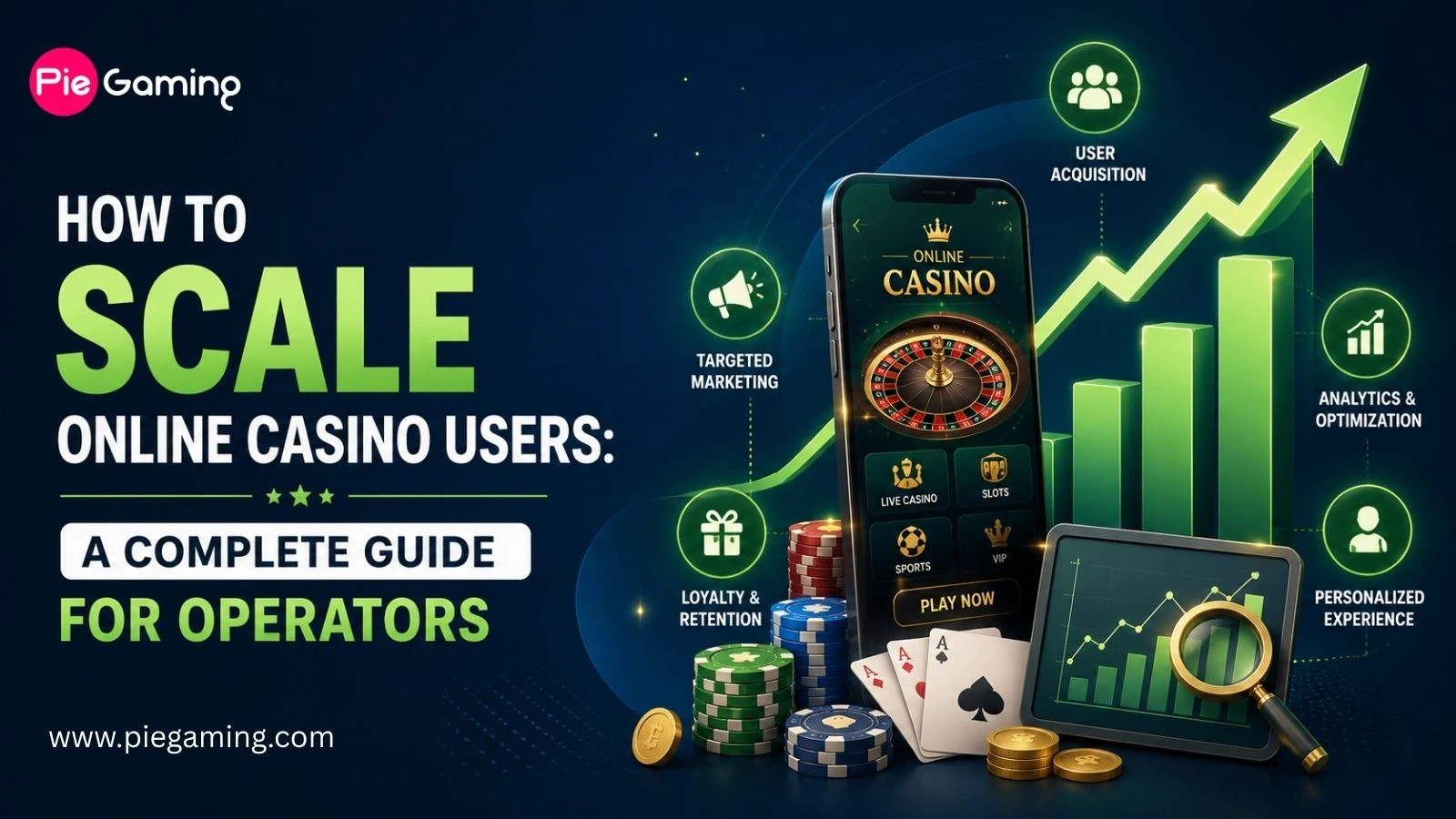
Los componentes clave para aumentar la base de usuarios de un casino online se resumen en cuatro áreas: los canales de adquisición adecuados, la interacción personalizada, el desarrollo de programas de fidelización y la toma de decisiones basada en datos. Crear una experiencia móvil, mantener el interés de los jugadores y adaptar la estrategia a los mercados que se desean atraer son igualmente cruciales para un crecimiento sostenible.

Este blog analiza las estrategias clave de los principales operadores de iGaming en 2026 y cómo puedes crecer como ellos y convertirte en líder del mercado. No te lo pierdas.
Abrir un casino en línea suena emocionante. Pero muchos operadores nuevos fracasan a los pocos meses debido a errores inevitables. Aquí tienes los 10 errores principales que debes evitar.

Aprenda cómo iniciar un casino en línea en Turquía en 2026. Obtenga consejos sencillos sobre leyes, licencias, pagos y más para gestionar su negocio sin problemas.
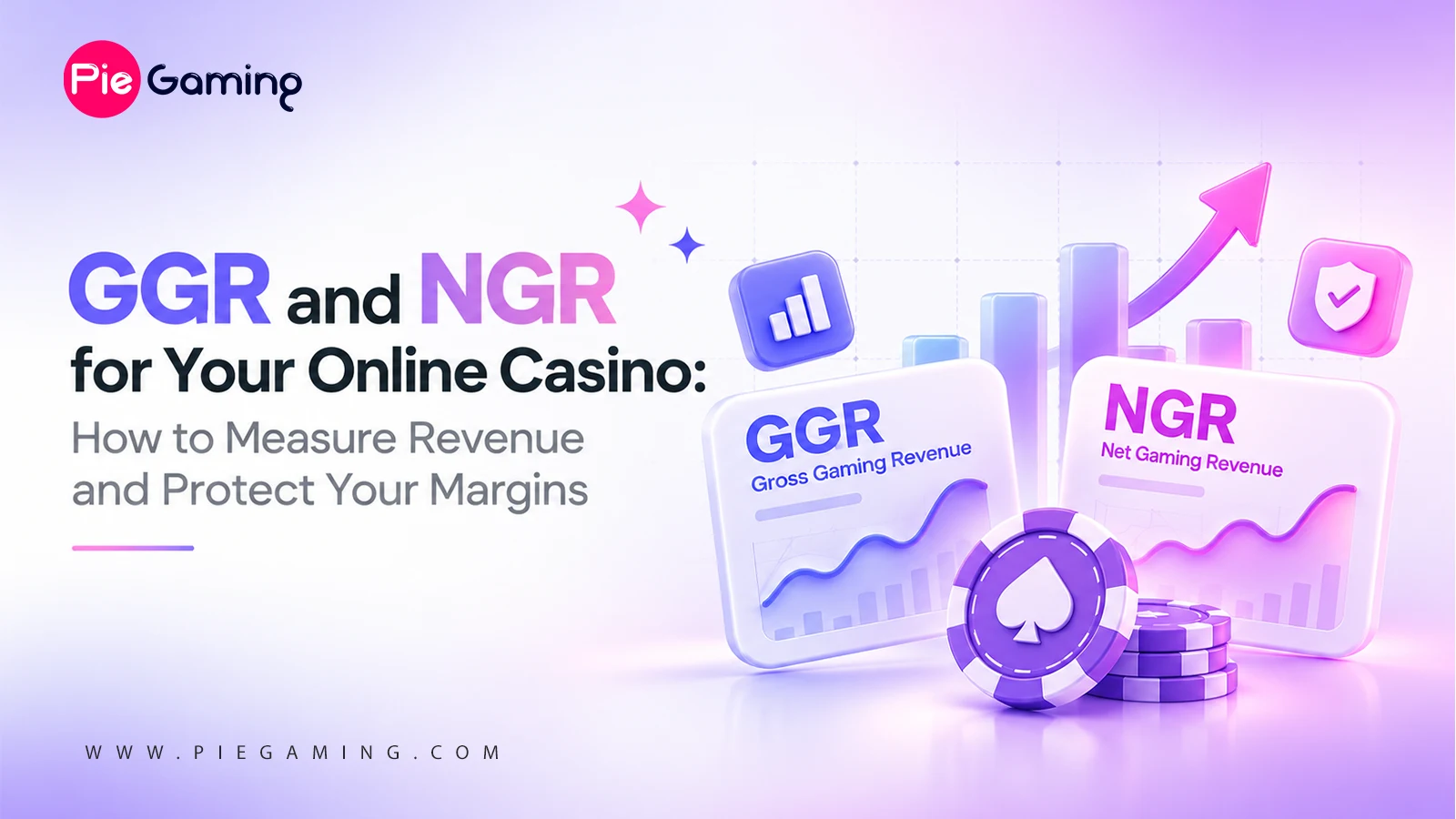
GGR y NGR son dos indicadores clave de ingresos que todo operador de casino debe monitorear. GGR es el total de apuestas menos los pagos a los jugadores, lo que refleja el rendimiento del juego antes de cualquier deducción. NGR es el GGR después de deducir bonos, impuestos, comisiones, regalías de proveedores y contracargos. La diferencia entre ambos revela dónde se está generando presión sobre los márgenes.

¡Nos vemos pronto en tu bandeja de entrada!

Manténgase a la vanguardia del juego. Suscríbete para exclusivo
¡Contenido, actualizaciones y información privilegiada!