
Kuanzisha kasino ya mtandaoni yenye mwelekeo wa kubadilika kunamaanisha kupata jukwaa lililotengenezwa tayari lenye programu iliyoundwa tayari na michezo iliyounganishwa tayari lakini kuibadilisha chapa kulingana na chaguo lako. Hatua muhimu ni kufanya utafiti kwenye soko kuamua bajeti ya kuchagua washirika wanaopata leseni ya michezo ya kubahatisha, kuanzisha njia za kulipa na zaidi.
If you are thinking about how to start a turnkey online casino, you are not the only one. More and more people are going this way because it avoids a lot of work.
The sekta ya casino mtandaoni is quickly expanding. The worldwide online gambling market is expected to grow to 153.57 billion dollars by 2030, increasing by 11.9% each year. That is a lot of space for new people to create a business.
Building a casino platform, from scratch, takes time, money, and a lot of technical skills. In this fast-paced world, no one has years to spend. This is where turnkey online casino software helps.
What Is a Turnkey Online Casino?
A turnkey online casino is a ready-to-deploy casino platform. A programu ya kasino ya turnkey provider builds it, configures it, and hands it over, ready to run under your own brand, your own look, and your own game selection.
That’s really the appeal when you’re working out how to start a turnkey online casino. The technical groundwork is already done for you. No code to write. No stack of separate vendor contracts to chase down and negotiate one by one. You’re essentially configuring a system that already works and shaping it around your market and your brand.
Kawaida turnkey casino provider package bundles six core components:
- Usimamizi wa Akaunti ya Mchezaji (PAM): registration, KYC checks, player segmentation, and activity tracking.
- Maudhui ya mchezo: nafasi, michezo ya muuzaji moja kwa moja, table games, and crash games, usually pulled in through aggregation deals with multiple studios.
- Malipo: cards, e-wallets, bank transfers, and crypto, where it’s allowed.
- Ofisi ya nyuma: a panel for reporting, game management, and the day-to-day running of things.
- CRM and bonus engine: tools for promotions, loyalty programs, and automated campaigns.
- Security and anti-fraud: real-time monitoring, encryption, and risk controls that protect both players and revenue.
On your own, each of those pieces means a separate vendor, a separate contract, and its own integration timeline. A turnkey setup folds all of it into one system that’s already been tested and is just waiting to be configured.
This is the difference in the creation of a turnkey online casino versus building one from scratch. By assembling dozens of moving parts yourself, you start with a working foundation. Your job shifts to branding, market fit and growth strategy, and not backend engineering.
Understanding these components matters before you talk to any provider. They define what you’re actually buying. They shape every decision, in the steps ahead. The trade-off is significant too: custom iGaming platform builds now often cost upwards of €500,000, a figure that prices many early-stage operators out of the from-scratch route entirely and makes turnkey the more realistic path to market.
Turnkey vs. White Label Casino
This is the most common decision early-stage operators face.
Kumbuka: If speed and low upfront cost are your priority, studio nyeupe casino programu is a reasonable way to enter the market. If you want brand ownership, flexible integrations, and stronger margins over time, turnkey is the better fit.
Soma Zaidi: Suluhisho za Kasino Nyeupe dhidi ya Turnkey: Ni Suluhisho Gani Anapaswa Kuchagua Opereta?
Start a Turnkey Online Casino in 9 Simple Steps
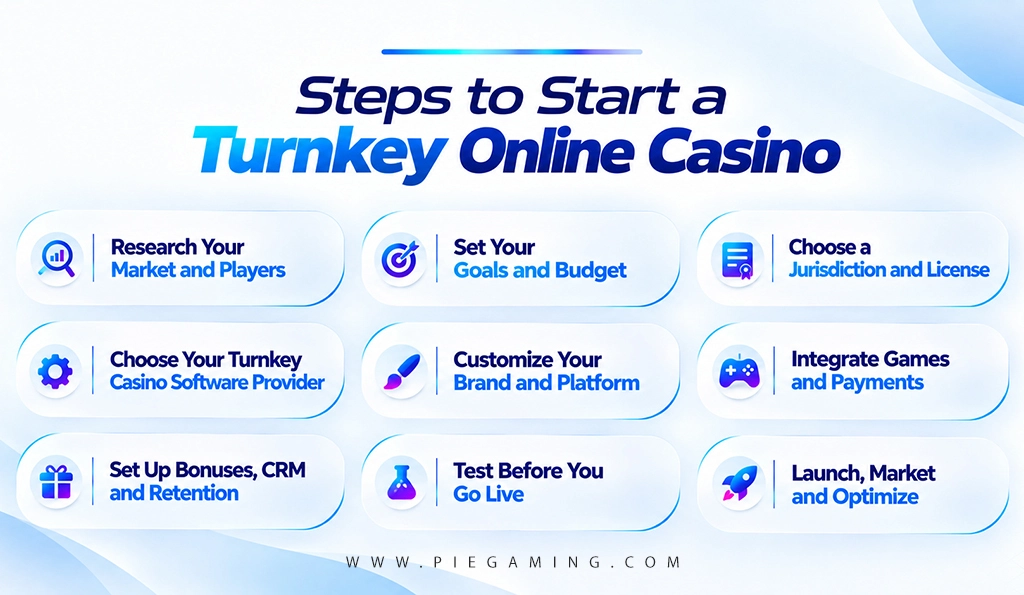
How to Start a Turnkey Online Casino in 9 Simple Steps
Here’s how to start a turnkey online casino, step by step, with the details operators actually need.
1. Research Your Market and Players
Don’t try to chase every region at once. Pick one or two target markets and actually study them, rather than spread yourself thin from day one. Look at license availability, local gaming taxes, how crowded the competition already is, and which payment methods players in that market already trust and use regularly.
Check device habits too: than 70 percent of online casino sessions now happen on mobile, according to industry engagement research. Therefore, first markets need mobile-first platforms from day one.
Then define your player profile. Slots first? Live dealer focused? Crypto friendly casino? This decision shapes your game portfolio; your payment stack, and your marketing spend before you have spoken to a vendor.
2. Set Your Goals and Budget
Put real numbers on paper: player acquisition targets, revenue milestones, a launch date you can realistically hit.
Then budget for the full year, not just the month you go live. Software and setup fees, licensing, game content, payment processing, marketing, support staff, ongoing compliance, all of it adds fast. And the marketing side isn’t getting any cheaper. UK gambling advertising spends rose 6.4% year-on-year to £46.7 billion in 2025, according to European Gaming’s industry data, so a budget that stops at launch day tends to run dry right when you need it most.
Acquisition costs are climbing across the board, so a launch- budget runs fast often right when you need marketing to spend most.
3. Choose a Jurisdiction and License
Your license decides which markets you can legally operate in, and it shapes how payment providers and affiliates view your brand from the very start.
Costs and timelines differ sharply by regulator. Curaçaos GCB license typically runs 50,000-200,000 all-in with a 6–12-month timeline, well-suited to cost-fast-moving operators.
Maltas MGA license often totals €80,000–€150,000+ in year one with a 4–6-month baseline timeline that can extend beyond that under deeper due diligence, but it carries stronger EU credibility. These figures come from Track360s 2026 for licensing research.
Explore options in our guides to the Curacao licence, Malta licence, na top iGaming jurisdictions. Speak to a gambling-law specialist before you commit.
4. Choose Your Turnkey Casino Software Provider
This is the decision with the longest reach. Get it wrong, and you’ll likely be migrating platforms within a year, at real cost and real downtime.
Compare providers on platform depth (PAM, customization, Ofisi ya nyuma), game library breadth, payment integrations, security standards, scalability, support availability, pricing model, flat fee versus GGR share. Game libraries alone vary a lot: some aggregator-backed platforms now offer more than 20,000 titles from hundreds of studios, while others offer a fraction of that.
Always ask for a demo and always ask for a reference call with an operator already running on the platform. A sales deck won’t tell you anything a real user can’t contradict.
5. Customize Your Brand and Platform
This is where the platform actually becomes yours. Configure your logo, color palette, themes, and UI layouts to match your brand, not a generic template for someone else designed.
Set your languages and currencies for each target market. Decide which game titles to surface and which to tuck away and build a category structure that fits how your players browse, think “Hot Games,” “New Releases,” or lobbies built around a specific market.
Before you sign anything, test how deep the customization really goes. Plenty of providers advertise full customization and then deliver little more than a color and logo swap over a fixed template. Ask to see the admin panel yourself. Not a screenshot in a sales deck.
6. Integrate Games and Payments
Build your opening game portfolio around your audience: slots, live casino, table games, and crash games, delivered through game aggregation rather than dozens of separate studio contracts. Aggregation turns what would be 50+ individual provider integrations into a single API connection, which cuts legal overhead and shrinks time to market from months down to weeks.
Then connect the payment methods that fit your market: cards, e-wallets, local bank transfers, and crypto where it’s permitted. Set up KYC and fraud rules alongside payments, not as an afterthought. This one’s worth getting right: up to 30% of players abandon sign-up when KYC is slow or clunky, according to HooYu’s gaming onboarding research, so a smooth verification flow is really a conversion-rate issue in disguise.
7. Set Up Bonuses, CRM and Retention
Configure welcome offers, free spins, loyalty tiers, and segmented campaigns before launching, not after you’ve already noticed players quietly drifting away.
Retention tools matter more than most new operators expect going in. Personalized offers and recommendations can lift retention and lifetime value by close to 30% in mobile-first gaming markets, according to Clever Tap’s engagement research. Segmentation and automation are what make that possible at scale, getting the right offer to the right player at the right moment instead of blasting one promotion out to everyone.
A mfumo wa bonasi ya kasino that your own marketing team can run independently without filing developer tickets for every campaign tweak saves time on every single promotion going forward.
8. Test Before You Go Live
Run functionality, performance, security, and cross-device QA, and don’t cut corners on any of them, even when the launch date is bearing on you.
Validate the entire player journey end to end registration, KYC, deposit, gameplay, bonus trigger, withdrawal, support contact. A withdrawal flow that breaks after launching costs you trust that’s genuinely hard to earn back, especially in a market where player reviews and forums spread fast.
A soft launch to a controlled audience is worth the extra week. It surfaces payment issues, UX friction, and edge-case bugs before you’ve committed a real marketing budget to driving traffic toward them.
9. Launch, Market and Optimize
Go live, then start tracking acquisition cost, conversion rate, retention, deposit volume, and game-by-game performance from week one.
Use SEO, paid search, affiliates, partnerships, and CRM to drive growth, always within the advertising rules of your licensed market, since those rules vary a lot by jurisdiction and change often. Check the rules before every campaign, not after a regulator flags one.
Launch isn’t really the finish line. It’s where the real optimization work, and the real margin, actually starts.
Key Features to Look for in Turnkey Casino Software
How Long Does It Take to Launch a Turnkey Online Casino?
There is no answer because different timelines all happen at the same time. How quickly you actually start a turnkey online casino depends on which part becomes the problem.
Setting up the platform is usually the part. Getting a license is always the slowest part of it. Handling payments and banking is in the middle. Can be easy to ignore.
The total time from setting up the software to going usually takes between 4 to 8 weeks once a license is already in place. Without a license, getting the license becomes a challenge and it can make the whole project take 6 months or longer.
Because these can run in parallel, operators who start licensing and payment onboarding early reach market faster than those who wait until the software is ready.
How Much Does a Turnkey Online Casino Cost?
The total cost depends on how large the project is where you want to operate and how much customization you need.
Here is a realistic first-year budget breakdown, so you can ask providers for the numbers.
Software costs and license fees are mostly onetime or fixed. Marketing is often where most operators underbudget, because starting a turnkey casino profitably depends more on long‑term customer acquisition costs than, on the platform fee of a turnkey online casino.
Ask every provider for a detailed quote covering your target market, features and integrations. For a deeper breakdown, see our guide to casino software development cost.
Launch Faster with PieGaming’s Turnkey Casino Software
PieGaming'S programu ya kasino ya turnkey is built for independent operators who want full control of their platform. Highlights:
- Launch in about 4–6 weeks using pre-configured systems and automated integrations
- Michezo ya 5,000 + from leading providers including Mageuzi, Pragmatic Play, OneTouch and Evoplay
- Deep branding control: themes, layouts, logos, languages and currencies
- Integrated PAM and CRM for KYC, segmentation and automated campaigns
- Bonus and rewards engine for cash bonuses, free spins and loyalty
- Shughuli za Crypto including Bitcoin, Ethereum, USDT and Litecoin
- Usalama na kupambana na ulaghai with 24/7 monitoring and behavioral risk analysis
- Paneli ya usimamizi wa hali ya juu for providers, players and real-time metrics
- Usaidizi wa kiufundi wa 24 / 7 and a mobile-first experience
PieGaming’s guided process covers requirement analysis, solution planning, UI/UX customization, platform setup, third-party integrations, QA testing and final launch.
Hitimisho
Starting a turnkey casino comes down to a few decisions made early and made well: your target market, your license route and your software partner. The platform removes the burden, but planning, compliance and marketing still decide whether you succeed.
Treat licensing as a workstream, budget beyond the software, and evaluate providers on customization, integrations and support rather than headline price. With the right partner you can go from plan to launch in weeks and focus on growing your brand.
Wasiliana Nasi
Maswali ya
-
What is the cost of creation of a turnkey online casino?
Costs vary with scope, jurisdiction and customization. Plan for software and setup fees, licensing, game content, payment processing, marketing and first-year operations. Typical turnkey packages start at $20,000 and go up to $100,000+.
-
Who should avoid launching a turnkey online casino?
A turnkey casino may not suit you if you: Need to go live in days with minimal budget (white label may fit better) . Have no capacity to manage licensing, compliance and integrations . Cannot fund marketing, since acquisition is often the largest ongoing cost . Want a fully proprietary, ground-up platform (a custom build fits better) .
-
When is a turnkey online casino needed?
It makes sense when you want your own brand, control over UI and game portfolio, flexibility over payment and game integrations, and better long-term margins, but do not want to build the technology from scratch.
-
Can a single platform handle multiple casino and lottery operations?
It depends on the platform's architecture. A platform with centralized PAM, wallet, game management and reporting can run multiple casino brands, markets and verticals from one back office. For lottery, confirm that the provider supports it natively and ask how it is integrated.
-
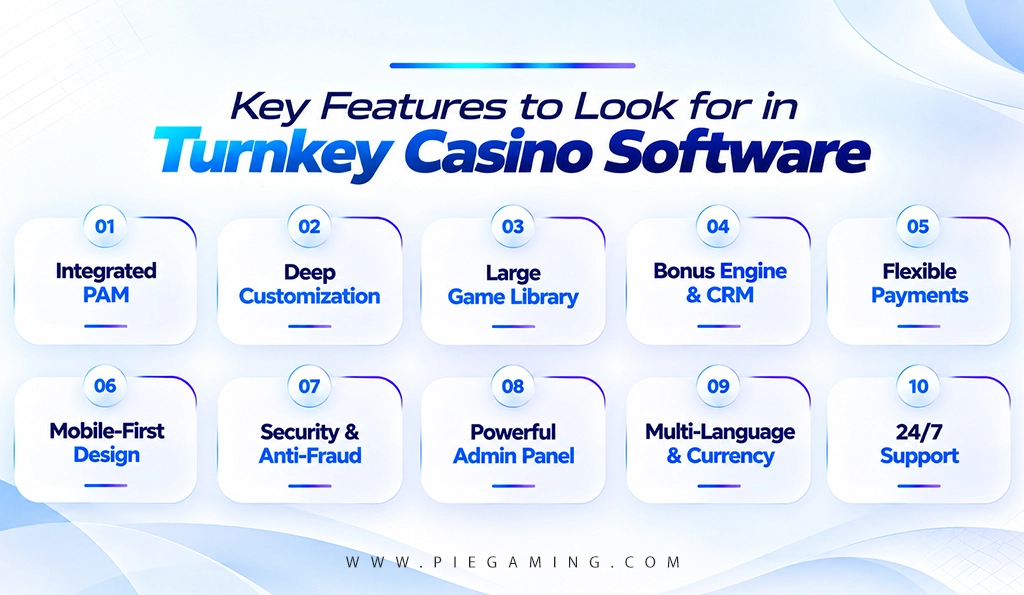
What key features should operators look for in modern turnkey casino software?
Prioritize PAM, deep customization, a large integrated game library, a bonus engine and CRM, flexible payments, mobile-first design, anti-fraud security, a strong admin panel and 24/7 support.
-
What makes a turnkey online casino different from a white-label solution?
A turnkey online casino software is a fully customizable platform with high control over brand, games and integrations, and higher margins. A white-label casino is a ready-made platform run under the provider's license, with limited customization and revenue sharing. White label is faster and cheaper upfront. Turnkey scales better.

Jaya Swaroop amekuwa akishughulikia teknolojia ya iGaming na kamari tangu 2019, akiwa na utaalamu katika majukwaa ya kasino mtandaoni, suluhisho za vitabu vya michezo, na mifumo ya leseni. Kazi yake inahusisha kuchambua uwezo wa jukwaa na kutathmini miundo ya gharama, mahitaji ya kufuata sheria, ujumuishaji wa malipo, mikakati ya soko, na masasisho ya udhibiti ambayo yanaathiri waendeshaji wanaoingia au kuongeza kasi katika nafasi ya iGaming. Akiwa na uzoefu katika uuzaji wa B2B na mkakati wa maudhui, amechangia katika mipango ya ukuaji na uzalishaji wa mahitaji inayoongozwa na SEO kwa biashara za kimataifa. Jaya ana shahada ya kwanza katika Sayansi (Kemia na Hisabati) na amethibitishwa katika uandishi wa maudhui, uuzaji wa barua pepe (HubSpot), usimamizi wa miradi, na Google Analytics.
Matatizo ya kasino mtandaoni yanaweza kuathiri waendeshaji katika kila hatua, kuanzia kuingia sokoni na malipo hadi kubaki kwa wachezaji, teknolojia, na faida. Jifunze changamoto muhimu na njia za vitendo za kuzishughulikia.
Kenya ina soko linalokua la kamari mtandaoni linaloungwa mkono na kuongezeka kwa matumizi ya intaneti na mifumo ya malipo ya simu. Mwongozo huu unafafanua hatua na itifaki unazoweza kufuata kwa kuanzisha biashara ya kasino mtandaoni nchini Kenya, ikiwa ni pamoja na kanuni na mahitaji ya leseni.
Vipengele muhimu vya kuongeza watumiaji wa kasino mtandaoni vinaweza kufupishwa katika maeneo manne. Njia sahihi za ununuzi, kutoa ushirikishwaji wa kibinafsi, kutengeneza programu za uaminifu, na kufanya maamuzi yanayotegemea data. Kuunda uzoefu wa simu, kudumisha ushirikishwaji wa wachezaji na masoko ya kutafsiri unayotaka kuvutia yote ni muhimu vile vile kwa ukuaji endelevu.

Blogu hii inaangazia mikakati muhimu ya waendeshaji wakuu wa iGaming mwaka wa 2026 na jinsi unavyoweza kukua kama wao kama kiongozi wa soko. Endelea kufuatilia hadi mwisho.
Kuanzisha kasino mtandaoni kunasikika kuwa jambo la kusisimua. Lakini waendeshaji wengi wapya hushindwa ndani ya miezi michache kutokana na makosa yanayoweza kuepukika. Hapa kuna makosa 10 bora ambayo lazima uyaepuke.
Jifunze jinsi ya kuanzisha kasino mtandaoni nchini Uturuki mwaka wa 2026. Pata vidokezo rahisi kuhusu sheria, leseni, malipo, na mengineyo ili kuendesha biashara yako vizuri.
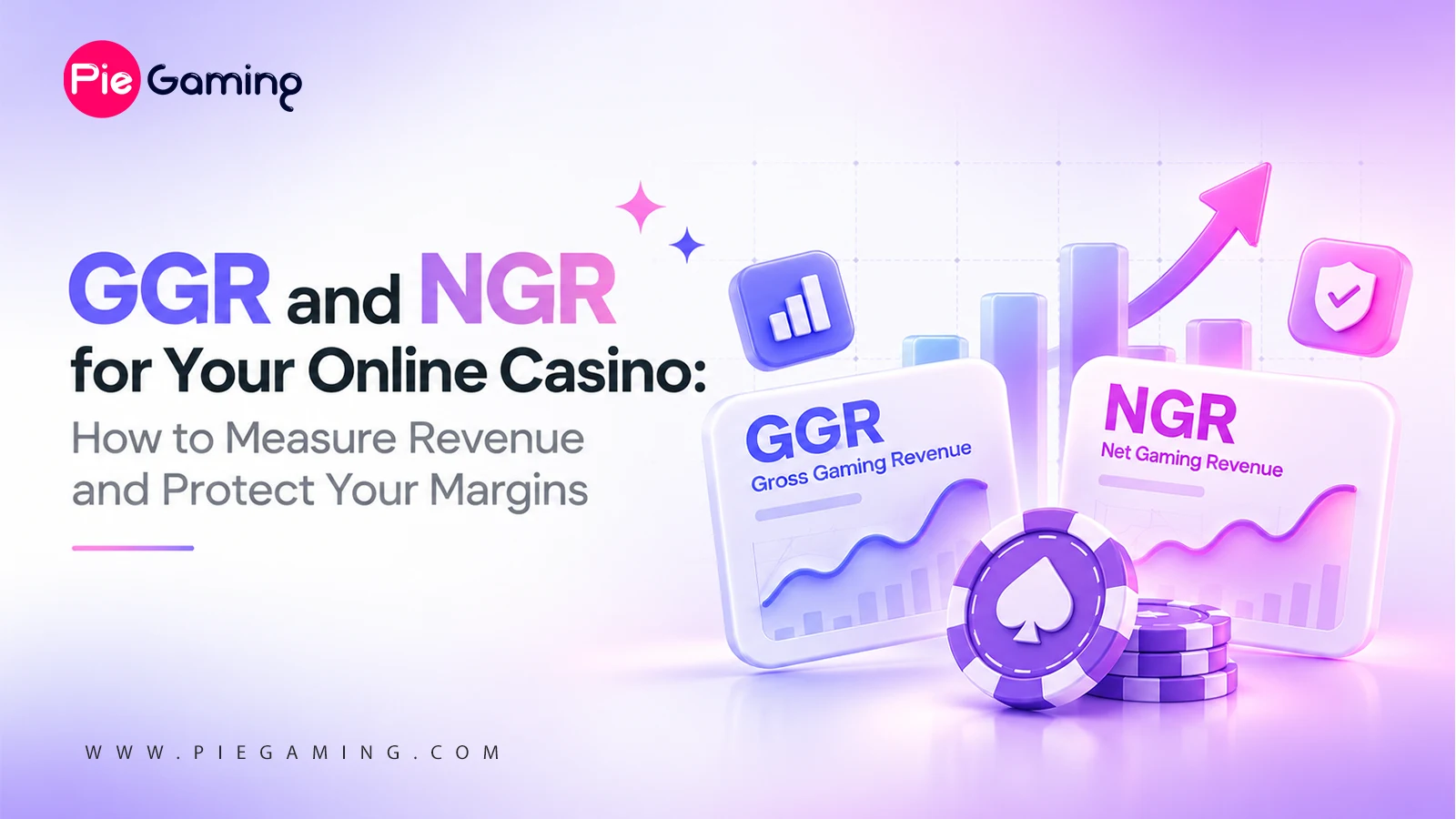
GGR dhidi ya NGR ni vipimo viwili vya mapato ambavyo kila mhudumu wa kasino anahitaji kufuatilia. GGR ni jumla ya dau ukiondoa malipo ya mchezaji, ikionyesha utendaji wa michezo kabla ya makato yoyote. NGR ni GGR baada ya bonasi, kodi, ada za malipo, mirabaha ya mtoa huduma, na marejesho ya malipo kukatwa. Pengo kati ya hizo mbili linaonyesha shinikizo la margin linapoongezeka.

Tutaonana kwenye kikasha chako hivi karibuni!

Endelea mbele ya mchezo. Jisajili kwa ajili ya kipekee
maudhui, masasisho, na watu wa ndani!