Mexico’s iGaming market is offering golden opportunities to operators, but navigating this market is complex. Why? Because sports betting is fully regulated, casino activities are operated in a more restrictive environment.
Today, Mexico is swiftly gaining a reputation as one of the most attractive iGaming markets in Latin America. The country has a population of over 130 million and increasing internet penetration, which presents a golden opportunity for online casino operators and sportsbook operators as well.
It is not as easy as it sounds to get into the Mexican gambling market. Mexico has a strict regulatory framework with regard to iGaming. This makes compliance and strategic planning crucial for iGaming operators’ long-term success.
Understanding the online casino & sports betting regulations in Mexico isn’t optional but necessary to stay competitive in the industry.
This guide will walk you through the Mexican regulatory laws on casino & sports betting, licensing, taxation, and future outlook.
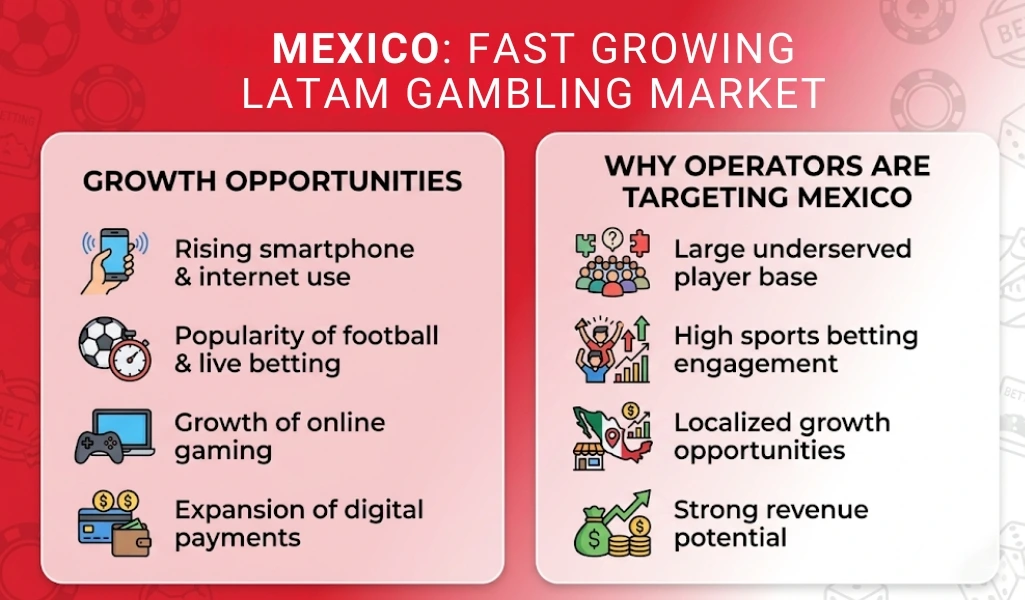
Mexico’s iGaming Market Growth Opportunities
Is Online Gambling Legal in Mexico?
Yes, online gambling is legal and regulated in Mexico, but within a specific and complex regulatory framework.
Mexico lets operators run gambling businesses under federal law. But the twist is that the country doesn’t issue standalone iGaming licenses; rather, it regulates iGaming activities via land-based licensing frameworks.
So, how do operators run an online casino business in Mexico? Online operators are strictly bound to follow the land-based licensing structure. Meaning? Operators seeking to offer iGaming products must have either a land-based operating permit issued by the federal government or formally partner with an entity that does.
This makes online gambling operations partially legal but strictly regulated.
Land -Based Vs. Online Gambling in Mexico
The table below highlights key differences between land-based gambling and online gambling in Mexico and helps operators evaluate market entry strategy.
| Factors | Land-based Gambling | Online Gambling |
| Legal status | Fully legal and regulated under the Mexican gaming license. | Legal but regulated indirectly via a land-based framework. |
| Licensing model | Requires direct license issued by SEGOB | Operates under an existing land-based license. |
| Market entry | Requires local presence in the country. | Requires collaboration with licensed land-based operators. |
| Operations | Operators can operate independently. | Standalone licenses are not issued; that’s why operators can’t operate independently. |
| Operational scope | Restricted to physical casinos. | Mobile, web, and remote betting platforms. |
| Compliance requirements | Strict compliance with security, audits, and operations. | AML/KYC, Data protection, fair gaming, and digital compliance. |
| Players reach | Limited to on-site visitors. | Accessible across the country through online platforms. |
| Revenue stream | Limited to location-based growth. | High growth due to online platforms. |
| Offshore operator entry | Allowed through partnership or investment. | Only possible via locally licensed operators. |
For players, the minimum legal gambling age in Mexico is 18+, which is applicable across all types of gambling activities, including both land-based and online.
Casino & Sportsbook Gambling laws in Mexico
Mexico’s gambling laws have evolved over the years. With updated legacy legislation and modern regulatory updates, here’s a clear breakdown of casino & sportsbook gambling laws in Mexico.
Federal Gaming and Raffles Law (1947)
The Federal Gaming and Raffles Law, enacted in 1947, is known as the foundation of all gambling regulations in Mexico. This law, enacted decades ago, continues to serve as the primary governing body regulating gambling in Mexico.
What does this law signify?
- Legalizes all gambling activities within the country
- Gives authority to the federal government
- Forms the legal base for licensing and oversight
2004 Regulatory Update
The Regulation of the Federal Law of Games and Lotteries (2004) was a revolutionary phase in the history of Mexican gambling law. This law streamlined the regulatory framework and added provisions for remote and online gambling.
Here are the guidelines set by this law:
- Outlined detailed compliance and operational requirements
- Defined proper licensing procedures
- Enabled SEGOB to issue the first federal license for remote gambling
2023 Regulatory Changes
An important development came in November 2023 when a presidential decree introduced amendments targeting 2004 regulatory laws. The newly introduced changes tightened the gambling regulatory landscape.
Changes introduced under this law:
- Prohibition on new online casino licenses
- Established operators can continue operating until license expiry
- Increased scrutiny on compliance operations
- Discussions around a proposed 2025 Bill to expand and modernize online gambling
For operators, this simply means introducing a stricter and more structured regulatory framework.
iGaming Regulatory Authorities in Mexico
Every land-based and online gambling operator should know the reigning regulatory bodies for compliance and licensing in Mexico.
SEGOB (Secretaría de Gobernación)
The Ministry of the Interior (Secretaría de Gobernación, or SEGOB) is the main federal governing body overseeing iGaming regulations in Mexico. SEGOB holds the power to authorize, give permits, and supervise all gambling activities within Mexican territory; the law is also applicable to operators licensed in foreign jurisdictions.
SEGOB is responsible for:
- Issuing licenses and permits
- Defining regulatory policies
- Supervising all types of industry operations
Dirección General de Juegos y Sorteos (DGJS)
The General Directorate of Games and Lotteries (Dirección General de Juegos y Sorteos, or DGJS) is the dedicated regulatory body overseeing the day-to-day administration of gambling activities in Mexico. DGJS operates under SEGOB.
The main role of DGJS is in issuing permits and enforcement, particularly around iGaming activities.
Here’s what this regulatory body does:
- Handles licensing and approvals
- Monitors operator compliance
- Enforces gambling laws and regulations
Licensing Requirements for Operators
Mexico enforces strict gambling laws, which every operator must follow. Operators entering Mexico’s gambling market must fulfill licensing requirements.
Here are the key licensing requirements operators must follow:
- Obtain authorization from SEGOB
- Offshore operators are not allowed to operate independently
- Collaboration with a locally licensed operator is necessary
- No standalone online casino licenses are available
Types of Licenses
There are typically three types of gambling licenses in Mexico available for operators. These include:
1. Land-based casino license
This is one of the primary licenses available, particularly for land-based casino operators. It allows physical casino activities like table games, sports betting, and slot machines within the jurisdiction. This license is issued by SEGOB/ DGJS, which ensures that all online operations are authorized.
2. Sports betting license
As the name suggests, this license is for operators seeking to run a sports betting business in the country. In Mexico, sports betting is a more regulated and commercially mature gambling market than casino market. Sports betting operators can procure this license from SEGOB.
3. Online betting authorization
It has been clear that there is no standalone online casino license available for operators in Mexico. Online betting authorization is linked to an existing land-based license. Once an operator obtains a land-based license, they can offer online casino services.
Read Blog – How to Secure a Gaming License?
Regulations for Online Casinos in Mexico
Online casinos in Mexico are operated under the framework of land-based gambling, which creates challenges for operators.
Here is the core regulatory reality for operators:
- Every online casino platform exists in a legal grey area
- 2023 regulatory updates have restricted the issuance of new licenses
| Note to Remember:
Operating an online casino business without holding a SEGOB license while serving a Mexican audience is illegal. |
As per AIEJA (the Association of Permit Holders, Operators, and Suppliers of the Entertainment and Gambling Industry in Mexico), 60% of bookmakers operating in Mexico in 2024 were operating without a SEGOB license.
Compliance requirements:
Operators must stick to the following licensing requirements asked by the Mexican gambling law:
- Fair gaming platform
- AML/KYC policies
- RNG certification
- Robust data protection
- Cybersecurity measures
Not meeting these requirements will lead to penalties and license revocation.
Read Blog – How to Buy Online Casino Software
Regulations for Online Sports Betting
Unlike online casinos, sports betting is a fully legal and regulated market in Mexico. It requires proper authorization from SEGOB/ DGJS to operate legally within the jurisdiction.
The activities covered under this include the following:
- Pre-match betting
- Live betting (in-play)
- Mobile betting
| Key Point to Remember:
Sports betting is a growing gambling segment in Mexico, making it a key entry point for operators. |
Taxation on Gambling in Mexico
For running an iGaming business in Mexico, operators must understand the taxation laws of the country. This is important for financial planning and the profitability of the business. The country imposes taxation on both operators and players:
Taxation on Operators
- Operators are required to pay 30% tax on Gross Gaming Revenue (GGR).
Taxation on Players
- Players must pay tax on their winning amount, typically around 1%, along with local or state taxes.
Read Blog – Strategies To Optimize GGR And NGR
Future of Online Gambling Regulations in Mexico
The iGaming regulatory framework in Mexico is evolving, bringing both challenges and opportunities for operators. The law in the country lacks a dedicated legal framework for online gambling; still, iGaming activities operate under the grey area.
Challenges in Mexico’s Gambling Regulations
- Outdated legal framework: a 1947 law is still in force.
- Restrictions on new casino regulatory laws and licenses.
- The licensing structure poses a significant challenge for offshore operators.
Though gambling activities are federally regulated, there are certain states where gambling is restricted for new land-based casinos. The states include Coahuila, Nuevo León, Tlaxcala, Guanajuato, and Baja California Sur.
Operators have to go through both federal and state-level regulations when planning land-based or online casino operations.
What Lies in the Future?
Today, the government of Mexico is actively working towards a reform of the 1947 law. Apart from this, many goals might be implemented in the future, including
- Modernization of gambling laws
- Expansion of regulated iGaming under new legislation
- Continuous growth in sports betting adoption
- Strict compliance and monitoring requirements
- Implementation of tax deduction at source (TDS)
It’s crucial for operators to stay ahead of regulatory updates to maintain compliance.
Read Blog – Top 10 Sports Betting Software Providers in 2026
Conclusion
The iGaming market in Mexico is the fastest-growing market in Latin America. Although the regulatory environment is a little challenging for operators, it is still navigable. Success in this market can only be achieved when you navigate its complex legal framework, build the right partnership, and ensure strict compliance.
For sportsbooks and casino operators, the opportunity is real. In the future, Mexico’s laws are going to be more comprehensive and stricter for operators, so keeping a regulation-first mindset is crucial for operators to sail through this market.

FAQs
-
Who regulates gambling in Mexico?
SEGOB is the primary regulatory body that regulates online gambling in Mexico via its regulatory arm Dirección General de Juegos y Sorteos (DGJS).
-
Can offshore operators venture into the Mexican market?
Yes, but not directly. Operators must connect with a locally licensed operator to run gambling businesses in the country. Offshore or foreign operators are not allowed to enter the market directly.
-
Is sports betting legal in Mexico?
Yes, sports betting is fully legal and regulated in Mexico, including online and mobile betting. Operators should have proper authorization from SEGOB/ DJIS and cover pre-match, live, and mobile betting.
-
How much is the gambling tax in Mexico?
Operators have to pay a tax on Gross Gaming Revenue (GGR) of 30%. This makes Mexico one of the higher-tax gambling jurisdictions in the world.


Monika Gola is a seasoned writer at PieGaming specializing in the iGaming industry. With years of experience, she delivers insightful content on trends, innovations, and strategies in the online casino domain. Monika's work is known for her clarity and depth, making complex topics accessible and easy to understand to a wide audience. Explore the world of iGaming through her engaging and informative content.
-

Discover top sports betting algorithm software and how they use data, AI, and real-time insights to improve odds, predictions, and overall betting strategies.
-
This guide explains Esports betting in 2026, covering how it works, popular bet types, key markets, platforms, strategies, legal considerations, and tips to help beginners start safely and make informed decisions.
-

Learn to leverage AI in your sports betting as a pathway to translate raw data to actionable analytics and precise predictive models. This guide discusses how some of the most dynamic algorithms are redefining the wagering industry for the next generation of online sports betting platforms and the players that use them.
-

This blog walks you through the top eSports games, most played and watched by the audience. Stay tuned to find out about the best eSports betting games available worldwide.
-

This guide explains virtual sports betting in clear, easy language. It covers how virtual sports work, why players enjoy them, and how operators use them alongside live betting. The guide focuses on the basics without technical jargon, helping readers understand where virtual sports fit in today’s iGaming market.
-

Algeria has no online casino or sports betting regulation to speak of — instead, the country enforces a near-total gambling ban rooted in civil law and Islamic principles. Yet despite the prohibition, offshore platforms continue to pull in millions of users every month, driven by high demand and a near-total absence of legal local alternatives.
-
Armenia has a regulated iGaming market with clear licensing and operational guidelines. This guide explores casino and sports betting regulations in Armenia, covering legal requirements, compliance standards, and how operators can establish a presence in this growing market.
-

Canada’s online gambling market is regulated under both federal laws and provincial regulations. The guide outlines Canada’s regulations regarding online casinos and sports betting, from licensing arrangements to access to legal terms for operators in a new market.
-

Planning to launch your iGaming business in Malta? This free guide covers sports betting and online casino regulations in Malta to help you run a safe and legal iGaming business.
-

This guide lists the top 10 sports betting odds providers in 2026, helping operators choose fast, accurate, and reliable data sources for their platforms.
-

In Spain, we have a structured iGaming framework guided by the Spanish Gambling Act. This guide covers the main regulations regarding online casinos and sports betting for Spain; licensing requirements, compliance rules, and regulatory authorities governing the market.
-

The world’s most regulated online gambling industry exists in the UK. This guide outlines all important regulations in place for online casinos and sports betting within the UK — from licensing requirements to regulatory compliance to responsible gambling principles.
-

Sports betting software development involves creating custom platforms. These platforms help manage bets, process payments securely, and provide live betting options. They also keep users engaged, which helps businesses grow.
-

Starting a sports betting business in the UK involves ensuring compliance, obtaining licenses, selecting software, setting up payment systems, and much more. Let’s explore this in greater detail.
-

The technology that supports modern sportsbooks comes from sports betting software providers. This article features leading providers and explains the capabilities operators should consider when picking the best platform to run their business.
-

Sports Betting in the iGaming Industry: A market finally getting its dues! Existing for over a century in various parts of the world,…
-

In the high-stakes sports betting world, fortunes can be made or lost as a result of a single match outcome. But what if…
-

This blog explores the world of sports betting, covering new sports betting trends like mobile apps and AI, key challenges, and future growth…
-

Odds on sports betting are the odds of an event as well as how much you get out of a winning bet. This easy-to-follow guide covers some of the basics on how odds function, how many ways sportsbooks format them—how they are presented—and how a game bettor can confidently read and interpret them.
-

The scope of Online sports betting in 2026 is growing fast, driven by new technology, better laws, and more players joining betting platforms worldwide. Read along to catch up with the changing trends.
-

This checklist covers everything your online sportsbook needs to succeed. From licensing and payment methods to odds providers and security. Use it to avoid costly oversights and stay ahead of your competition.
-

White label betting exchange solutions let you launch your own peer-to-peer betting platform easily and quickly. This guide covers how they work, key features, and benefits for operators.
-

See how white label sportsbook solutions make online sports betting better. Explore custom features, quick setup, and benefits for operators in 2025.
-
Discover the top 6 tips for selecting reliable turnkey betting platform providers to enhance the betting experience for your customers. Click to read now.
-

White label betting exchange platforms are becoming more popular in 2026. This list shows top providers that offer ready-to-use solutions with liquidity already included, custom branding options, and quick setup for casino operators.
-

Want to launch your own sportsbook? Learn how to create your own sports betting platform from scratch — from licensing to compliance. Start smart in 2026.
-

The growing popularity of sports betting is opening doors for operators. Read here the history, present and future of the global sports betting industry.

Voila!
See you in your inbox soon!

Stay ahead of the game. Subscribe for exclusive content, updates, and insiders!


