Algeria has no online casino or sports betting regulation to speak of — instead, the country enforces a near-total gambling ban rooted in civil law and Islamic principles. Yet despite the prohibition, offshore platforms continue to pull in millions of users every month, driven by high demand and a near-total absence of legal local alternatives.
Picture this: millions of people are placing bets online every single day, but in Algeria, even one wager could land you in legal trouble. Algeria is one of the strictest countries in the world when it comes to gambling. Online casinos, sports betting, all of them, are banned outright under national law.
This isn’t just bureaucratic red tape. The restrictions run deep, rooted in Islamic principles and backed by real legislation like Law 18-05. There’s no system for securing an iGaming license, no grey area, no “technically legal if you squint” loophole for operators to slip through.
The result is a fascinating contradiction where the appetite for online gambling clearly exists, but legal access simply doesn’t.
So, what does that mean for Algerian players? Many are turning to offshore platforms, navigating a space that sits firmly outside the law. Understanding online casino and sports betting regulations in Algeria, how that works, and what risks come with it, is exactly what this guide is here for.
Understanding Algeria’s Gambling Laws and Legal Framework
Overview of Algeria’s gambling laws
Algeria doesn’t just discourage gambling, it bans it. Unlike some countries that rely on a single piece of legislation, Algeria uses a combination of civil law, criminal law, and religious laws to keep gambling off the table entirely. The result is one of the most restrictive gambling markets in the world.
The Legal Foundations
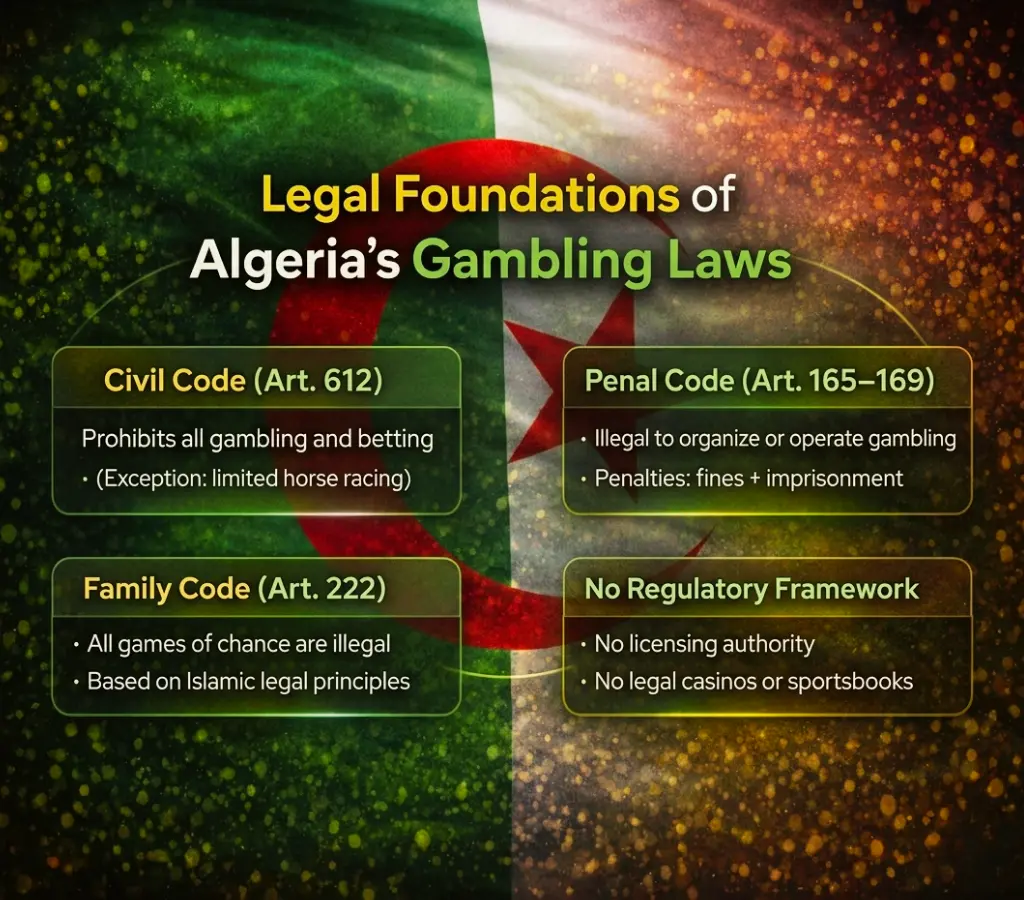
Several laws work together to make gambling illegal in Algeria:
- Civil Code (Article 612) prohibits gambling and betting across the board, with only narrow exceptions like horse racing.
- Penal Code (Articles 165–169) criminalizes anyone who organizes or operates gambling, with penalties ranging from 3 to 12 months in prison and fines between 500 and 20,000 DZD.
- Family Code (Article 222) declares all games of chance illegal, reflecting how deeply Islamic law shapes the country’s legal thinking.
On top of all this, there is no gambling regulator in Algeria. No licensing body, no framework for operators to apply through, nothing. Legal casinos and private sportsbooks do not exist here.
How Strict Is the Ban?
Pretty strict. Around 99% of Algeria’s population is Muslim, which goes a long way in explaining why the laws are shaped the way they are.
Beyond that:
- Zero licensed casinos or sportsbooks operate legally in the country.
- Online gambling is completely banned, with authorities actively blocking gambling websites.
- The legal gambling age technically sits at 18 but only applies to the rare state-controlled exceptions.
The Few Exceptions (State-Controlled Only)
A small number of gambling activities are allowed, but only when the government controls them directly. These include:
- Horse racing betting is the main legal outlet.
- State-run lotteries and sports pools operated through public entities like Pari Sportif Algérien.
Betting on foreign events is not permitted, and around 40% of lottery winnings are redirected toward public causes like sports programs. The goal here is not to build an iGaming industry. It is to generate public revenue while keeping private operators out entirely.
What About Online Gambling?
Illegal. Law 18-05, introduced in 2018, explicitly bans all internet-based gambling. Authorities block websites and monitor digital activity to enforce this. Some Algerian players do access offshore platforms, but doing so comes with real risks:
- No consumer protection or legal recourse if something goes wrong.
- Fines of up to 1 million DZD (roughly $7,700).
- Prison sentences of up to one year under newer legislation.
Gambling in Algeria is not regulated. It is restricted. The system is built on religious values, social protection, and tight government control, with just enough room for state-run exceptions. For most players, that means high demand with almost no legal way to meet it, pushing activity underground and onto offshore platforms that operate well outside the law.
Regulatory Framework and Authorities in Algeria
Algeria doesn’t follow the typical regulatory playbook. There is no dedicated gambling commission, no licensing system, and no legal pathway for private operators to enter the market. Instead of regulating gambling, the system is built almost entirely around restricting it, with oversight spread across multiple government institutions rather than sitting with one central authority.
In practice, responsibility is divided. The Ministry of Youth and Sports oversees a small number of legal, state-controlled betting activities like lotteries and sports pools. Law enforcement agencies handle the other side, monitoring illegal gambling operations and enforcing the ban on the ground.
Here is how the setup breaks down:
- No dedicated gambling regulator. There is no central body licensing or supervising gambling activity, and no framework exists for private or foreign operators to work within.
- Split oversight. The Ministry of Youth and Sports manages limited legal betting, while police and enforcement agencies crack down on anything outside those boundaries.
- No licensed private operators. Only state-run entities like Pari Sportif Algérien are permitted to operate. Commercial casinos and sportsbooks are prohibited entirely.
- Laws target operators, not players. The legal focus falls on those who organize or promote online casino and sports betting platforms. Individual players are far less frequently prosecuted.
- Active enforcement online. Gambling websites are blocked by internet providers, and financial transactions linked to betting may be monitored.
Licensing, Compliance, and Payment Realities in Algeria
Algeria does not have a gambling licensing system. There is no legal framework for private operators to apply through, no approved platforms, and no licensed casinos or sportsbooks operating within the country. Outside of a handful of state-run offerings, gambling is simply not permitted.
Unlike regulated markets, where operators jump through compliance hoops to earn their license, Algeria has no such structure in place. There are no published standards for anti-money laundering, know-your-customer checks, auditing, or responsible gambling tools. The reason is straightforward: private gambling businesses are not allowed to exist here, so there is nothing to regulate.
The key realities look like this:
- No licensing regime for private or foreign operators.
- No compliance frameworks covering AML, KYC, or auditing standards.
- Only state-controlled entities like Pari Sportif Algérien are permitted to operate.
- No legal pathway exists for entering the Algerian gambling market.
What This Means for Payments
The restrictions don’t stop at operators. Because gambling is illegal, banks and iGaming payment providers are not permitted to support gambling transactions either, which creates real headaches for anyone trying to use offshore platforms.
- Local iGaming payment solutions like CIB and EDAHABIA are not built for gambling transactions, and any activity linked to betting risks being blocked or flagged.
- No legal payment gateways exist for gambling platforms, leaving players on offshore sites relying on methods that are unreliable at best and risky at worst.
- Crypto was once a workaround, but that door is closing fast. Financial authorities are increasingly monitoring suspicious transactions and tightening controls around alternative payment methods.
The absence of a licensing and compliance framework does not make things easier for anyone involved. It simply pushes all gambling-related financial activity into informal, higher-risk territory, with no safety net on either side.
Taxes on Gambling in Algeria
Algeria’s approach to gambling taxation is about as straightforward as its approach to gambling itself. Since almost everything is illegal, tax only applies to a very narrow set of state-controlled activities, mainly lotteries, horse racing, and sports pools. There is no broader fiscal framework because there is no legal commercial gambling market to build one around.
Within those limited exceptions, the tax rate is notable. A flat 40% is automatically deducted from player winnings at source, meaning players receive their payout already net tax with no separate filing required.
It is one of the higher rates globally, and it is not designed to fuel private profit. Revenue flows toward sports development, public welfare programs, and charitable causes, keeping the entire system firmly in state hands.
Here is how it breaks down across activity types:
| Gambling Activity | Legal Status | Tax Rate | Collection Method | Use of Funds |
| State Lotteries | Legal (state-run) | 40% | Withheld at source | Charity and public welfare |
| Sports Pools (PSA) | Legal (limited) | 40% | Withheld at source | Sports development |
| Horse Racing Betting | Legal (restricted) | 40% | Withheld at source | Public funding |
| Land-Based Casinos | Illegal | N/A | N/A | N/A |
| Online Gambling | Illegal | N/A | N/A | N/A |
In practice, gambling taxation in Algeria functions less like a commercial revenue system and more like a state-controlled channel tied to social and sporting goals. The narrow scope says it all.
Read Blog – Explore What Are Online Casino KPIs?
Enforcement, Penalties, and Advertising Restrictions in Algeria
Algeria backs its gambling ban with real consequences. The approach combines criminal penalties, digital monitoring, and a blanket ban on gambling advertising, creating a system designed to limit both the supply of gambling and its visibility to the public.
The legal focus falls primarily on operators, facilitators, and promoters rather than everyday players. Under the Penal Code (Articles 165–169), those who organize, run, or assist gambling operations face:
- Imprisonment ranging from 3 to 12 months.
- Fines between 500 and 20,000 DZD.
Individual players sit in a more ambiguous position. The law does not explicitly criminalize simple participation, and enforcement against casual players is rare. That said, anyone linked to organized, commercial, or repeated gambling activity can still face legal consequences, so the grey area is not as safe as it might seem.
Here’s How Enforcement Works in Practice:
Algeria’s enforcement strategy is less about catching individual bettors and more about preventing gambling operations from taking root at all. Active measures include:
- ISP-level blocking of foreign gambling websites.
- Restrictions on payment processing linked to betting activity.
- Monitoring of suspicious online and cross-border financial transactions.
- Crackdowns on local facilitators and intermediaries.
These controls have tightened since Law No. 18-05 came into effect in 2018, which extended the gambling ban explicitly into the digital space and gave authorities a stronger legal basis for online enforcement.
Advertising Restrictions
The restrictions do not stop at operators. There is no legal framework allowing private gambling businesses to advertise or promote their services in Algeria at all. Even the narrow state-controlled activities that are permitted are not commercially promoted. For private operators, the rules are clear:
- No gambling advertisements of any kind.
- No affiliate marketing, sponsorships, or influencer promotions.
- Online gambling content is blocked or censored.
- Foreign platforms targeting Algerian users face active restrictions.
Taken together, Algeria’s enforcement model works on two fronts. It targets the supply side through legal penalties and digital controls, and it limits visibility through comprehensive advertising bans. Players may not be the primary target, but the absence of any legal protection means engaging with offshore or organized gambling still carries genuine risk.
Why Offshore Gambling Still Exists in Algeria
The ban exists, but the demand hasn’t gone anywhere. Despite strict restrictions, offshore betting platforms continue to attract millions of Algerian users. In September 2025 alone, gambling websites recorded over 2.1 million visits from Algeria, with major platforms pulling in hundreds of thousands of users every month.
So why does it persist? A few reasons:
- Sports culture drives demand. Football betting, particularly in European leagues, is a major draw, with users regularly placing bets in the €50 to €100 range.
- VPNs make access easy. Government blocks are routinely bypassed through VPNs, and mobile devices make the whole thing harder to police.
- There are no legal alternatives. With no licensed online casinos or private sportsbooks available, offshore platforms are the only real option for most players.
- A growing digital ecosystem. Rising smartphone penetration and internet usage keep feeding demand, with broader digital sectors projected to grow at roughly 9.8% annually through 2031.
- Informal networks fill the gaps. Local agents help recruit users and facilitate transactions, quietly embedding gambling into the informal economy.
- Offshore operators are out of reach. Licensed in places like Curaçao or Malta, these platforms sit outside Algerian jurisdiction and are difficult to shut down directly.
Stricter enforcement has made things harder, but the market keeps adapting. Where demand is high and legal, options are nonexistent; offshore gambling tends to find a way.
Compliance Tips for Online Casino & Sportsbook Operators
Key compliance tips for online casino and sportsbook operators
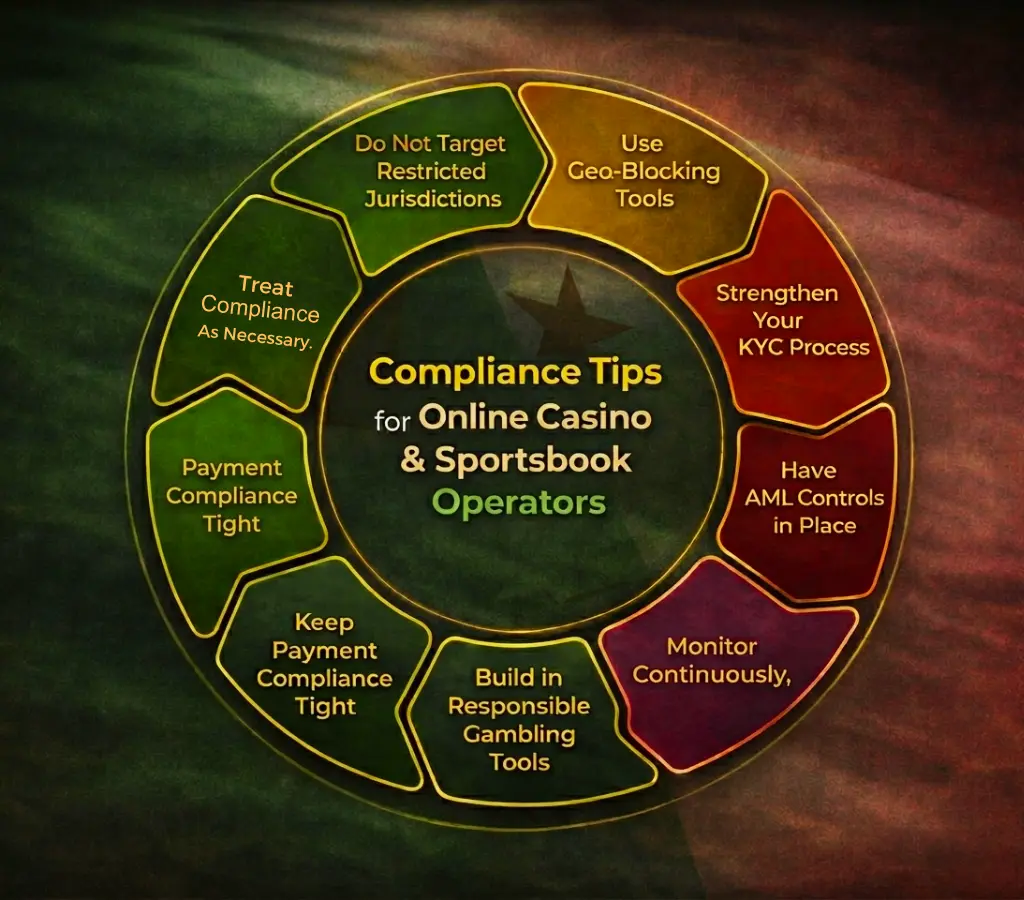
Algeria is a restricted market, and for operators, that comes with clear responsibilities. Whether you are starting an online casino or a sportsbook, here is what good compliance looks like when dealing with markets like this one.
Do Not Target Restricted Jurisdictions
This one is straightforward. Operators should not actively market to users in countries where gambling is prohibited. That means no localized advertising, no language-specific targeting, and no region-based promotions aimed at Algerian users.
Pushing into restricted markets puts your licenses, payment relationships, and reputation at risk in the jurisdictions where you are actually allowed to operate.
Use Geo-Blocking Tools
Blocking access from restricted regions is a core compliance requirement, not an optional extra. Operators should have IP detection, GPS tracking, and device-based location checks in place to prevent users in prohibited jurisdictions from accessing their platforms.
Strengthen Your KYC Process
Knowing who your players are is non-negotiable. A solid KYC setup typically covers:
- Identity document verification.
- Age checks before any gameplay begins.
- Address verification and biometric checks where required.
KYC is a legal requirement across most regulated markets and is your first line of defense against underage gambling, fraud, and identity misuse.
Have AML Controls in Place
iGaming platforms handle high transaction volumes, which makes them a target for financial crime. Strong AML systems should:
- Track transactions and flag suspicious activity.
- Verify the source of funds for high-value users.
- Run ongoing risk assessments rather than one-time checks.
Monitor Continuously, Not Just at Onboarding
Compliance does not end once a player signs up. Real-time monitoring of player behavior and transactions is now considered the standard, helping operators catch unusual betting patterns or sudden deposit spikes before they become bigger problems.
Keep Payment Compliance Tight
Payment systems need to align with your broader compliance framework. That means verifying payment methods match user identity, monitoring cross-border transactions, and flagging high-risk payment behavior early. Getting this wrong can lead to account freezes, processor bans, or direct regulatory action.
Build in Responsible Gambling Tools
Regulated markets increasingly require operators to offer responsible gambling features as standard. These include:
- Deposit and loss limits.
- Self-exclusion options.
- Behavioral tracking for users showing signs of risk.
Beyond compliance, these tools matter for player protection and long-term brand credibility.
Treat Compliance as Infrastructure
The most effective iGaming platforms do not bolt compliance on at the end. They build KYC, AML, and monitoring systems directly into their platform architecture from the start, making it easier to scale and adapt as regulations evolve.
Wrapping Up…
Algeria’s stance on online casino and sports betting regulations is clear and unlikely to shift anytime soon. The ban is comprehensive; enforcement is active, and legal alternatives are almost nonexistent. Players who turn to offshore platforms do so without any real protection, and operators who target
Algerian users take on a serious compliance risk. Until the legal landscape changes, demand will continue to be met through unofficial channels, quietly operating outside the boundaries of the law.
FAQs
-
Is sports betting legal in Algeria?
Sports betting is illegal for private operators; only limited state‑run pools exist. Individuals risk penalties if linked to organized or commercial betting under the Penal Code.
-
Can you legally open a casino in Algeria?
No; commercial casinos are strictly banned. Algeria’s laws prohibit private gambling operations, allowing only tightly controlled state‑run games such as limited lotteries and sports pools.
-
Why is gambling banned in Algeria?
Gambling is banned due to religious (Islamic) values, social‑order concerns, and a desire to curb crime and addictive behavior, aligning with Algeria’s conservative cultural framework.
-
Does Algeria issue licenses for online casinos?
Algeria does not issue licenses for online casinos. All unlicensed online gambling, including foreign‑based sites, is explicitly prohibited under current law.
-
Who controls legal betting in Algeria?
State‑run entities control the narrow legal betting sphere, mainly through state‑authorized lotteries and sports pools, with no role for private operators.
-
Is there any future regulation planned for iGaming in Algeria?
No credible plans for iGaming legalization exist; Algeria is tightening enforcement (blocking sites, criminalizing crypto payments), suggesting continued prohibition rather than regulated online gambling.


Palak Madan is a enthusiastic writer at PieGaming. With over 2+years of experience crafting engaging content and a strong literature background, Palak brings a unique perspective to the world of words. Her ability to blend creativity with strategic thinking has made her a sought-after content creator. She's eager to dive deep into the intricacies of iGaming software, uncovering the stories behind the technology and translating complex features into compelling narratives.
-

Discover top sports betting algorithm software and how they use data, AI, and real-time insights to improve odds, predictions, and overall betting strategies.
-
This guide explains Esports betting in 2026, covering how it works, popular bet types, key markets, platforms, strategies, legal considerations, and tips to help beginners start safely and make informed decisions.
-

Learn to leverage AI in your sports betting as a pathway to translate raw data to actionable analytics and precise predictive models. This guide discusses how some of the most dynamic algorithms are redefining the wagering industry for the next generation of online sports betting platforms and the players that use them.
-

This blog walks you through the top eSports games, most played and watched by the audience. Stay tuned to find out about the best eSports betting games available worldwide.
-

This guide explains virtual sports betting in clear, easy language. It covers how virtual sports work, why players enjoy them, and how operators use them alongside live betting. The guide focuses on the basics without technical jargon, helping readers understand where virtual sports fit in today’s iGaming market.
-
Armenia has a regulated iGaming market with clear licensing and operational guidelines. This guide explores casino and sports betting regulations in Armenia, covering legal requirements, compliance standards, and how operators can establish a presence in this growing market.
-

Canada’s online gambling market is regulated under both federal laws and provincial regulations. The guide outlines Canada’s regulations regarding online casinos and sports betting, from licensing arrangements to access to legal terms for operators in a new market.
-
Mexico’s iGaming market is offering golden opportunities to operators, but navigating this market is complex. Why? Because sports betting is fully regulated, casino activities are operated in a more restrictive environment.
-

Planning to launch your iGaming business in Malta? This free guide covers sports betting and online casino regulations in Malta to help you run a safe and legal iGaming business.
-

This guide lists the top 10 sports betting odds providers in 2026, helping operators choose fast, accurate, and reliable data sources for their platforms.
-

In Spain, we have a structured iGaming framework guided by the Spanish Gambling Act. This guide covers the main regulations regarding online casinos and sports betting for Spain; licensing requirements, compliance rules, and regulatory authorities governing the market.
-

The world’s most regulated online gambling industry exists in the UK. This guide outlines all important regulations in place for online casinos and sports betting within the UK — from licensing requirements to regulatory compliance to responsible gambling principles.
-

Sports betting software development involves creating custom platforms. These platforms help manage bets, process payments securely, and provide live betting options. They also keep users engaged, which helps businesses grow.
-

Starting a sports betting business in the UK involves ensuring compliance, obtaining licenses, selecting software, setting up payment systems, and much more. Let’s explore this in greater detail.
-

The technology that supports modern sportsbooks comes from sports betting software providers. This article features leading providers and explains the capabilities operators should consider when picking the best platform to run their business.
-

Sports Betting in the iGaming Industry: A market finally getting its dues! Existing for over a century in various parts of the world,…
-

In the high-stakes sports betting world, fortunes can be made or lost as a result of a single match outcome. But what if…
-

This blog explores the world of sports betting, covering new sports betting trends like mobile apps and AI, key challenges, and future growth…
-

Odds on sports betting are the odds of an event as well as how much you get out of a winning bet. This easy-to-follow guide covers some of the basics on how odds function, how many ways sportsbooks format them—how they are presented—and how a game bettor can confidently read and interpret them.
-

The scope of Online sports betting in 2026 is growing fast, driven by new technology, better laws, and more players joining betting platforms worldwide. Read along to catch up with the changing trends.
-

This checklist covers everything your online sportsbook needs to succeed. From licensing and payment methods to odds providers and security. Use it to avoid costly oversights and stay ahead of your competition.
-

White label betting exchange solutions let you launch your own peer-to-peer betting platform easily and quickly. This guide covers how they work, key features, and benefits for operators.
-

See how white label sportsbook solutions make online sports betting better. Explore custom features, quick setup, and benefits for operators in 2025.
-

Discover the top 6 tips for selecting reliable turnkey betting platform providers to enhance the betting experience for your customers. Click to read now.
-

White label betting exchange platforms are becoming more popular in 2026. This list shows top providers that offer ready-to-use solutions with liquidity already included, custom branding options, and quick setup for casino operators.
-

Want to launch your own sportsbook? Learn how to create your own sports betting platform from scratch — from licensing to compliance. Start smart in 2026.
-

The growing popularity of sports betting is opening doors for operators. Read here the history, present and future of the global sports betting industry.

Voila!
See you in your inbox soon!

Stay ahead of the game. Subscribe for exclusive content, updates, and insiders!


