Since the 2025 ban of POGO, attention has turned more to domestic development, safety considerations, and market participation in the Philippines. Legal compliance with the Casino Betting Regulation in the Philippines — the current casino betting rules, in addition to the stricter KYC, advertising, and anti-money laundering practices, are enacted by PAGCOR.

The Philippine gaming landscape has proved to be one of Asia’s most blooming industries. The whole industry has undergone an incredible “Great Reset.” Regulating casinos and sports betting in the Philippines is carried out under the governance of the Philippine Amusement and Gaming Corporation (PAGCOR).
As of March 2026, the regulatory landscape has changed with the total banning of offshore operations and a tightening of the rules, which is a strategic move to shape national policy. The Philippine government carefully weighed the benefits to the economy and public security through Executive Order 74 and the passage of domestic online gaming. This plays a central role in combating addiction and crime. This story is a strategic move to shape national policy and the passing of the Anti-POGO Act of 2025.
With the removal of offshore entities and the solidification of Sports Betting Laws in the Philippines, it has gradually transitioned its policies regarding the industry towards a “domestic-first” approach.
At present, the Casino Betting Regulations in the Philippines stress openness and protection of players, and they assure the iGaming industry in the Philippines as a safe, regulated, and sustainable part of the country’s economic development. As a local player or future operator, grasping this new legal landscape is your first step to maneuvering the future of Philippines online gambling.
Key Regulatory Bodies Governing Gambling in the Philippine
PAGCOR (The Giant)
Historically, the Philippine Amusement and Gaming Corporation (PAGCOR) worked in a distinctive “double role” as a commercial casino operator and the lead regulatory agency in the industry. In fact, in a watershed 2026 move, PAGCOR is now at the stage where it’s coming to the end of its privatization plan. The agency has dropped its player status and has sold off its self-operated Casino Filipino branches, becoming 100% pure regulator. By having no conflicts of interest, this is more transparent. The only way to regulate Philippine online gambling would mean strictly licensing and enforcement.
Special Economic Zones (CEZA, APECO, AFAB)
Special Economic Zones (CEZA), APECO, AFAB, etc., had their own special licenses, which were independent powers to grant offshore gaming licenses. Executive Order 74 and the Anti-POGO Act of 2025 have curtailed such powers. Offshore betting will therefore be subject to control. Today, the main activities are B2B tech hubs for infrastructure and fintech. They no longer present one “backdoor” for offshore operators to take advantage of local targeting by way of gaming, but make certain that all online gambling in the Philippines is in compliance with the nationally recognized norms.
Games and Amusements Board (GAB)
And while PAGCOR has jurisdiction over the casinos, the GAB is the exclusive guardian of professional sports. They protect the integrity of sportsbooks, which include all manner of information about sports from professional basketball to the fiercely regulated digital explosion of “Sabong” (cockfighting). Through licensing bookmakers and professional athletes, the GAB maintains the fairness of the match and a level playing field for sports betting without any game-fixing. That is why online gambling is legal in the Philippines for sports fans.
Anti-Money Laundering Council (AMLC)
AMLC is the financial watchdog for this industry. The 2025-2026 requirements include casino and online activity being classified under the category of covered persons and a requirement on casinos and online gambling operators to report transactions exceeding ₱5 million. This also means that every bet online now amounts to a digital paper trail, enabling the AMLC to keep an eye out for suspicious activities, as well as suspicious activity associated with illicit funds. This modern surveillance makes certain that the Philippines’ online gambling market is no longer a breeding ground for financial crime, but rather an open and safe ecosystem.
A Safe & Regulated Market
The Philippines generated one of the strongest gaming ecosystems in Asia. By setting up clearly defined roles, PAGCOR’s pure regulation of it all to GAB’s sports integrity to AMLC’s financial accountability, the government answered the question, ‘is online gambling legal in the Philippines?’ in the loudest voice possible, “Yes,” as long as it takes place within this tightly controlled, multi-faceted structure. It is this “safe market” approach that underlies the industry’s 2026 expansion.
Who Regulates What in the Philippines Gambling Industry?
A quick snapshot of the key authorities and their roles in overseeing Philippines online gambling.
| Regulatory Body | What They Regulate | Key Role in Online Gambling Philippines |
| PAGCOR | Casinos, online gambling platforms, licensing | Primary regulator ensuring legal operations and answering is online gambling legal in Philippines through licensing |
| CEZA / APECO / AFAB | Special economic zone gaming operators | Previously handled offshore licensing; now aligned with stricter domestic-focused regulations |
| GAB | Sports and betting on professional events | Regulates sports integrity and oversees betting activities, including sabong |
| AMLC | Financial transactions in gambling | Monitors funds, enforces AML/KYC, and ensures every bet is traceable and secure |
Recent Policy Changes in the Philippines Online Gambling
Total POGO Ban and Anti-POGO Act of 2025
With the adoption of the Anti-POGO Act of 2025, the history of Philippines online gambling took an unprecedented turn. The Act effectively confirmed the directives in Executive Order 74, and it permanently barred all Philippine Offshore Gaming Operators (POGOs) and their rebranded counterparts, Internet Gaming Licensees (IGLs). The Act acknowledged that though offshore gaming generated money, it also created systemic risks such as human trafficking and financial fraud. By Jan 2025, licenses were revoked, marking the complete withdrawal of offshore-facing entities from Philippine soil.
The Strategic Pivot: Transitioning from IGL to PIGO
Now that offshore operations have left, the government is exclusively focused on domestic development. This is where the PIGO (Philippine Inland Gaming Operator) model becomes most focal. Unlike the old POGO system that favored players from abroad, a PIGO is licensed only to serve players who are physically present in the Philippines. This transition makes sure that online gambling Philippines benefits the local economy directly. Licenses for PIGO are usually issued to established land-based integrated resorts (such as Solaire or Okada) and accredited e-games providers to sell online slots, table games and sports betting services to registered Filipino members on ultra-secure, geo-fenced platforms.
Stricter Penalties & Enforcement: The 2026 Crackdown
The “new era” is not just about new licenses; it is a new era of teeth. The 2025 Act imposes harsh criminal penalties to make sure no “underground” POGOs remain.
First Offense: Imprisonment of 6 to 8 years and fines up to ₱15 million.
Third Offense: Imprisonment up to 12 years and fines of ₱50 million.
Public Officials: Face immediate dismissal and perpetual disqualification from public office. Any government employee guilty of aiding illegal sites is liable for immediate dismissal and further disqualification from public office.
The Crackdown: Real-World Impact
For players, the crackdown means accessing unlicensed offshore “mirror” sites is more dangerous than ever. The Cybercrime Investigation and Coordinating Center (CICC) now has active cooperation with ISPs to continuously and in real-time block illegal domains. Operators using illegal sites face asset seizures, while players risk losing money with zero legal recourse. In 2026, the only way to make sure your money is safe is to verify that a platform maintains a real, valid, and local PAGCOR-PIGO license.
Relevant Authorities and Legislation
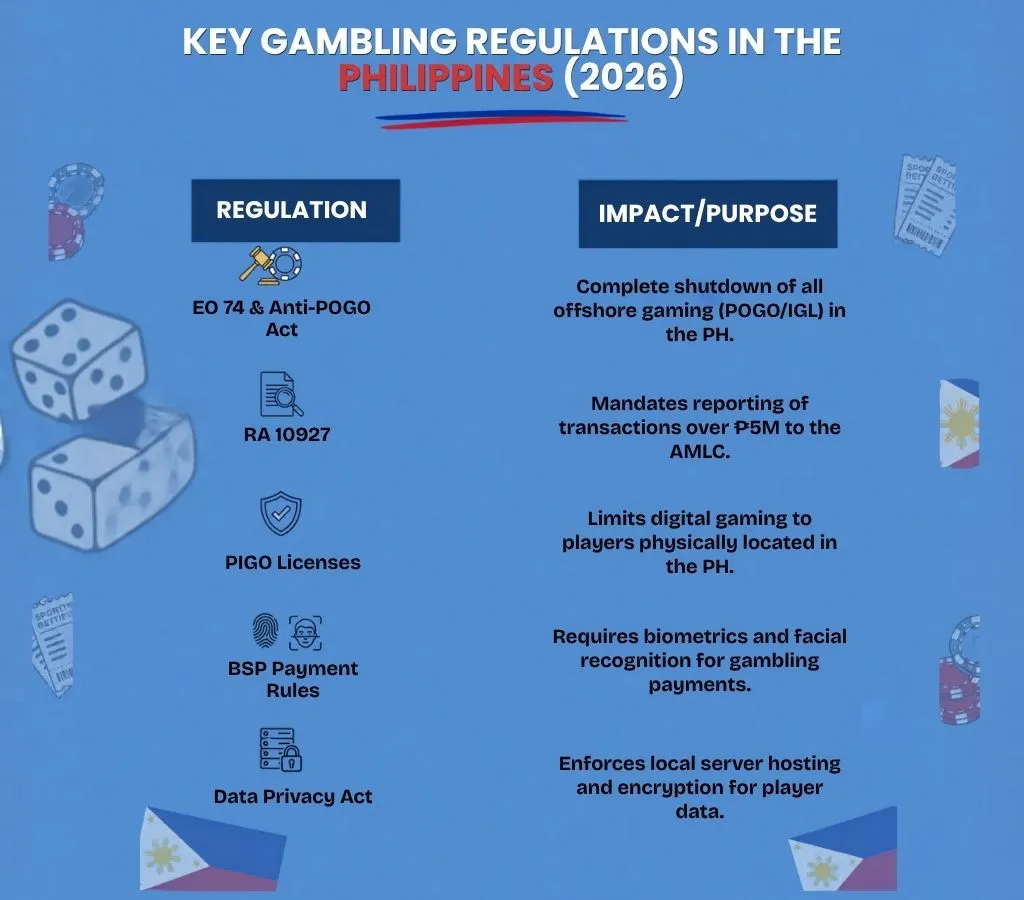
Philippines gambling regulations 2026 overview
Key Gambling Regulations in the Philippines (2026)
| Regulation | Impact / Purpose |
| EO 74 & Anti-POGO Act | Complete shutdown of all offshore gaming (POGO/IGL) in the PH. |
| RA 10927 | Mandates reporting of transactions over ₱5M to the AMLC. |
| PIGO Licenses | Limits digital gaming to players physically located in the PH. |
| BSP Payment Rules | Requires biometrics and facial recognition for gambling payments. |
| Data Privacy Act | Enforces local server hosting and encryption for player data. |
How to Get a Gambling License in the Philippines
The licensing journey is divided into three critical phases, moving from legal structure to technical proof and final regulatory approval.
Phase 1: Corporate Foundation
An operator is required to have a rock-solid legal presence in the country before applying to PAGCOR.
- Local Incorporation: Every applicant needs to be incorporated with the Securities and Exchange Commission (SEC) and registered as a Philippine company. The company should also have at least two resident founders and key officers (President, Treasurer and AML Compliance Officer) that are based in the Philippines.
- Capitalization needs: In order to secure the stability of the market, one must first build capital. A standard PIGO or E-Games license would have operators working at least ₱100 million (or roughly $1.8 million), and paid-up capital requirements, which may start at $450,000+ based on classified activity.
Phase 2: The Technical Audit
PAGCOR’s technical requirements for offshore “leakage” must be some of the strictest in Asia to deter it from happening.
- Hosting Infrastructure: All primary servers and other backups must be hosted on the premises in the Philippines, a non-negotiable requirement for 2026. To ensure the regulator has physical access for auditing, cloud hosting is only available on a cloud basis, at local data centers authorized by PAGCOR.
- Geo-Blocking on a compulsory basis: Operators will face military-grade geo-fencing. Because only users who have a Philippine IP address can join the betting interface, it blocks foreign traffic and secures the “Inland” character of the PIGO license.
Phase 3: The Application Checklist
Once the foundation is laid, the formal application dossier is submitted to PAGCOR’s Licensing and Regulatory Group.
- Letter of Intent (LOI): A formal proposal aimed at PAGCOR Chairman outlining the business model and target market.
- Probity Checks: comprehensive background investigations for all directors, all stakeholders along with UBOs (Ultimate Beneficial Owners) to make sure they are “fit and proper”.
- Submission of Software Certification (GLI/BMM Testlabs): GLI (Gaming Laboratories International) or BMM Testlabs, indicating the legitimacy of RNG and game code.
- Application Fees: A non-recoverable processing fee of $50,000 or more, for online casino titles (plus a deposit for each game category (Slots, Sports, etc.)
Read Blog – Explore How to Get a Gaming License
Special Economic Zones in the Philippines Gambling Regulation
Special Economic Zones have influenced the landscape of Philippine online gambling, particularly in relation to the proliferation of offshore gaming activity. These areas provided licensing systems that earlier favored foreign operators; however, they now operate in an increasingly more stringent environment based on the new legal terrain in the Philippines for online gambling.
1. Cagayan Economic Zone Authority (CEZA)
CEZA was among the first entities to license offshore gaming operators that aimed to sell in international markets. It was instrumental in defining early online gambling systems in the Philippines. But post the POGO ban, its roles have narrowed, matching tightening regulations and enhancing clarity around is online gambling legal in the Philippines.
2. Aurora Pacific Economic Zone and Freeport Authority (APECO)
APECO operated similarly to CEZA by providing licenses for online gaming within its jurisdiction. It sought foreign investment through regulated offshore gambling. Following recent reforms in online gaming Philippines, APECO now works under significantly stricter compliance with regulations for the government’s recent transition to domestic and regulated gaming practices.
3. Authority of the Freeport Area of Bataan (AFAB)
AFAB also granted licenses to offshore gaming operators before changing regulations. Its role is also changing with the new legislation; more regulation and less offshore activity. AFAB’s position now accords with updated Philippines online gambling regulation, which mandates transparency, emphasizes the participation of local players, and is driven by compliance issues.
Regulatory Fragmentation and Centralization under PAGCOR
For years, the Philippine gambling ecosystem operated under multiple authorities including PAGCOR, CEZA, APECO, and AFAB, each issuing licences under different frameworks. While this approach accelerated the growth of online gambling in the Philippines, it also created regulatory fragmentation, enforcement inconsistencies, and confusion around compliance for operators and players.
This fragmented system often made it difficult to clearly answer whether online gambling is legal in the Philippines, as legality depended on the licensing authority and target market. Overlapping jurisdictions also opened gaps that illegal or loosely regulated operators could exploit, raising concerns around player safety, financial transparency, and national security.
To address these challenges, the government is now moving towards centralizing control under PAGCOR. This includes its transition into a purely regulatory body through the 2026 privatization of Casino Filipino, as well as the complete phase-out of offshore operators like POGOs. The goal is to establish a single, consistent framework for online gambling in the Philippines that improves oversight, simplifies licensing, and strengthens enforcement.
With PAGCOR at the center, the industry is expected to become more transparent, efficient, and globally aligned, benefiting both operators seeking clarity and players looking for a safe and regulated gambling environment.
Player Restrictions & Prohibited Groups Under Gambling Laws
Not everybody can engage in Philippine online gambling. The government specifically delineates its categories for restricted groups to ensure fairness and responsibility.
Government Personnel:
Corporate officials or employees of local enterprises and persons involved in regulating gaming have no right to play online games from beginning to end. Doing so prevents conflicts of interest and misuse of authority.
At-Risk Individuals:
Those with a gambling history or low income can be limited. That’s in support of responsible gambling habits.
Self-Exclusion:
Players can choose to leave platforms voluntarily. Licensed operators need to provide this service. It teaches users to check their own behavior and helps avoid causing harm.
These moves build trust in online gambling Philippines. And they explain that online gambling is legal in the Philippines, only for eligible and verified players.
Compliance Requirements for Licensed Operators
These platforms are subject to strict licensing requirements to operate legally in online gambling Philippines. They are there to ensure that they are safe, fair, and compliant. Operators have to do business locally. They will need approval from PAGCOR. You need to have financial stability. Background checks are also done.
- KYC (Know Your Customer) and AML (Anti-Money Laundering) systems are required. Every transaction must be tracked. Every transaction must be accounted for. This assists in providing secure betting conditions.
- Platforms also need to introduce responsible gambling tools, such as restrictions for deposits and self-exclusion features.
- Audits and reporting are required on a regular basis. Failure to comply can result in heavy penalties or the loss of the license itself.
These obligations state whether online gambling is legal in the Philippines—only when operated by licensed operators who meet rigorous regulatory standards.
Local Incorporation
For businesses to operate legally in online gambling Philippines, they must be based in a local entity. This facilitates accountability and compliance with national regulations. It starts by sending a Letter of Intent to PAGCOR. Operators also need to prepare all necessary documents to enroll, such as company registration, financial records, and ownership details.
Next, applicants are to fill out and submit to PAGCOR the official application kit. The authority does due diligence, background checks, and carries out inspections. Operators have to pay licensing fees and obtain their permit, once approved. This rigorous process emphasizes that online gambling in the Philippines is legal but only for properly registered and verified entities.
Server & Infrastructure Location
Infrastructure requirements are an essential dimension of licensing in the Philippines online gambling. Operators need to ensure their systems are secure, traceable, and compliant with local regulations.
Platforms can usually only host servers within approved jurisdictions or PAGCOR-monitored environments. This permits transaction and player activity tracking in real time. Technical systems should enable data security, anti-fraud measures, and uninterrupted operations.
Regular audits and inspections are conducted. Regulators control over server and infrastructure location to provide oversight and protect users, ensuring that online gambling in the Philippines remains safe, transparent, and legally compliant.
The National Responsible Gambling Programme: The Pillars of Protection
To establish an environment free from threats, the “friction for safety” provisions of the 2026 guidelines protect the vulnerable while ensuring the integrity of the market.
Mandatory KYC (Know Your Customer):
We are no longer through basic email verification. In order to stop identity theft and “mule accounts,” all PAGCOR-licensed applications will have KYC (Know Your Customer) as an absolute check for the deposit of any peso.
Real-Time Verification:
A live high-resolution photo is required of a player of a valid government ID. Users need to do the “real-time selfie” scan, which uses A.I. to determine 3D depth and movement, confirming that a live person–not a static selfie or a deepfake — is signing into your account.
The Exclusion List: A Protection for Victims
At the same time, the Philippine government, through mechanisms it officially introduces, includes a way for individuals and families to make limited access to gaming systems. As soon as a person is published on the National Database of Restricted Persons (NDRP), they are prohibited from all land-based and online casinos licensed to operate in the country.
- Self-Exclusion: People who see a developing issue can self-ban themselves for 6 months, 1 year or 5 years. In 2026, these are nonnegotiable requests for the first six months so that the person has a real “cooling off” moment.
- Family Exclusion: It’s often the last people to admit to a problem, and immediately recognized in the process of doing so is that a loved one, such as a spouse or parent, with children who are at least 18 years old, would have been required for this reason as well. It requires proof of kinship and irrevocability for an initial period of 3 months.
- Prohibited Groups: The public is not all citizens, so the legality of online gambling in the Philippines will not be for everyone. The members of the groups in question cannot participate or have appropriate premises or play any games.
- Government officials: Any professional working for the Philippines government, or any of its agencies.
- Uniformed: Members of Armed Forces of the Philippines (AFP) and Philippine National Police (PNP). Minors: Any individual under the age of 21.
- Gaming Staff: People employed by a casino or PIGO.
- Banned Personalities: anybody already included in the NDRP or persons who have court orders against their gambling business.
Future Horizons: Where is the Philippines Market Heading?
The Philippines’ online gambling landscape is undergoing profound changes. In this market, we are experiencing a new era. A more stable, transparent, and technologically advanced industry exists which is very much moving out beyond the past “POGO era.”
The Massive Shift: From VIP Rooms to Online Mass Market
Historically, the Philippine gaming sector has been dominated by high-roller “VIP” rooms within physical integrated resorts. But 2025-2026 figures prove a major reversal. The “Mass Market”, regular local players are now the main driver of growth. This is driven by an increasing amount of live dealer content and digital slots that provide the casino experience from the comfort of home.
Mobile-First Dominance
In the Philippines, the “casino” is in one’s hand. 92% of Filipino bettors are now making smartphone bets.
This dominance is driven by:
- Low-cost connectivity: Huge declines in average mobile data costs (₱200/GB avg).
- App Development: Local PIGO operators have prioritized “lite” applications that are easy to use and even work well on mid-range devices with minimal performance problems, so all demographic groups can easily access them.
GCash & Maya Ecosystem: A Fintech Revolution
The implementation of local e-wallets has led to the most significant impetus for online gambling Philippines.
Accessibility: GCash and Maya, which boast more than 80 million users, have already made deposits and withdrawals instantly available.
After BSP Memorandum M-2025-029, these apps have stripped “in-app” gambling icons to discourage problematic gaming, and they have also removed the possibility of “in-app” gambling icons because of a “guarantee of good behavior”. But they continue to be the main payment channels of licensed sites, providing a secure, audited digital evidence file that offshore sites hardly ever get. Philippine gambling statistics for the decade 2025-2026. The numbers tell a tale of a resilient and swiftly modernizing industry.
E-Games GGR Growth
Gross Gaming Revenue from electronic games amounted to an impressive ₱154.5 billion in 2024, which could exceed ₱200 billion at the end of 2026.
Total Market Valuation: The overall Philippine gaming market stands on track of $7 billion by 2025, where electronic gaming is the fastest-growing sub-sector.
Player Demography: There are more than 1.5 million active players in the regulated domestic digital space, with a mobile app usage rate 30% YOY.
Strategic Forecasting: The New Edge
From now on, however, this is not a game of one side/the other but a compliance advantage, that is, the difference between the winners and losers. PAGCOR restricts celebrity partnerships and primetime advertising to protect the youth.
Owners best at Localized Strategy (from SEO, to community-building, and Clean Gaming) will take the helm. With the government aiming to privatize its own casinos, the position of private PIGO operators should increase. Future direction is Stronger Regulation and of a Domestic Growth model treating gambling as a secure, taxed, and respected form of digital entertainment.
Conclusion
The regulatory scenario on online gambling in the Philippines is being transformed in a definitive way. Over time, enhanced regulation, the ban on offshore operators and the move toward PAGCOR-led centralisation are all contributing to a cleaner, more controlled system in place in the country. All these concepts are considered in both the Sports Betting Regulations in Philippines and the Casino Betting Regulations in Philippines, today by the government to ensure that proper regulation is followed and to protect the player and sustainability in the long run.
For operators, this means shifting to more stringent licensing requirements and a more domestically focused market. For players too, it makes for safer venues and more definite legal limits when inquiring if online gambling is legal in the Philippines.
As regulations continue to evolve, the future of online gambling Philippines lies in responsible growth, strong governance, and a system built on trust.

FAQ's
-
Is sports betting legal in the Philippines?
Yes, sports betting is legal in the Philippines if conducted through PAGCOR-licensed operators or authorized entities. Unlicensed or offshore betting platforms are illegal.
-
What is the difference between RA 9287 and PD 1602?
PD 1602 penalizes illegal gambling in general, while RA 9287 strengthens it by imposing stricter penalties specifically for illegal numbers games like jueteng.
-
What is RA 9287 all about?
RA 9287 is a law that intensifies penalties against illegal numbers games. It aims to curb activities like jueteng by increasing fines and imprisonment terms.
-
Are casinos considered covered persons under RA 10927?
Yes, casinos are considered “covered persons” under RA 10927. They must comply with AMLC regulations, including KYC, reporting, and monitoring suspicious transactions.
-
What are the latest rules for online betting in the Philippines?
Online betting is legal only through licensed domestic operators (PIGOs). Offshore operators (POGOs) are banned, and strict AML, KYC, and compliance rules apply to all platforms.

Jaya Swaroop is an enthusiastic content writer at PieGaming with a keen interest in the iGaming industry. With a strong foundation in copywriting and research, she brings clarity and structure to complex subjects. Jaya has a knack for simplifying complex iGaming concepts and turning them into clear, engaging content that informs and connects with industry audiences.
-

This blog looks at land-based vs online casinos in 2026, showing which one is growing faster, making more money, and offering better options for casino businesses.
-

Online casino and sports betting in Italy are legal under ADM regulation. Operators must obtain licenses, follow strict compliance rules, and adhere to advertising and player protection laws, ensuring a highly controlled and transparent iGaming market.
-

In 2025, online casino and sports betting in Tunisia will have strict rules. Operators need proper licenses, and many gambling activities are still limited or not clearly allowed. This blog will guide you through the iGaming regulations in Tunisia.
-

Online sports betting and casino games are legal in Brazil, but only for licensed operators. This guide breaks down how the system works, covering licensing, costs, taxes, and compliance, so operators know exactly what it takes to enter and run a legal iGaming business in Brazil.
-

Explore top iGaming events 2025 in this blog. Learn why you need to be part of gambling conferences and what you can learn from them.
-
Find out why SiGMA Asia 2025 is a must-visit event for iGaming operators, startups, and investors. See what’s happening, who’s coming, and how it can help grow your iGaming business in Manila.
-

The global iGaming industry is expanding constantly as more regions get online gambling regulations. This report will outline potential iGaming markets to consider casino operators and presents market entrance strategies by exploring these factors.
-
The South African online gambling market is tightly regulated, allowing sports betting under licensed operators while prohibiting online casinos. What operators must know to enter this market? Read here.

Voila!
See you in your inbox soon!

Stay ahead of the game. Subscribe for exclusive content, updates, and insiders!


