Turkey has some of the strictest gambling regulations in Europe, mainly limiting legal wagering to state-monopoly organizations like Milli Piyango and IDDAA. This blog covers the legal frameworks, severe penalties for unlicensed operators, and important information on online casino and sports betting regulations in Turkey.
Turkish gambling policy has strict rules. Most forms of betting are illegal. The state holds a very tight grip on the market. The gambling laws in Turkey are designed to prevent addiction and money laundering. The Ministry of Justice recently stepped up its push. It also directed 171 chief public prosecutor offices in all 81 provinces to act. They must now ramp up the investigations into illegal gambling. They are targeting unauthorized online betting sites specifically in iGaming.
Legal Status of Sports Betting
Is sports betting legal? Yes, but through specific paths. The market is heavily regulated by the government. You can’t legally rely on independent or offshore sites. Violation of Turkey betting restrictions can incur significant fines. Prosecutors will now ramp up efforts, Hürriyet Daily News reported. They will compile cases and report them systematically to develop an efficient information network. The state intends to coordinate meetings twice a year involving the judiciary, police, and specialized units to solve case challenges.
Role of IDDAA (Government Betting System)
IDDAA is the official government betting system in Turkey. Launched in 2004, it was meant to formalize the market. This entity owns a complete monopoly of the industry. No other private company has the ability to provide odds without a state backing. IDDAA oversees all legally permissible betting and is the only licensed betting institution in Turkey. It keeps tax revenue within the country.
Types of Legal Sports Betting Activities
Legal betting options are fairly limited. Far and away the most common option is betting on football. You can bet on basketball, volleyball, and tennis, too. But it offers limited sports coverage compared to international sites. Certain prop bets and niche sports may be unavailable. The state decides which matches show on the official bulletin.
Is Online Casino Legal in Turkey?
The short answer is no. All online and land casinos, including small and medium-sized companies, are technically illegal all over Turkey. There are no government licenses for private casino operators. This makes it one of Europe’s most restrictive environments for gaming.
Ban of Land-Based Casinos
Are Turkish casinos legal? Not since the late 1990s. Turkey used to have a booming casino industry. In 1998, however, the government implemented a total ban. That came in the aftermath of a high-profile assassination of a “casino king” and increasing concern about money laundering. More than 70 establishments closed overnight. No physical casino has operated legally on Turkish soil since then.
The Legal Status of Online Casinos
The prohibition applies to the digital realm, as well. Under the Turkish Penal Code, online casinos are banned completely. We may be able to access some offshore platforms, but they operate without any legal standing. Such sites carry significant risks as well: Players may face enormous administrative fines that are periodically adjusted by administrators. These sites are unlicensed; there’s no player protection at all. Frozen bank accounts and blocked payments are both possible difficulties. The Ministry of Justice keeps blocking these illegal domains daily as a means of protecting citizens.
| Can you legally play on offshore online casinos in Turkey?
No, using offshore casino sites is not fully legal. Even if accessible, these platforms are unlicensed in Turkey. Authorities may block access, and users face risks like account issues, fund loss, and possible fines due to strict national gambling laws. |
Is Sports Betting Legal in Turkey?
In Turkey, sports betting is only legal when done through state-approved channels. A strict monopoly system is enforced by the government to control the industry and receive tax revenue. Any online service that does not have a local license is considered illegal and faces heavy blocking by authorities.
The Role of Spor Toto Organization
The Spor Toto Organization is the governing body for betting on games. It is an organization of the state that takes responsibility for the fair distribution of betting revenues back into the Turkish sports infrastructure. Which games are to be played and what is to be legal throughout the whole country depend upon this central authority.
Authorized operators and IDDAA
The name that is most widely known in Turkish legal betting is IDDAA. IDDAA is the official fixed-odds sports betting game. Despite the official state ownership, private operators, such as Şans Girişim, run the system today under tight government contracts. There are also a number of authorized online agents who are legal intermediaries and provide a safe place for users. Only with IDDAA’s betting partners can you stay within the law and wager on your favorite teams.
Why are online casinos illegal in Turkey?
The strict government control and rising social concerns have made online casino use illegal here in Turkey. The nation adopts a zero-tolerance policy with regard to unregulated gambling; it does not tolerate it.
Government Control of Gambling Revenue
Turkey does not let anyone have their own platform like Milli Piyango and IDDAA, but only state providers, which are state-run. This keeps all the gambling revenue inside the country. Since 1996, all private gambling operations have been banned. However, online gambling in the illegal area has kept increasing. To combat this, they now have sophisticated cybercrime units to trace and terminate these platforms. In recent years, enforcement has ramped up. This has even affected the big operators. For instance, Betsson’s Q4 revenue was €304 million versus €307 million. The company’s operating income also fell 24% to €53 million, in part because tougher enforcement in areas like Turkey has hampered the deals.
Religious & Cultural Factors
Turkish gambling policy is heavily influenced by cultural beliefs. Digital platforms are growing in addiction, President Recep Tayyip Erdoğan has warned. He said, “almost every phone has become a casino.” He also said gambling, as well as drugs and alcohol, is damaging society at levels comparable to or greater than terrorism.
Issues Related To Fraud And Addiction
The government regards the use of online gambling as a grave safety risk. As it happens, addiction is rampant thanks to mobile phones’ easy access. Unlicensed sites also make users fall prey to fraud and data misuse. Erdoğan has committed to eliminating illegal gambling “by whatever means necessary,” with not only operators but also payment processors as its targets.
Read Blog – Discover where online casinos are legal
Penalties for Illegal Online Gambling in Turkey
Turkey imposes some of the most strict penalties globally to discourage illegal gambling. The entire chain, from the casual player to the giant offshore operator and financial intermediaries who pay them out, is under assault with the legal framework.
Fines for players:
According to Turkish law, taking part in illegal betting is classified as an administrative offense. Players caught betting on unlicensed sites face hefty monetary penalties. These fines vary from year to year in size and can be in the thousands to tens of thousands of Turkish Lira. As the government watches bank movements and the movements of digital wallets, monitoring “digital footprints” has grown into a key tool for identifying and disciplining single bettors.
Legal consequences for operators:
Those who run or promote illegal sites face criminal consequences, not merely administrative. Any person who promotes or advertises unlicensed fixed-odds or pari-mutuel betting is punishable by imprisonment from one to three years under the Betting Law. Courts may also impose judicial fines of up to three thousand days. That might lead to a fine of around TRY 1,500,000 (approximately EUR 30,000) in aggregate. For legal persons engaged in these offenses, the state is able to confiscate all revenue made from the profits and permanently remove a license already in effect.
Blocking of gambling websites:
The Information and Communication Technologies Authority (BTK) takes a constant effort to deny access to illegal domains. Turkey is taking a proactive stance towards zero tolerance to stop illegal online traffic, with thousands of URLs blacklisted every day and so forth. It’s a cycle of cat-and-mouse between the two for illegal operators and illegal hosts that forces them to change domains all the time, but it’s also an obstacle for the average user to jump around the space, too.
Payment restrictions:
Law enforcement authorities have narrowed the net around payment processors in striking proportions. By 2025 and 2026, the government began to update the Penal Code by imposing stricter punishments against “facilitators.” Bank and payment gateway authorities themselves are now required by law to flag and block suspicious transactions associated with gambling keywords. This has included a dramatic clampdown on digital wallets, which will only further make it harder for ordinary people to deposit funds or withdraw winnings from offshore platforms.
Read Blog – Learn How Odds Work in Sports Betting
Quick Reference: Gambling Laws and Regulations in Turkey (2026)
This table provides a comprehensive overview of Turkey’s current gambling legal status, authorized entities, and the severe criminal and financial penalties enforced as of 2026.
| Category | Legal Status | Governing Body / Licensed Entity | Key Penalties & Enforcement |
| Sports Betting | Legal (State Only) | Spor Toto & IDDAA (Authorized agents include Nesine, Bilyoner, Misli) | State Monopoly: Using unlicensed offshore sites is illegal and carries heavy fines. |
| Online Casino | Strictly Illegal | None (No licenses issued to private or foreign firms) | High Risk: Website blocking by BTK; players face administrative fines and frozen bank accounts. |
| Physical Casinos | Strictly Illegal | None (Total ban since 1998) | Criminal Offense: Operators face immediate closure and criminal prosecution. |
| Horse Racing | Legal | Turkey Jockey Club (TJK) | Restricted strictly to the TJK-controlled pari-mutuel system. |
| Lotteries | Legal | Milli Piyango | State-sanctioned draws only; private lotteries are prohibited. |
| Operators & Promoters | Criminalized | N/A | 1 to 3 years imprisonment; Judicial fines up to TRY 1,500,000 (~€30,000). |
| Financial Facilitators | Under Crackdown | MASAK / Central Bank | Strict monitoring of digital wallets and payment gateways to block illegal transfers. |
| Law Enforcement | Active | Ministry of Justice & Cybercrime Units | 171 prosecutor offices across all 81 provinces now conducting active investigations. |
How Turkey Blocks Online Gambling Sites
Turkey employs a tiered system to block illegal gambling sites. The government uses technical controls and financial restrictions to restrict access and use.
ISP-level blocking: The main type is blocking at the ISP level. They force internet service providers to block access to illegal websites. This is accomplished via IP blocking and DNS filtering. Users in Turkey are prevented from opening these sites through ordinary networks after being flagged. This approach is widely used. In 2024 alone, authorities searched out and acted against some 233,000 illegal gambling websites, illustrating the scope of enforcement.
Payment gateway restrictions: Turkey aims at the money flow too. Banks and payment providers are not permitted to conduct gambling transactions. The government has even suspended licenses and confiscated assets of fintechs linked to illicit online betting. It’s a barrier to accepting or withdrawing funds from users.
Use of blacklists: Local authorities keep blacklists of illicit domains. These lists are shared with ISPs and law enforcement. Websites are added regularly in accordance with investigations. Operators affiliated with these domains are also a frequent target of criminal complaints.
Crackdown on VPN usage: Most users use VPNs to evade restrictions. But Turkey also began to block VPN services, too. In some of its recent actions, authorities have ordered ISPs to block access to multiple VPN tools. This prevents access to offshore gambling platforms.
In the end, Turkey’s strategy includes much more than blocking sites. It aims to restrict access, monitor activity, and dismantle the entire illegal gambling ecosystem.
Do Turkish Players Use Offshore Casinos?
Yes, many Turkish players use offshore casinos. Despite strict local laws, these sites are still accessible. But using them comes with clear risks.
Benefits vs Risks
Offshore casinos provide more variety. Players have access to global games, live casinos, and multiple sports markets. Bonuses and promotions are more attractive than the local options. But the risks are high. These platforms are not regulated in Turkey. There is no legal protection for players. Problems with blocked accounts, delayed withdrawals, and unfair practices can arise. Banking restrictions also lead to frequent payment failures.
Legal Grey Areas
Offshore gambling exists in a grey area. It is not fully legal, yet still widely used. Authorities continue to monitor and restrict access. It’s a level of uncertainty for players over time.
For operators looking to enter the market
From the perspective of businesses, there is a need for the right technology in order to enter the iGaming space. PieGaming offers advanced casino and sportsbook solutions. By supporting multiple games, seamless integrations, and scalable features, its platform empowers operators in building and launching high-performance iGaming platforms.
Is it safe to use offshore casinos in Turkey?
No, it is not fully safe. Offshore casinos are unregulated in Turkey. Players face risks like blocked withdrawals, data security issues, and legal uncertainty. With strict government monitoring and payment restrictions, using such platforms can lead to financial loss and limited protection.
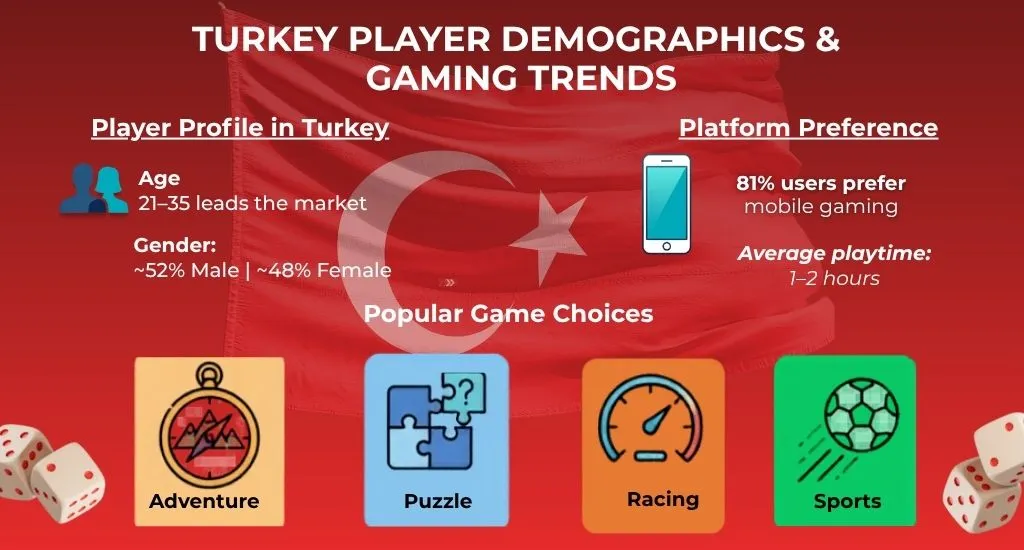
Demographics and game trends of turnkey players
Comparison: Turkey vs Other Regulated Markets
One of the most restrictive gambling locations across the globe is Turkey. It’s run under a state-controlled system, with casinos banned and strict enforcement. In contrast, many countries have developed regulated systems that permit private operators while protecting players.
- The UK is one of the most developed markets. And there are several licensed operators subject to very strict oversight.
- Malta serves as a global licensing center for iGaming companies.
- In Sweden, the licensing model is regulated, with strong consumer protection measures.
- India presents a mixed approach, where laws vary by state, creating a semi-regulated environment.
These are markets that prioritize regulation, transparency, and tax revenue. Turkey, on the other hand, exercises control and restriction over the growth of the market.
Turkey vs Other Regulated Markets
Turkey stands apart due to its strict bans and limited legal options, while other markets aim to balance regulation with industry growth.
| Factor | Turkey | United Kingdom | Malta | Sweden | India |
| Market Type | Highly restricted | Open & regulated | Licensing hub | Regulated | Semi-regulated |
| Sports Betting | State-controlled only | Multiple operators | Multiple operators | Licensed operators | State-dependent |
| Online Casinos | Illegal | Legal with license | Legal with license | Legal with license | Mostly unregulated |
| Licensing | No private licenses | UK Gambling Commission | Malta Gaming Authority | Swedish Gambling Authority | Varies by state |
| Player Protection | Limited | Strong | Strong | Strong | Moderate |
| Enforcement | Very strict | Compliance-focused | Compliance-focused | Compliance-focused | Inconsistent |
| Offshore Gambling | Illegal | Regulated | Regulated | Restricted but allowed | Widely used |
Payment Methods & Restrictions in Turkey
Turkey’s financial environment must be thoroughly monitored to ensure money keeps out the uncontrolled cash flow to illegal gaming. As for 2026, the ‘Action Plan’ of the government will need to be even more severe to choke off a more drastic financial blood flow out of all the new offshore platforms.
Blocked payment methods: The Financial Crimes Investigation Board (MASAK) is the main monitor. As of January 1, 2026, new rules compel banks to note the origin and cause of any money flows over 200,000 TRY. Vague explanations are not okay; users must choose specific categories for their transfers. Payments associated with dubious “gaming” or “betting” are then flagged and blocked automatically.
Issues with local banks: Turkish banks have progressed from passive blocking. Most leading institutions now also issue direct legal warnings to customers whose accounts appear to be the target of some serious criminal activity. Under the 11th Judicial Package, prosecutors can freeze bank accounts for up to 48 hours in an investigation without a court order. That zero-tolerance policy means even minor, frequent transfers to known paid “mules” become eligible for permanent account closure and criminal profiling.
E-wallet and crypto usage trends: once traditional banking becomes more restrictive, the fight has turned to the fintech industry.
- E-wallet: The Central Bank revoked six payment institutions’ licenses for doing nothing to stamp out illegal betting and other illicit flows. Digital wallets are now subject to the same high standards of ID verification and reporting as are banks. These have a cost of approximately 15%, a figure that reflects the huge burden of legal and regulatory fees to handle and hold banks accountable for the risks associated with illegal betting for users.
- Crypto: Crypto is still a good substitute for blocking with one-dimensional blocks if one uses stablecoins like USDT. But Turkey’s authorities just took their biggest step –a clampdown on cryptocurrencies in question, totaling over €470m in crypto assets held by a range of illegal networks. With suppliers like Tether, the state has become more adept at freezing “dirty” digital assets, leaving no one to rely on the blockchain for the safe-haven status of illegal betting in Turkey.
Tips for Operators Targeting the Turkish Market
Turkey is a very restricted market. It requires operators to be cautious and tactical. Direct targeting can pose legal and financial risks.
Avoid targeting Turkey directly:
This is why services should not be marketed or promoted directly to Turkish users. Local laws prohibit businesses from engaging in private gambling operations. Advertising, targeting, or promoting to potential Turkish players carries penalties, fines, or prosecution.
Focus on compliant jurisdictions:
Operators should instead focus on regulated markets. Areas such as the United Kingdom, Malta, or Sweden provide clear licensing regimes. There they are, operating legally and offering long-term stability to the business for growth. Use Geo-Restriction Technology.
Use geo-restriction technology:
From the viewpoint of operators, access from Turkey should be restricted using IP and location filters. As a result, accidental access is avoided and compliance risks minimized. It also demonstrates sound operational practices.
Promote legal betting alternatives:
Reveal legal options in Turkey as part of the legal arguments, say state-run platforms. Do not treat offshore services as substitutes for Turkish users. You have to put compliance first, and this establishes authority and enables the company to avoid liability and enforcement action against them.
Conclusion
Turkey is still one of the most heavily regulated gambling markets in the world. The government strictly enforces rules that limit both access and participation. Sports betting regulations in Turkey are an important component, as only state-run platforms are allowed to operate legally. This has generated an extremely confined atmosphere for both players and operators.
At the same time, casino regulations in Turkey are even more restrictive. Land-based casinos are banned, and online casinos operate outside the legal framework. Offshore platforms are widely perceived as open but provide risks such as payment-related challenges and legal uncertainties.
FAQ's
-
Why is online gambling banned in Turkey?
To control gambling revenue, reduce addiction risks, and align with cultural and social values. The government allows only state-run betting systems.
-
Can Turkish players use foreign betting sites?
Technically accessible, but not legal. These sites are unlicensed in Turkey and come with legal and financial risks.
-
Is VPN gambling legal in Turkey?
No. Using a VPN to access gambling sites is not legal and may lead to penalties if detected.
-
Is online gambling a regulated activity?
No. It is mostly prohibited. Only limited, state-controlled betting activities are regulated in Turkey.

Jaya Swaroop is an enthusiastic content writer at PieGaming with a keen interest in the iGaming industry. With a strong foundation in copywriting and research, she brings clarity and structure to complex subjects. Jaya has a knack for simplifying complex iGaming concepts and turning them into clear, engaging content that informs and connects with industry audiences.
-

What is a mobile casino, and why is it growing at this pace? A mobile casino allows users to play real-money games on smartphones anytime, anywhere. Powered by advanced mobile casino software, it offers smooth gameplay, secure transactions, and instant access. Discover how mobile casinos function and why they lead the iGaming space.
-

Can you really win slots? Not always but playing smart makes a bigger difference than most people think. This guide covers top 10 slot game strategies to maximize your winning potential.
-

This guide covers the best white label casino solution provider. Learn about the top providers, features, and common mistakes to avoid.
-

This guide covers casino cost development, with estimates varying from $15000 for white label solutions to $500,000+ for fully custom platforms. Choose the…
-

A sweepstakes casino is an online casino in which individuals play with Gold Coins (to have fun) and Sweepstakes Coins (to win real prizes), and is regulated by no-purchase-necessary promotional laws rather than gambling laws.
-
Kenya has a growing online gambling market supported by increasing internet adoption and mobile payment systems. This guide clarifies the steps and protocols you can follow for setting up an online casino business in Kenya, including regulations and licensing requirements.
-
This blog is your blueprint to scale online casino traffic from 1,000 to 100,000. Learn here how to increase users for online casinos significantly.
-

Telegram casinos are a new gaming channel where users access casino games directly via Telegram bots or mini app-driven channels. This guide explains how Telegram casinos work, including how they are built, their key features, why they function, and why many companies want to explore this growing platform.
-

Online casino business offers major benefits to operators such as affordability, global reach, expansion into new markets, lower overheads, and many more.
-
This blog delves into ‘how multi-lingual support is crucial for your online casino success?’ Learn here how you can dominate the international online casino market with multi-lingual support.
-

Starting an online casino sounds exciting. But many new operators fail within a few months due to evitable mistakes. Here are the top 10 mistakes you must steer clear of.
-
Learn how to start an online casino in Turkey in 2026. Get easy tips on laws, licenses, payments, and more to run your business smoothly.
-

Improving GGR and NGR is important for your online casino’s success. This guide shares easy strategies like giving out better bonuses, retaining players, and using data to grow your profits.
-
Online casino software is the comprehensive technical engine that powers everything from immersive game rendering and secure payment processing to player management and regulatory compliance.
-
Investors who want to start an online casino in Spain must comply with the rules and regulations imposed by the Spanish authorities. Let’s discuss the key steps for starting an online casino in Spain.
-
The European online casino market size reached USD 40.5 billion in 2024. Moving ahead, IMARC Group predicts the market to reach USD 73.1 billion by 2033, with a CAGR of 6.6% during 2025-2033. Read here how you can open an online casino in Europe and be a part of this lucrative industry.
-
Online casino laws differ by country. Some places allow and regulate them, while others ban them. Knowing the rules helps players choose safe…
-

This guide highlights the top 10 global casino game development companies in 2026, helping operators and investors identify reliable partners for building scalable, compliant gaming platforms.
-

A complete guide to starting a crypto casino in 2026, covering licensing, software selection, crypto payment integration, game providers, and proven marketing strategies to launch and scale successfully.
-

Live dealer casinos play a key role in building player trust and engagement in iGaming. This guide looks at the top live dealer casino software providers in 2026, covering their technology, games, studio quality, compliance, and integrations.
-
Casino game aggregators are platforms that integrate games from multiple providers through one API, helping online casinos launch faster, reduce technical complexity, and offer a diverse, scalable game portfolio.
-

This write-up lists down the top 10 Turnkey Casino Software Providers in 2026. Read along to find the best provider for your iGaming business.
-
Choosing the right Bitcoin casino software provider is crucial for building a secure, scalable, and profitable online casino business. Here’s a quick look…
-
This write-up talks about the best online casinos supporting GCash in the Philippines—also, the gaming variety, bonuses, and customer support they provide.
-

A social casino is a type of online gaming in which players play a casino-style game using virtual coins. Their purpose is mainly entertainment, social interaction, and free play, not money wagering.
-
A casino game aggregator is a great choice for operators because it streamlines game management, offers diverse content from multiple providers, enhances player engagement, and maximizes revenue. Read ahead to learn more.
-

A Bitcoin casino enables players to gamble with cryptocurrency rather than traditional payment methods. This guide outlines the mechanics of Bitcoin casinos, their key features, and why many players and operators are turning to those platforms.
-

Online slot games exist in a variety of formats, from traditional three-reel slots to modern video slots bursting with features. It discusses the different kinds and functionality of online slots, so players (and operators) understand what differentiates each style.
-

Online casino KPIs are essential metrics that measure performance, player behavior, and revenue. This blog explains what KPIs are, and how to analyze them leading your online casino to success.
-
A curated list of the top online casino software providers in 2026, helping operators evaluate platforms based on scalability, compliance readiness, features, and long-term growth potential.
-

Casino affiliate programs are a way for online casinos to attract new players through performance-based partnerships. By using an affiliate program, they promote platforms and earn commission when referred players sign up or deposit, and can be used to profit from that loyalty, which in turn allows iGaming operators to grow in a way that maximizes their own income.
-
RTP, or Return to Player, is a key metric that shows the percentage of wagered money a casino game pays back to players over time. This guide explains how RTP works, why it matters, and how it influences player decisions and game selection.
-

Explore how a casino back office system enhances profits through effective management, data analysis, and operational efficiency, driving success in the gaming industry.
-
Real-time dealer experiences are offered online game playing live casino games. This guide delves into the major live casino software providers in the Philippines covering their technologies, studio quality, game offerings, and the area’s reputation as a live gaming industry hub.
-

Live dealer casinos recreate the experience of gaming in a real casino by streaming games with professional dealers in real time. Players will be able to join tables, interact with the dealers, place bets online, and have a good and genuine casino experience.
-
Want to start an online casino in Latin America? This guide breaks down iGaming in Latam, covering everything from laws to what players like. Learn how to jump into this growing market and make your mark.
-
A casino bonus engine offers casino operators the ability to automatically create, manage, and optimize promotional offers. Discovers how this powerful tool streamlines bonus management, personalizes player rewards, and improves retention while making casino promotions more efficient and data driven. It doesn’t have to be hard to launch an iGaming platform.
-

As a casino operator, you might have wondered several times if the games that you’re featuring are engaging enough in the current scenario….
-
Sweepstakes casinos are becoming popular as an alternative online gaming model. This guide explores top sweepstakes casinos, how this model works, and why it appeals to players looking for legal, engaging gaming experiences without traditional real-money wagering.
-
iGaming in Brazil is one of the hottest discussions in the iGaming town right now! What has changed in Brazil’s betting dynamics? How are new entrants moving in smoothly? Let’s find out.
-
Gaming platforms use online casino game providers to create slots, table games, and live dealer experiences that drive today’s gaming platforms. This guide discusses some of the best casino game providers and what operators and players find popular in their content.
-

Dive into the world of iGaming incentives. Explore definitions and types of top online casino bonuses and promotions. Learn about the best practices for implementing these rewards to boost your player engagement.
-

Discover the top advantages of turnkey online casino software to start your online casino business in a jiffy. It is a popular and scalable software.
-
Launch your online casino effortlessly. Discover the features of a turnkey casino software solution, from great games to secure payments and easy management.
-
Randomness is the foundation of iGaming. It is a cornerstone of the game’s outcome. In a traditional land-based casino, iGaming is sheer luck….
-
When it comes to the fiercely competitive world of online gambling, choosing the right white label online casino software means the difference between…
-

The future of casino game aggregators hinges on innovation and adaptability. As iGaming evolves, it must adapt technology, meet market demands, and overcome challenges to remain relevant.
-

In this faster-than-ever-evolving world of online gambling, only innovative solutions and strategic partnerships can help operators stay ahead of the game. We are…
-

Discover how turnkey casino software helps operator launch faster, cut costs, and scale their casino platform. Learn if it’s the real key to iGaming success here.
-
Launching an online casino doesn’t have to be complex or time-consuming. This blog explains what is turnkey casino software and why it’s the fastest, smartest way to build, launch, and scale a fully functional online casino with confidence.
-

White label and turnkey casino solutions offer two distinct paths to launching an online casino. White label platforms enable quick entry with lower upfront costs but limit control and customization. Turnkey solutions, while requiring higher investment and longer setup time, provide full operational flexibility. Choosing the right model depends on your business goals, budget, and long-term growth strategy.
-

Opening an online casino is just part of the process—real growth comes from promotion. Learn effective methods of promoting your online casino, attracting quality players, and building long-term brand visibility through smart digital marketing and player acquisition techniques.
-

Buying online casino software is one of the first steps in launching any new business. The guide describes what operators need to consider when choosing the software to use such as features, integrations, scalability, and what kind of software works for their business.
-

This guide explains everything involved in starting an online casino in Mexico. The legal system, licensing alliances, market prospects, expenses, and platform establishment. It discusses the ways in which operators can venture into the online gambling industry in Mexico, whether to utilize turnkey or white label, integrate local payments and develop a regulatory iGaming platform.
-
Argentina’s growing iGaming market offers strong opportunities. Operators must navigate provincial licensing, local regulations, payments, and taxation to successfully launch and start an online casino platform in Argentina
-
This guide helps land-based casino owners start an online casino by covering key steps like technology setup, licensing, payment systems, and compliance needed for a 2026 launch.
-
This guide explains how to choose the best online casino website builder by evaluating features, scalability, security, customization options, and long-term business requirements.
-

Retention of players is important for any casino in the online market, especially small ones, which have to continue to win for the long term. This series provides some useful tips for mini casinos that can help keep players engaged, loyal, and returning for more.
-

To start an online casino in 2026 requires the right mix of licensing, technology, game content, and compliance to succeed in a competitive iGaming market. This guide breaks down the essential steps including software selection, growth ideas, etc.
-
Have you been thinking of starting your own online casino for quite a long time but haven’t been able to pick one? Establishing…
-

Due to their rapid development, crash games have gained large popularity among online casino players thanks to their fast gameplay and easy-to-play mechanics. The new post examines why crash games are so popular, highlighting crash games’ features, player appeal, and engagement that have caused their explosive growth.
-

Discover the key elements that define a good online casino. From user experience and security to game variety and seamless payment, learn what makes a good casino stand out.
-

This blog will walk you through a complete analysis of online vs offline casinos, including their pros and cons. Read along to find which business model is best for you.
-
With short gameplay and basic mechanics, crash games have become a common feature among online casinos. This guide dives deeper into what is expected in a casino crash game, from fairness in gameplay and smooth game execution, along with attractive graphics and a payout structure that rewards players.
-

South Africa provides increasing opportunities for online casino companies, but knowing the legal framework is essential. This guide includes the necessary licensing requirements, regulations, and key steps for running an online casino in South Africa successfully.

Voila!
See you in your inbox soon!

Stay ahead of the game. Subscribe for exclusive content, updates, and insiders!


