To get a South Africa iGaming license, operators must apply for a provincial bookmaker license, set up a local company, meet strict compliance requirements, and pass due diligence. Online casino licensing is not permitted under current law.
Breaking into the iGaming space in South Africa? The opportunity is real. Online gambling pulls in over R5 billion (~$300M USD) every year, with more than 3 million active bettors and counting.
But here’s where most businesses trip up: they dive in without understanding the legal side first, and that costs them time and money.
The good news? Securing an iGaming license in South Africa is hard, yes, but totally workable once you know the rules.
South Africa’s regulatory system isn’t a maze if you approach it right. Most online licenses are issued through the Western Cape Gambling and Racing Board (WCGRB), which has become the go-to authority as demand for online platforms keeps climbing.
The key is getting familiar with what’s required before you start, not halfway through.
Think of it this way: the businesses that move fastest aren’t the ones who rush. They’re the ones who came prepared. With the right guidance and a clear picture of what to expect, you won’t be guessing your way through the process.
So, here’s exactly how getting a South Africa iGaming license actually works, broken down into simple steps.
| The short answer is online casinos are prohibited, licensed sports betting is fully above board, and offshore gambling is a personal risk with no legal backing. |
The legality of online gambling in South Africa would depend on one thing and that is the nature of gambling you are referring to. The National Gambling Act 7 of 2004 criminalizes popular online casino games popular casino games as slots, poker and live dealer tables on the spot. They cannot be locally licensed. Sports betting on the Internet, however, is not illegal provided that the bookmaker has a valid provincial license.
Offshore platforms are located in darker waters. Their users are seldom prosecuted, but there is no legal protection at all on their side. Banks can and do block payments under anti-money laundering rules, and if something goes wrong with an offshore operator, no South African authority can step in to help.
The National Gambling Act 7 of 2004 remains the law of the land, as of 2026. It establishes national guidelines, divides the load between national and provincial authorities, and closes the frontier to unlicensed or interactive gambling online.
This is especially relevant to section 11 of the Act which criminalises interactive gambling unless it has been explicitly approved which explains the absence of any legal licensing avenue to online casinos in South Africa currently.
Still, things are on the move, slowly but surely. In 2024, a Remote Gambling Bill was proposed with the aim of introducing online gambling to a more appropriate regulatory structure but was never passed. Meanwhile, law enforcement is busy pursuing illegal operators, even remote gambling servers. Tax reforms are being considered, but there is no legalisation of online casinos that is imminent.
Even the regulatory structure functions at two levels. The National Gambling Board (NGB) nationally deals with policy, oversees the industry and points out illegal activity, although it does not issue licences.
The provinces have to do that. The nine provinces of South Africa have their own gambling authorities, licence their own, and in the national framework pursue their own variant of the rules. This implies that there is no exclusive licence that encompasses the entire country. The operators who wish to operate in more than one province must go through each of them individually.
Types of Gambling Licenses in South Africa
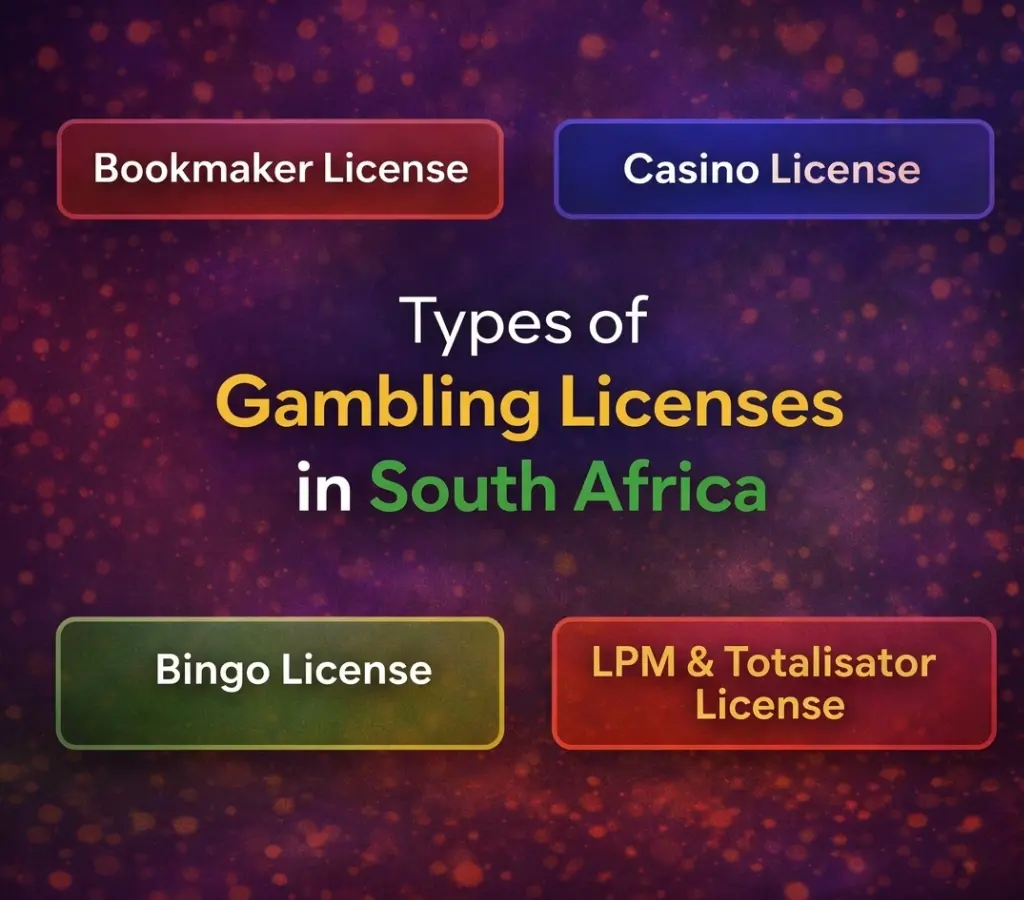
Key gambling license types in South Africa
South Africa runs a closed, activity-based licensing system. Every licence is tied to a specific type of gambling, issued by Provincial Licensing Authorities, and must align with what the National Gambling Act (2004) actually permits. There is no unified national iGaming licence, and operators are expected to meet both provincial conditions and national restrictions at the same time.
Bookmaker License
The bookmaker licence is the only licence that legally supports any form of online gambling activity, and even then, it covers betting only, not casino gaming. Here is what it allows operators to do:
- Offer fixed-odds sports betting across events like football and cricket.
- Provide horse racing betting through totalisator systems.
- Run online betting platforms if the relevant province gives the green light.
The boundaries here matter, though. A 2025 Supreme Court ruling confirmed that casino-style games cannot be offered under a bookmaker’s licence, so the line between betting and gaming is legally enforced, rather than merely implied. It is also worth noting that a provincial bookmaker licence does not automatically work as a national one.
Casino License
A casino licence covers online slot games, table games, and on-site gambling, but it is strictly land-based. It is tied to a specific physical location, capped per province by law, and typically awarded through a competitive bidding process. Even operators who hold a casino licence cannot legally take their offering online. That door is firmly closed.
Bingo, LPM and Totalisator Licenses
These licences cover other regulated sectors, and all of them are land-based.
Bingo License applies to traditional halls and electronic bingo terminals operating from approved venues.
Limited Payout Machine (LPM) License allows low-stakes gambling machines in pubs, bars, and clubs, subject to strict limits on bet size and payouts. Operators need both an operator licence and a site licence to run these.
Totalisator License covers pool betting, mainly in horse racing, where winnings come from a shared pool. These operations are often linked with bookmaker activity.
Supporting and Operational Licenses
Beyond operational licences, South Africa also requires supporting licences for others involved in the industry:
- Manufacturer and Supplier Licence for companies providing gaming software, systems, or machines.
- Key Employee Licence for directors, executives, and key decision-makers within a licensed business.
- Agent Licence for intermediaries or affiliates acting on behalf of licensed operators.
These are mandatory for anyone participating in the ecosystem, but they do not permit gambling operations on their own.
Why There Is No Online Casino License in South Africa?The absence of an online casino licence in South Africa is deliberate. Section 11 of the National Gambling Act prohibits interactive gambling outright, and no licensing framework exists. Here is where things stand as of 2026:
Any operator offering online casino services locally is in direct violation of national law, not simply a grey area. |
Why Choose South Africa for iGaming Licensing?
South Africa is not your typical open iGaming market. But operators who take the time to understand how it works often find it more rewarding than markets that look easier on the surface. The advantages here are specific, practical, and very real, especially if your focus is regulated sports betting.
1. Stable Legal Framework for iGaming Operators
The National Gambling Act (2004) has governed gambling here for over two decades without significant disruption. What is permitted and what is not has always been well defined, which removes a lot of the uncertainty that comes with newer or less structured markets.
2. Large and Proven Sports Betting Market
Regulated sports betting market revenue has crossed ZAR 59 billion annually, with the broader market estimated at over ZAR 75 billion. Sports betting drives the majority of this activity, and most of it is now happening online through mobile devices.
3. Fast-Growing Online and Mobile Betting Sector
Bookmaker turnover has grown at double-digit rates in recent years, and that momentum shows no signs of slowing. Operators can scale faster through digital channels without the overhead of physical infrastructure.
4. Strong Sports Culture That Drives Consistent Betting Activity
Football, horse racing, cricket, and rugby command deep and consistent engagement from South African bettors, creating year-round demand that operators in newer markets spend years trying to build.
5. Trust Advantage That Licensed Operators Hold Over Offshore Platforms
Local licensing brings KYC requirements, anti-money laundering controls, responsible gambling tools, and formal dispute resolution, all of which build the kind of player trust that drives long-term retention.
6. Flexible Market Entry Through Provincial Licensing
The provincial structure gives operators the flexibility to enter one province at a time and scale gradually rather than committing to a high-stakes national rollout.
7. Large Share of Unregulated Market Open for Licensed Operators
Over 60 percent of online gambling activity still flows to unregulated offshore platforms, representing a ready audience waiting for licensed alternatives.
Step-by-Step Process to Get a South Africa iGaming License
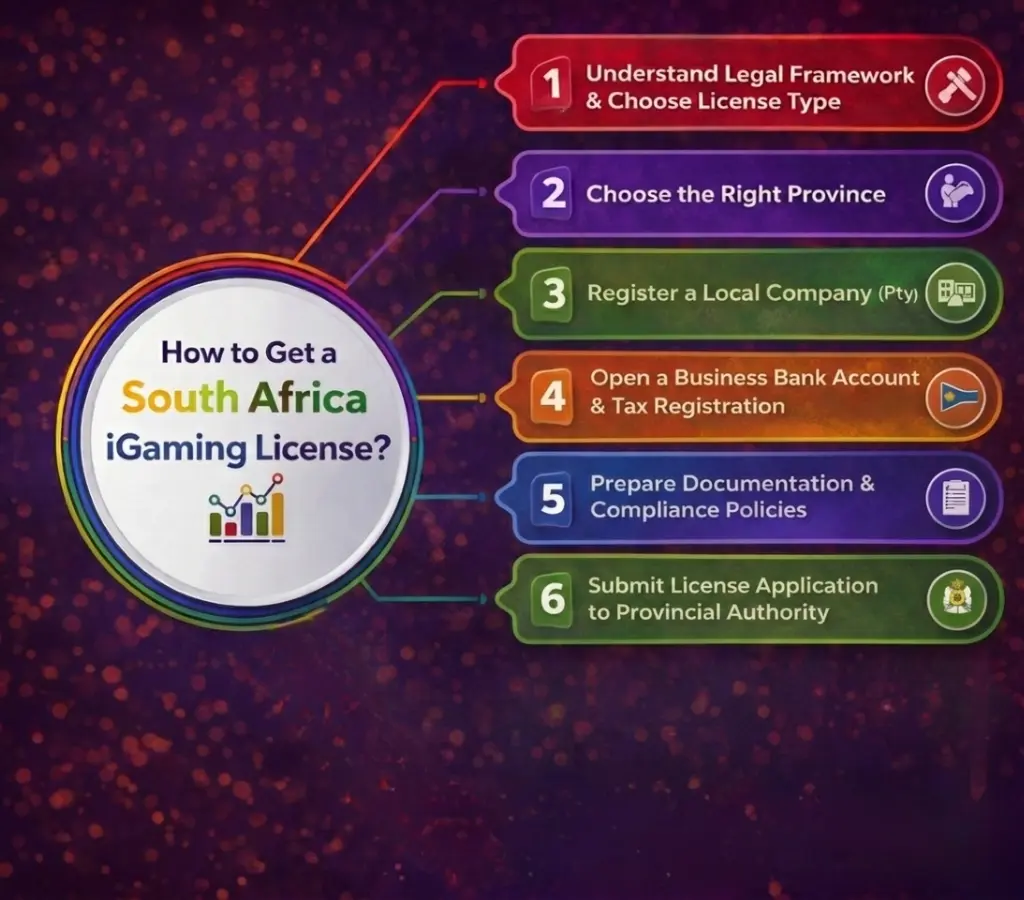
Steps to apply for South Africa iGaming license
Getting licensed in South Africa follows a defined process. Knowing each step before you start puts you ahead of most competitors entering the market.
Step 1 – Understand Legal Framework & Choose License Type
Before anything else, your business model needs to align with what the National Gambling Act (2004) actually permits. Online casino gaming remains prohibited at the national level, and as of 2026, no authority issues online casino licenses. Online betting, however, is allowed under a bookmaker license.
One thing worth knowing: some provinces permit casino-like betting products under bookmaker structures, but these are still regulated as betting, not casino gaming. Your entire model needs to build around betting compliance from the start.
Step 2 – Choose the Right Province
Province selection is a strategic decision, not just an administrative one. Licensing is handled entirely at the provincial level, and your choice directly affects your chances of approval and how quickly you can move.
Some provinces issue licenses through limited tenders or formal application windows. Others, like the Western Cape, accept bookmaker applications on a rolling basis. Understanding how your chosen province operates before you apply saves a significant amount of time and effort.
Step 3 – Register a Local Company (Pty Ltd)
You cannot apply for a license without a South African legal entity in place. This means registering a (Pty) Ltd company and being fully transparent about your ownership structure, beneficial owners, stakeholders, and financial backing. The license is issued to the local entity, not the parent company, so this step cannot be skipped or deferred.
Step 4 – Open a Business Bank Account & Tax Registration
Financial transparency is non-negotiable at this stage. You will need a local South African bank account, registration with SARS, and full compliance with FICA anti-money laundering and KYC regulations.
Banks will require complete KYC documentation on directors and shareholders, along with proof of business activity and source of funds. Without verified banking and tax registration in place, your application simply will not move forward.
Step 5 – Prepare Documentation & Compliance Policies
This is the stage where most applications run into trouble. Regulators expect a detailed business plan, financial projections, funding sources, ownership disclosures for shareholders holding five percent or more, and a full account of any criminal or regulatory history.
On top of that, you need documented AML and KYC policies, responsible gambling controls, and clear IT and operational workflows. Provincial boards can request additional documents at any point and may conduct independent verification beyond what you submit. Treat this as a deep regulatory audit of your entire operation, not a paperwork exercise.
Step 6 – Submit License Application to Provincial Authority
Applications go to the relevant Provincial Licensing Authority for your chosen province. There is no central or national application process.
Authorities will evaluate your business viability, potential market impact, socio-economic contribution, and if a retail component is involved, the proposed location. Bookmaker applications can be submitted continuously in some provinces, while other license types depend on formal windows or public tenders.
Step 7 – Pass Due Diligence & Background Checks
This stage involves thorough probity investigations across your entire operation. Regulators will look into the source of your funds, criminal records both locally and internationally, prior to business history, and any previous licensing activity.
The integrity and financial stability of shareholders will also be assessed. Any inconsistency, whether it is unclear funding, hidden ownership, or gaps in your history, can result in rejection.
Step 8 – Get Platform & Software Certification
A licence approval alone does not mean you can start operating. Your platform needs to meet technical and regulatory standards before you go live.
This includes secure transaction tracking, player verification systems, responsible gambling features, and audit-ready reporting. Depending on your setup, you may also need to integrate with regulatory monitoring systems and get your platform providers or software suppliers formally approved.
How Much Does a Gambling License Cost in South Africa?
Getting Licensed in South Africa is not a single transaction. It is a combination of provincial fees, compliance costs, legal structuring, and setup expenses that add up quickly.
The realistic total investment sits well above ZAR 1 million (~$50,000+) once everything is factored in.
| Cost Area | Estimated Range | Key Insight |
| Application and Licensing Fees | ZAR 14,000 to 350,000+ | Varies by province and scale of operation |
| Annual Licence Fee | ZAR 2,800 to 350,000 | Recurring yearly cost |
| Probity and Investigation Fees | ZAR 10,000+ annually | Charged separately from application fees |
| Legal and Compliance | ZAR 200,000 to 500,000 | Includes lawyers, consultants, and policy drafting |
| Technology and Platform | ZAR 300,000+ | Platform development, payment integration, certification |
| Company Setup | Varies | Registration, structuring, shareholder documentation |
| Operational Reserves and Capital | Varies | Player fund protection and financial guarantees |
| Annual Ongoing Costs | Hundreds of thousands of ZAR | Renewals, audits, staff licensing, system monitoring |
| Realistic Total Entry Cost | ZAR 1M to 3M+ ($50K to $150K+) | Depends on scale and operational complexity |
Disclaimer: These figures are based on publicly available information and may vary depending on the province, license type, and scale of your operation. Treat this as a general guide, not legal or financial advice. Always consult a qualified professional for costs specific to your business.
Read Blog – Explore Casino Software Development Cost
What Are Challenges in Obtaining a South Africa iGaming License
Getting licensed in South Africa is achievable, but it is not without its hurdles. Knowing what challenges lie ahead gives you a better chance of navigating them successfully.
No Legal Route for Online Casino Operations
The National Gambling Act (2004) prohibits online casino games outright. No license for this type of operation has ever been issued, and nothing has changed as of 2026. Your entire business model needs to be built around sports or event betting from the start.
Provincial Fragmentation Adds Operational Complexity
Nine separate provincial regulators each run their own licensing process with their own rules, fees, and approval standards. A bookmaker license lets you accept bets nationally, but each province still has its own consumer protection and advertising rules that apply independently.
Legal Uncertainty Around Casino-Style Betting Products
The line between a betting product and a casino-style product is not always clear, and different provinces read it differently. A product approved today could face restrictions later, which means building contingency into your offering before you go live is not optional.
Intensive Due Diligence and Fit and Proper Requirements
Regulators dig deep into ownership structure, source of funds, financial history, and criminal background. Every director and key employee gets vetted individually. Small inconsistencies can delay approval by months, and unclear funding can end an application entirely.
High Compliance Burden That Continues After Licensing
Anti-money laundering systems, KYC verification, responsible gambling controls, and transaction monitoring are all ongoing requirements. Licenses are reviewed regularly and can be suspended if standards slip. The operational cost of staying compliant is something operators consistently underestimate.
Wrapping Up…
Getting licensed in South Africa takes effort, patience, and the right structure. But the market on the other side of that process is worth it. Proven demand, a mobile-first betting audience, and a less crowded regulated space make this one of Africa’s strongest iGaming opportunities. The operators who succeed here are simply the ones who took the process seriously from the very beginning.

FAQs
-
Why is South Africa an attractive market for iGaming investment?
South Africa offers a population of over 60 million, strong sports betting culture, established infrastructure, and licensing costs far lower than Europe. Growing mobile usage and clear bookmaker regulations make the return on investment potential genuinely attractive for serious operators.
-
How the Gambling Licensing Process Works in South Africa?
Licences are issued provincially under the National Gambling Act. You register a local Pty. Ltd. submit your documentation and business plan, clear due diligence, and certify your platform. One provincial licence covers online betting operations nationally.
-
How long does approval take?
Expect six to twelve months in total. Preparation and company registration take two to four months. The review and due diligence stage adds another five to twelve months, depending on the province and licence type.
-
Do I need a local office in South Africa?
Yes, a registered Pty. Ltd. with a local address and a public officer is mandatory. Foreign entities cannot apply directly. This ensures tax compliance and gives regulators the transparency they require to oversee your operation.
-
What is the easiest license to get in South Africa?
The bookmaker licence through the Western Cape is the most accessible route. It runs on a rolling application basis, carries fees starting from around ZAR 14,000 to 30,000, and avoids the competitive bidding and high barriers that come with casino licensing.

Palak Madan is a enthusiastic writer at PieGaming. With over 2+years of experience crafting engaging content and a strong literature background, Palak brings a unique perspective to the world of words. Her ability to blend creativity with strategic thinking has made her a sought-after content creator. She's eager to dive deep into the intricacies of iGaming software, uncovering the stories behind the technology and translating complex features into compelling narratives.
-
To obtain the Anjouan Gaming License, applicants must collect and submit all the important documents. Learn the process of obtaining Anjouan iGaming license.
-
This blog covers everything from success keys to case studies of successful Asian iGaming operators to help start your dream business.
-
Self-exclusion tools are an important part of responsible gambling as they allow players to restrict their access to gaming platforms, allowing them to self-exclude or even just block out access. This article describes how these tools work and how they affect iGaming platforms in terms of compliance, player protection, and long-term platform credibility.
-
Learn how to get a Kahnawake iGaming license in 2026 with this step-by-step guide covering eligibility, application requirements, costs, and compliance for online casino and sportsbook operators.
-
Choosing between Malta vs Curacao iGaming license is one of the important decisions for operators. This guide highlights the cost, application process, market access, etc., to help you make the right choice.
-
Discover the top 5 iGaming markets to watch in 2026. Learn about their rules, growth potential, and why they matter for operators planning…
-
This blog explores ways and platforms to find and partner with top sports betting affiliates to grow the iGaming business.
-

This blog explains how iGaming affiliate marketing software helps operators boost revenue through smart tracking, automation, fraud prevention, and better campaign control.
-
The Isle of Man iGaming license is reputed for being world-renowned with strict regulatory scrutiny and global credibility. We have made a guide to the application process, licensing requirements, costs, and benefits for operators looking to start a reliable and compliant gaming business.
-
This blog breaks down the key strategies of top iGaming operators in 2026 and how you can grow like them as a market leader. Stay tuned until the end.
-

This blog is a comprehensive guide on key success strategies for European iGaming Operators. Read on to build your iGaming empire in the European market.
-
If you have landed on this blog, that simply means you’re planning to enter among the most lucrative iGaming markets in the world…
-
Malta is one of the best iGaming jurisdictions in the world. The guide goes into details on getting an iGaming license in Malta: requirements (regulatory and registration), application process, costs, and why the Malta Gaming Authority license is respected globally.
-
The Curaçao iGaming license – the most popular option for online casino and sportsbook startups – offers flexibility and affordability. The guide details the licensing process, application process, costs involved, and the reason that many operators opt for Curaçao when entering into the global iGaming market.
-
Affiliate software is instrumental in managing partnerships and keeping track of performance in iGaming. This guide provides an overview of many iGaming affiliate software providers and features that operators can utilize for running an efficient affiliate marketing program.
-
Provably Fair technology promotes transparency in online gambling by enabling players to independently verify online game outcomes. This guide covers what the system is, why the system is beneficial for player trust and becomes embedded in modern crypto-based iGaming, and how its most popular platforms for online gaming systems are largely built on a few of its many implementations.
-
Payment solutions are a staple of any iGaming platform. This guide details leading iGaming payment providers and the technology capabilities which help operators to secure deposits, make quick withdrawals, and facilitate transactions for players all over the world.
-
Operators may own a set of branded casino platforms with the help of custom white-label iGaming software, so they can start without building everything from scratch. Discover how these flexible solutions empower businesses to customize features, scale faster, and enter competitive gaming markets efficiently.
-
Launching an iGaming platform doesn’t have to be complex. Discover how turnkey solutions simplify development, reduce costs, and help operators launch a fully functional casino or sportsbook quickly with ready-to-use technology and integrations. Learn how turnkey solutions simplify development, reduce costs, and enable operators to launch a fully functional casino or sportsbook quickly with ready-to-use technology and integrations.
-
White label solutions make it much simpler to get up and running on an iGaming platform without building everything from scratch. This resource describes how operators can leverage white label technology to get into the market faster with ready-to-use software, integrated games, and a suite of key backend tools.
-
This blog will explore the main factors to think about when choosing an iGaming software developer. It will also cover other important questions…
-
This guide breaks down the most reliable iGaming platform providers shaping the market in 2026. Whether you are launching a new platform or upgrading your existing system, this detailed guide will help you select the right partner for long-term growth and profitability.
-
Risk management tools assist iGaming operators in detecting fraud, preventing money laundering, and protecting revenue. This guide explains why these tools are essential for modern online casinos and how they help identify risks early while ensuring safer, more reliable gaming operations.
-

White label iGaming Solutions offer ready-made, budget-friendly gambling websites. They come with AI tools, automation, and built-in legal compliance. They help you customize your site, grow your business, and launch quickly.
-
Starting an online poker business requires the right technology, licensing, and player engagement strategy. This guide explains the key steps to launch and scale a successful online poker platform in today’s competitive iGaming market.
-

Building an iGaming platform involves multiple stages, from planning and design to testing and deployment. This guide breaks down the complete iGaming software development life cycle and explains how each phase contributes to a secure, scalable gaming platform.
-
Steps to find the right turnkey iGaming software provider for your iGaming business. One who can help your business achieve a thriving business within weeks.
-
Discover how the custom front end improves the user experience to aid player acquisition & retention. Read do’s & don’t’s of great visual front-end.
-
Discover how digital wallet payments in iGaming help ensure speedy, safe, and accurate transactions. Know which types of digital wallets are worth adding.
-
This blog is a detailed guide on “how to secure a gaming license.” From definition to types of gaming license, steps involved and more – read here everything.
-
Latin America is booming in the global iGaming niche and has been one of the fastest-growing regions. This guide covers key markets, regulatory considerations, and possibilities for operators who attempt to extend their online casino or sportsbook business in the area.
-

Wondering how AI can be effective for your casino and sports betting business? This blog talks about the impact of AI in iGaming industry.
-
Affiliate programs offer an excellent method for acquiring players through performance-based collaborations through iGaming platforms. This document explains the steps to open and operate an affiliate program, how to set up and run an affiliate program in iGaming software, and how to attract affiliates and drive consistent player growth for the long term.
-
RNGs are the core technology which ensures online casino fairness. This guide explains what is RNG in iGaming, types of it, how it works, and how it’s beneficial for operators.
-
What is iGaming and how the industry has evolved over the years? Let’s understand everything about the iGaming industry – meaning, type, history, trends, future – in this blog.

Voila!
See you in your inbox soon!

Stay ahead of the game. Subscribe for exclusive content, updates, and insiders!


