
Découvrez comment les logiciels de paris sportifs automatisés gèrent les cotes, l'acceptation des paris, les risques et les paiements : ce que les opérateurs peuvent automatiser et ce qui nécessite encore un trader.

Le monde des paris sportifs évolue à une vitesse fulgurante. Un clin d'œil et vous ratez une opportunité, une hausse soudaine des mises ou une occasion en or. Pourtant, de nombreux opérateurs s'appuient encore sur des systèmes manuels qui ne peuvent tout simplement pas suivre le rythme. Et les enjeux sont colossaux : marché mondial des paris sportifs ont généré plus de 100 milliards de dollars de recettes brutes de marché rien qu'en 2025.
À cette échelle, même les petits retards et les erreurs finissent par coûter cher. C'est là qu'intervient le logiciel automatisé de paris sportifs. En 2026, les opérateurs les plus performants ne se contentent pas d'aller plus vite, ils exécutent des systèmes automatisés. logiciel de paris sportifs qui réagit d'elle-même.
Ils laissent les algorithmes prendre en charge les tâches les plus complexes. De l'ajustement des cotes en temps réel à la gestion des risques et à l'exécution instantanée des paris, l'automatisation s'occupe de ce qu'aucune équipe humaine ne peut raisonnablement faire à cette vitesse et à cette échelle.
Découvrons ce qu'est un logiciel de paris sportifs automatisé !
Comment fonctionne le flux d'automatisation ?
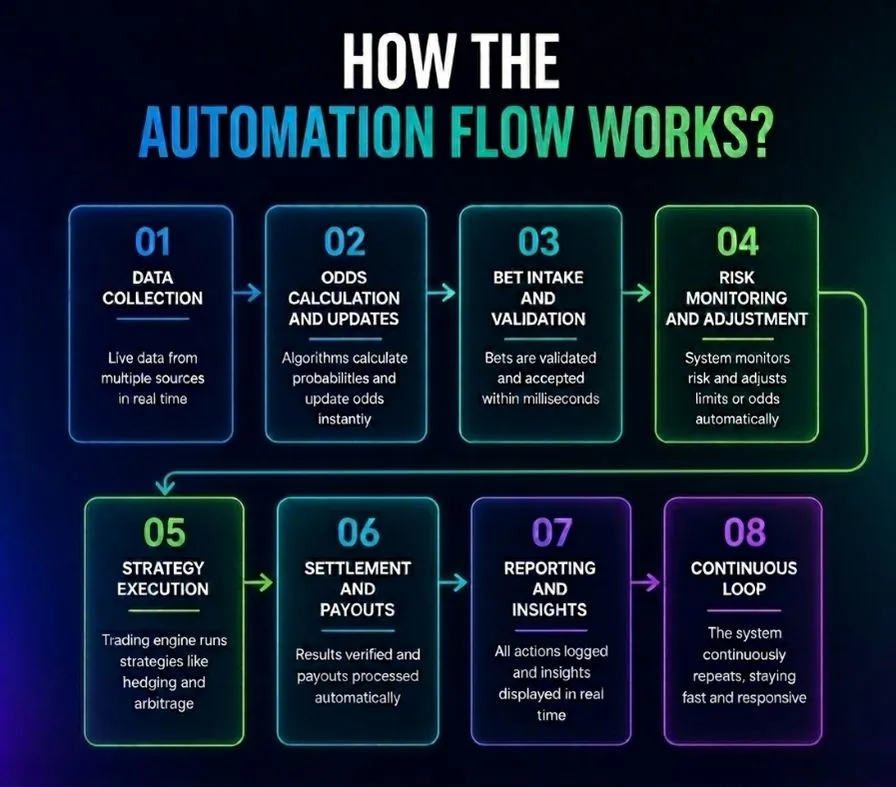
Aperçu du fonctionnement du flux d'automatisation
Derrière l'automatisation se cache un développement de logiciels de paris sportifs Processus à flux direct et continu où les données circulent rapidement et les décisions sont prises instantanément. Chaque étape est liée à la suivante, permettant au système de réagir en temps réel sans intervention humaine.
1. Collecte de données en temps réel
Tout commence par des flux de données en direct : statistiques du match, statistiques des joueurs, tendances historiques et informations en temps réel comme les buts, les blessures ou les fautes. Le système exploite simultanément diverses sources pour garantir l’exactitude et la mise à jour des données.
2. Calcul et mise à jour des cotes
Ces données entrantes alimentent directement le système de cotes. Les chiffres sont traités par des algorithmes et des modèles d'IA, la probabilité est calculée et les cotes sont mises à jour en temps réel. Un carton rouge est donné, un but est marqué, et les cotes changent sur tous les marchés sur lesquels vous êtes impliqué avant même que vous ayez eu le temps de réagir.
3. Prise en charge et validation des paris
Dès qu'un utilisateur place un pari, le système se met en marche. Il vérifie les cotes, valide la mise, confirme l'état du marché et accepte ou refuse le pari en quelques millisecondes. Sans file d'attente ni délai.
4. Surveillance et ajustement des risques
En arrière-plan, tout le temps, il y a Gestion des risques liés aux jeux en ligne Ce module analyse les tendances de paris et détecte toute anomalie, comme un afflux massif de paris sur un même résultat. En cas de signal d'alarme, il ajuste les limites, modifie les cotes ou suspend automatiquement le marché afin de maîtriser l'exposition.
5. Exécution de la stratégie
Le moteur de trading ne reste pas inactif non plus. Il exécute des stratégies prédéfinies comme la couverture ou l'arbitrage, en plaçant et en ajustant des positions en fonction des fluctuations du marché, le tout sans qu'aucune intervention humaine ne soit nécessaire.
6. Règlement et versements
À la fin de la partie, le système vérifie les résultats auprès de sources de données fiables et règle automatiquement les paris. Les paiements sont rapides, ce qui réduit les délais et limite les litiges.
7. Rapports et informations
Toutes les actions sont enregistrées et traitées dans des tableaux de bord en temps réel. Les opérateurs peuvent ainsi, à tout moment, suivre leurs performances, évaluer leur exposition aux risques et générer des rapports de conformité ou de revue stratégique.
L'ensemble du flux est maintenu en boucle continue, garantissant ainsi que la plateforme soit réactive, précise et prête à faire face à tout événement imprévu.
Lire le blog – Valeur espérée dans les paris : explication de la marge
Composants essentiels d'une plateforme de paris automatisée
La performance d'une plateforme de paris dépend de son infrastructure technique. L'interface utilisateur est ce qu'elle montre, mais c'est l'écosystème backend qui garantit rapidité, précision et fiabilité. Voici un aperçu des composants qui la rendent opérationnelle.
1. Moteur de probabilités
Considérez le moteur de calcul des cotes comme le cerveau de l'ensemble du système. Il collecte en permanence des données en temps réel : conditions de course, historique des performances des chevaux, statistiques des jockeys, volumes de paris, et même la météo. Il utilise ensuite des modèles d'intelligence artificielle pour calculer et mettre à jour les cotes. cotes de paris en temps réel.
Ici, les chiffres ne sont pas fixes. Si un cheval très populaire commence à montrer des signes de fatigue, ou si une vague soudaine de paris modifie la répartition des mises, le système se recalibre instantanément.
Un retrait de dernière minute, un changement de l'état de la piste, une forte hausse des mises, la plateforme réagit à tout en quelques millisecondes, ce qui lui permet de rester compétitive tout en protégeant ses marges.
2. Module de gestion des risques
Il s'agit du système de défense de la plateforme, et il fonctionne en permanence. Il surveille chaque pari entrant, à la recherche de schémas anormaux. Si plusieurs paris importants sont placés simultanément sur un outsider depuis des comptes liés, le système le signale immédiatement.
À partir de là, la plateforme peut réduire les limites de mise pour certains utilisateurs, ajuster les cotes pour gérer les risques, ou suspendre un marché, le tout sans intervention humaine. Les systèmes plus avancés établissent même des profils de risque pour les utilisateurs, distinguant les parieurs occasionnels des parieurs expérimentés, afin d'appliquer des contrôles plus précis là où ils sont le plus pertinents.
3. Moteur de paris et de trading
C’est ici que l’exécution a lieu. Les paris sont traités, comparés aux marchés disponibles et exécutés instantanément, même en cas de volumes importants.
Les versions les plus avancées de ce moteur ne se contentent pas de traiter les paris. Elles exécutent des stratégies de trading automatisées comme… arbitrage, la couverture et la tenue de marché, en ajustant continuellement les positions en fonction de l'évolution des marchés.
La rapidité est primordiale. Un retard de quelques secondes seulement peut entraîner un déséquilibre des chances ou des conséquences financières imprévues.
4. Moteur de règlement
Une fois la course terminée, le système de règlement prend le relais. Il se connecte aux fournisseurs officiels de données de course, vérifie les résultats, calcule les gains et met à jour automatiquement les portefeuilles des utilisateurs. Aucune intervention manuelle, aucune attente.
Cela a plus d'importance qu'il n'y paraît. Le règlement manuel engendre des retards, et les retards alimentent la méfiance. Un processus de règlement automatisé et transparent garantit la transparence et minimise les litiges.
5. Analyses et rapports
Les données brutes sont inutiles si on ne peut pas les exploiter. Cet élément transforme toutes les données collectées sur la plateforme en données exploitables et faciles à comprendre grâce à des tableaux de bord en temps réel. En un coup d'œil, les opérateurs peuvent visualiser les volumes de paris, les profits et pertes par marché, le comportement des utilisateurs et les tendances de fidélisation.
Il gère également l'aspect moins glamour, mais tout aussi important : la conformité. Le système génère automatiquement des rapports prêts à l'audit sur les transactions, l'activité des utilisateurs et les flux financiers, évitant ainsi aux opérateurs de se précipiter en cas de contrôle des autorités de réglementation.
Les plateformes de haute technologie vont encore plus loin grâce à l'analyse prédictive et aux alertes en cas de pics de demande ou de mauvais résultats du marché avant même que cela ne se produise.
6. Couche d'intégration
Tous les composants mentionnés ci-dessus doivent communiquer entre eux et avec le monde extérieur. La couche d'intégration assure cette communication. Elle gère les API qui connectent les fournisseurs de données de cotes en direct et de données de courses. fournisseurs de solutions de paiement pour les jeux en ligne, les systèmes de vérification KYC et AML, et la gestion des comptes utilisateurs dans un flux unique et transparent.
Un utilisateur doit pouvoir placer un pari qui sera validé par le système, les cotes les plus récentes seront récupérées, le pari sera confirmé et la transaction enregistrée en quelques secondes. La couche d'intégration rend cela possible, sans qu'aucune erreur ne soit commise.
Lire le blog – L'IA dans les paris sportifs
Opérations de paris sportifs manuelles et automatisées
Dans les paris sportifs, votre efficacité opérationnelle influe directement sur vos marges et l'expérience de vos utilisateurs. L'écart entre les systèmes manuels et automatisés est plus important que la plupart des opérateurs ne le pensent, et en prendre conscience est la première étape vers la création d'un système évolutif.
| Aspect | Opérations de paris manuelles | Opérations de paris automatisées |
| Gestion des cotes | Les traders fixent et ajustent les cotes manuellement, ce qui entraîne des mises à jour plus lentes et un risque de biais humain. | Les moteurs d'intelligence artificielle mettent à jour les cotes instantanément, en réagissant aux données en direct, aux tendances de paris et à l'exposition au risque en temps réel. |
| Rapidité d'exécution | Le placement et la validation des paris peuvent prendre du temps, surtout lors des pics de trafic pendant les événements majeurs. | Les paris sont exécutés avec une latence ultra-faible, même en période de forte affluence. Pas de files d'attente, pas de ralentissements. |
| Gestion du risque | La surveillance manuelle rend difficile la détection des fraudes ou des comportements inhabituels avant que le préjudice ne soit causé. | Des algorithmes en temps réel détectent instantanément les anomalies et peuvent ajuster automatiquement les limites ou suspendre les marchés sans intervention humaine. |
| Évolutivité | La croissance est limitée par les effectifs. Un volume d'activité plus important implique davantage d'embauches, de formations et de frais généraux. | Conçu pour évoluer. Gère des milliers d'utilisateurs et de paris simultanés, sans personnel supplémentaire. |
| Exactitude | L'erreur humaine dans la fixation, le règlement et la communication des cotes constitue un risque permanent. | Les calculs automatisés garantissent l'exactitude des prix et des paiements, réduisant considérablement les risques d'erreurs coûteuses. |
| Processus de règlement | La vérification manuelle des résultats ralentit les choses et ouvre la porte aux litiges. | Le règlement s'effectue instantanément grâce à l'utilisation de flux de données intégrés et d'un traitement automatisé des paiements. |
| Coûts opérationnels | Les coûts liés au personnel, à la formation et à la supervision s'accumulent au fil du temps, ce qui rend les coûts à long terme difficiles à maîtriser. | Investissement initial plus élevé, mais coûts opérationnels nettement inférieurs à mesure que la plateforme se développe. |
| Expérience utilisateur | Les mises à jour lentes et les retards frustrent les utilisateurs, surtout pendant les paris en direct, où chaque seconde compte. | Une expérience fluide et en temps réel, avec des mises à jour instantanées et des transactions plus rapides sur tous les plans. |
| Utilisation des données | Les données historiques et en temps réel sont rarement exploitées à leur plein potentiel dans la prise de décision. | L'analyse avancée et l'IA traitent en continu de vastes ensembles de données, permettant une tarification plus intelligente et des analyses plus précises. |
| Conformité et rapports | La saisie manuelle des données est chronophage et plus susceptible de contenir des inexactitudes au moment où cela compte le plus. | Des rapports prêts pour l'audit, générés automatiquement en temps réel, permettent aux opérateurs de rester en conformité sans avoir à se démener. |
Les systèmes manuels peuvent se débrouiller à petite échelle, mais leurs limites s'accumulent rapidement. Les plateformes de paris automatisées offrent la rapidité, la précision et l'évolutivité indispensables pour être compétitif dans l'environnement actuel des paris à haute fréquence.
Avantages de l'automatisation pour les opérateurs de paris sportifs
L'automatisation n'est plus un simple atout. Pour les opérateurs qui cherchent à se développer, à préserver leurs marges et à offrir une expérience de paris qui fidélise les utilisateurs, c'est devenu la norme.
1. Des marges bénéficiaires plus élevées grâce à des probabilités plus judicieuses
Dans les paris sportifs, chaque détail compte. Données en temps réel L'intelligence artificielle est utilisée pour maintenir les cotes à des niveaux optimaux en permanence, en resserrant les spreads, en égalisant les mises et en limitant l'exposition aux parieurs avertis. Il en résulte une organisation qui anticipe les fluctuations du marché au lieu de s'efforcer de les rattraper.
2. Contrôle des risques en temps réel
Plus une menace est identifiée tôt, moins elle coûte cher à gérer. L'automatisation repère les schémas suspects, les opérations d'arbitrage et les activités inhabituelles dès leur apparition et réagit immédiatement en modifiant les limites, en suspendant les marchés ou en réévaluant les probabilités. Aucun délai, aucune vérification manuelle, aucun dommage évitable.
3. Évolutivité sans frais opérationnels supplémentaires
Plus d'utilisateurs devraient se traduire par plus de revenus, pas par plus d'embauches. Les systèmes automatisés gèrent des milliers de paris et de marchés simultanés sans nécessiter de personnel supplémentaire, ce qui facilite l'expansion géographique et sportive sans que les coûts n'explosent avec le volume d'activité.
4. Traitement et règlement des paris plus rapides
Les utilisateurs attendent de la rapidité et des moteurs automatisés capables de la leur offrir. Les paris sont traités instantanément, les résultats sont validés dès leur confirmation et les paiements sont effectués rapidement. Cette fiabilité instaure la confiance, et la confiance fidélise les utilisateurs.
5. Expérience utilisateur améliorée
Ce qui fonctionne en arrière-plan se reflète dans l'expérience utilisateur. Cotes en temps réel, confirmations instantanées, suggestions personnalisées et une plateforme qui reste performante même pendant les événements les plus intenses. Une expérience agréable incite les utilisateurs à rester plus longtemps et à parier davantage.
6. Prise de décision basée sur les données
Un site de paris sportifs génère quotidiennement une quantité considérable de données. Celles-ci sont exploitées grâce à l'automatisation. Les comportements de paris, les tendances du marché et les indicateurs de performance sont intégrés à des tableaux de bord permettant aux opérateurs de prendre des décisions plus éclairées en matière de tarification, de promotions et d'engagement des utilisateurs.
Architecture technologique sous-jacente aux logiciels de paris automatisés
L'architecture technique de tout site de paris performant et rapide est conçue pour un seul objectif : garantir le bon fonctionnement de l'ensemble du système au moment crucial. Les composants principaux gèrent la logique et les opérations ; cependant, c'est cette couche qui assure une disponibilité optimale, même dans les situations les plus critiques.
1. Pipeline de données et traitement de flux
Les plateformes automatisées ne patientent pas. Elles traitent les données en continu, intégrant les informations en temps réel sur les matchs, l'activité des paris et les flux externes au fur et à mesure que les événements se déroulent. Ainsi, les cotes, les signaux de risque et les actions des utilisateurs sont toujours basés sur la situation actuelle, et non sur ce qui s'est passé quelques secondes auparavant.
2. Infrastructure à faible latence
Dans le secteur des paris, chaque milliseconde compte. L'infrastructure est conçue pour minimiser les délais à chaque étape, de la réception des données à la confirmation du pari. Les bases de données en mémoire et le calcul en périphérie garantissent des temps de réponse ultra-rapides : mise à jour des cotes, confirmation de pari… tout est instantané, même en cas de forte affluence.
3. Architecture des microservices
Au lieu d'un système monolithique dépendant de la défaillance de l'ensemble du système, les plateformes modernes sont décomposées en services plus petits et indépendants. Chacun gère une tâche spécifique et peut évoluer indépendamment. La plateforme est ainsi plus facile à mettre à jour, plus flexible à gérer et bien plus résiliente. Si un service rencontre un problème, les autres continuent de fonctionner sans interruption.
4. Déploiement natif du cloud et mise à l'échelle automatique
Le trafic des sites de paris est imprévisible. Un événement majeur peut provoquer des pics de trafic en quelques minutes. Le déploiement natif du cloud gère cette situation en augmentant automatiquement la capacité lors des pics de demande et en la réduisant une fois le trafic stabilisé. La plateforme reste performante en cas de besoin et économique dans le cas contraire.
5. Surveillance, journalisation et tolérance aux pannes
Aucun système n'est à l'abri des problèmes, mais un système bien conçu les détecte avant même que les utilisateurs ne s'en aperçoivent. Une surveillance continue assure le suivi des performances sur l'ensemble de la plateforme, une journalisation centralisée conserve un historique précis de chaque action et des mécanismes de basculement s'activent automatiquement en cas de panne. Les opérations restent ininterrompues et, lorsqu'une intervention s'avère nécessaire, les informations nécessaires à sa résolution sont déjà disponibles.
Défis liés à la mise en œuvre des systèmes de paris automatisés
L'automatisation résout de nombreux problèmes, mais elle comporte son lot de défis que les opérateurs doivent relever dès le départ. Rapidité et efficacité ne servent à rien si les bases sont fragiles.
Problèmes de dépendance et d'exactitude des données
Un retard dans la transmission des données ou quelques secondes de données erronées lors d'un événement en direct peuvent entraîner des cotes incorrectes et des règlements erronés. La multiplication des fournisseurs de données, les niveaux de validation et les systèmes de secours permettent d'éviter des erreurs coûteuses.
Coût d’installation initial élevé
L'infrastructure, les flux de données, les modèles d'IA et les intégrations tierces représentent autant d'éléments à prendre en compte avant même le premier investissement. Le défi consiste à garder la tête froide quant à l'engagement initial tout en restant concentré sur les véritables retours sur investissement à long terme.
Équilibrer l'automatisation avec la surveillance humaine
L'automatisation est rapide, mais elle ne tient pas toujours compte de la situation. Les événements imprévus et les cas particuliers peuvent prendre au dépourvu un système entièrement automatisé. Le véritable défi consiste à savoir où laisser libre cours à l'automatisation et où maintenir l'intervention humaine.
Conformité réglementaire dans les décisions automatisées
La réglementation des jeux d'argent varie selon les régions et évolue fréquemment. Chaque décision automatisée doit être conforme et traçable. En cas de non-respect de cette réglementation, les conséquences vont au-delà des amendes et peuvent mettre en péril les licences d'exploitation.
Transparence dans les systèmes algorithmiques
Lorsqu'une plateforme fonctionne comme une boîte noire, il devient difficile d'expliquer ses résultats aux autorités de régulation et de résoudre les litiges entre utilisateurs. Des journaux clairs, des modèles explicables et des pistes de décision traçables sont essentiels pour que les opérateurs gardent un contrôle réel.
Comment choisir le bon logiciel de paris automatisés
Choisir le bon logiciel de paris automatisés ne se résume pas à cocher une simple liste de fonctionnalités. Il s'agit de trouver un système adapté à votre mode de fonctionnement, qui contribue à la croissance de votre entreprise et s'intègre facilement à votre infrastructure existante. La plupart des opérateurs finissent par comparer une solution sur mesure à une solution standard. solution de paris sportifs en marque blancheVoici les principaux facteurs à évaluer :
| Facteur | Ce qu'il faut chercher | Pourquoi ça compte |
| Solutions personnalisées vs solutions en marque blanche | Les plateformes personnalisées offrent un contrôle total, mais leur développement est plus long. Une solution en marque blanche est préconfigurée et prête à être déployée plus rapidement. | Si la priorité est une mise sur le marché rapide, la marque blanche est une solution pertinente. Si votre modèle nécessite une personnalisation poussée, une fabrication sur mesure justifie le temps et l'investissement supplémentaires. |
| Capacités d'intégration | Vérifiez avec quelle facilité le logiciel se connecte aux fournisseurs de données, aux passerelles de paiement, aux systèmes KYC et aux outils CRM via les API. | Des intégrations défaillantes ralentissent tout et créent des lacunes dans les données. Des intégrations propres et bien conçues garantissent des opérations en temps réel et réduisent les problèmes techniques. |
| Fiabilité et assistance des fournisseurs | Recherchez une expérience éprouvée, des garanties de disponibilité solides, des mises à jour régulières et une équipe d'assistance qui réagit réellement en cas de problème. | Les interruptions de service coûtent cher et érodent rapidement la confiance des utilisateurs. Un fournisseur fiable assure la stabilité de la plateforme et veille à ce que les problèmes soient résolus avant qu'ils ne s'aggravent. |
Ces trois facteurs ne suffisent pas à déterminer toutes les décisions, mais ce sont généralement ceux qui comptent le plus lorsque les opérateurs choisissent entre différentes plateformes. Si vous les prenez en compte, le reste devient beaucoup plus simple.
Comment PieGaming Prend en charge les paris automatisés
|
Emballer…
Les logiciels de paris sportifs automatisés ne servent pas seulement à rester compétitifs. Il s'agit de bâtir une infrastructure véritablement pérenne. Des décisions plus rapides, une meilleure gestion des risques et une capacité d'adaptation optimale découlent de la mise en place d'un système adapté. Que vous optiez pour une solution en marque blanche ou une solution personnalisée, le choix vous appartient. paris sportifs clé en mainL'automatisation devrait déjà être installée.
Les entreprises qui investissent aujourd'hui dans l'automatisation ne se contentent pas de résoudre les problèmes actuels. Elles se positionnent pour réussir sur un marché de plus en plus exigeant.

Questions fréquemment posées
-
Qu'est-ce qu'un logiciel de paris sportifs automatisé ?
Les logiciels de paris sportifs automatisés utilisent des algorithmes pour gérer les cotes, les paris et les risques sans intervention manuelle. Ils traitent les données en temps réel pour optimiser les opérations des bookmakers, améliorer la précision et faciliter leur croissance.
-
Comment fonctionne un logiciel de paris automatisés ?
Elle collecte des données en direct, calcule les cotes, accepte les paris, surveille les risques et règle les résultats, le tout en temps réel. Chaque étape est automatisée, ce qui permet à la plateforme de réagir instantanément sans intervention humaine.
-
Les paris sportifs automatisés seront-ils légaux en 2026 ?
Cela dépend du lieu où vous opérez. Sur les marchés réglementés, les paris automatisés sont autorisés à condition que les opérateurs respectent les exigences en matière de licences, les normes de conformité et les directives relatives au jeu responsable établies par les autorités locales.
-
L'IA est-elle utilisée dans les outils automatisés de paris sportifs ?
Oui, et c'est un élément essentiel au fonctionnement de ces plateformes. L'IA analyse les données, prédit les résultats et ajuste les cotes en temps réel, permettant ainsi aux opérateurs d'améliorer leur précision, d'anticiper les risques et de mettre en œuvre des stratégies de paris plus efficaces sur tous les marchés.


Palak Madan écrit sur l'industrie du jeu en ligne depuis 2024. Elle s'attache à aider les opérateurs et les fondateurs à comprendre leurs options lors du lancement d'un casino en ligne, du choix du bon fournisseur de logiciels à l'évaluation des coûts et des exigences de conformité sur les différents marchés. PieGamingElle aborde des sujets tels que les solutions de casino en marque blanche, le choix de plateformes et l'entrée sur le marché, transformant des informations complexes du secteur en conseils pratiques pour les personnes qui créent des entreprises de jeux en ligne. Elle suit également de près les évolutions en matière de licences et de réglementation, notamment la manière dont les nouvelles règles influencent l'entrée et le développement des opérateurs dans différentes juridictions.

Les micro-paris sont une forme de paris sportifs en direct qui se concentrent sur les moments clés d'un match. Au lieu de miser sur le résultat final, les parieurs misent sur ce qui va se passer ensuite : le prochain lancer au baseball, le prochain point au tennis, la possession du ballon au basketball ou la prochaine balle au cricket. Grâce à un règlement quasi instantané, les micro-paris offrent une expérience plus rapide et plus dynamique que les paris sportifs traditionnels.

Les paris sur l'e-sport offrent une opportunité majeure aux opérateurs, et le choix du bon partenaire peut avoir un impact considérable sur la rentabilité, l'engagement des joueurs et l'efficacité opérationnelle.

Découvrez ce que sont les paris sportifs en point de vente physique, comment fonctionnent les établissements de paris sportifs sur place, et quels sont les coûts et les rendements du modèle de vente au détail par rapport au modèle exclusivement en ligne.

Découvrez ce que comprend un logiciel de paris hippiques (marchés de paris mutuels et à cotes fixes, flux de courses et paiements), ainsi que le coût d'une version de base ou d'une licence complète.

Découvrez comment les algorithmes de paris sportifs calculent les cotes et gèrent les risques, ainsi que les principaux logiciels d'algorithmes comparés en fonction des données, des modèles et des options d'intégration.
Découvrez comment fonctionnent les paris sur l'e-sport en tant que secteur vertical : titres, marchés, flux de cotes et logiciels nécessaires aux opérateurs pour ajouter l'e-sport à un bookmaker existant.
Découvrez comment l'IA est utilisée dans les paris sportifs pour le calcul des cotes, la détection des fraudes, les marchés en direct et la segmentation des joueurs, et ce que cela change pour les opérateurs.

À bientôt dans votre boîte de réception !

Gardez une longueur d'avance. Abonnez-vous en exclusivité
contenu, mises à jour et initiés !

